
Session: Retail media networks or immersive stores? Three ISE 2026 experts argue it out
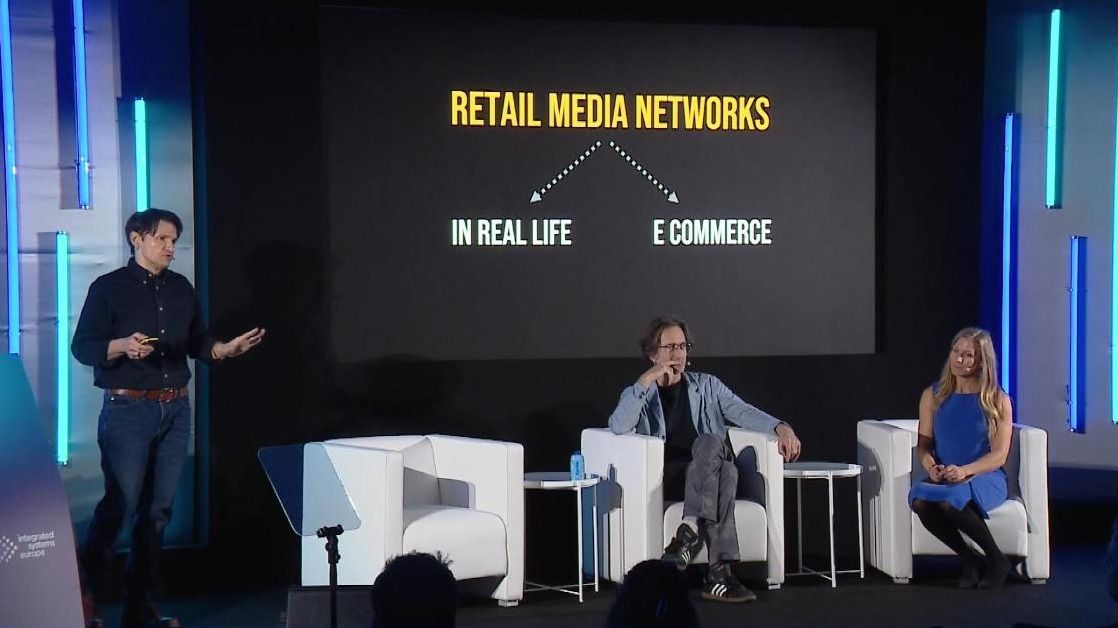
Koerner Design, Vertiseit Group and Volvox Labs on how retail media networks and immersive experiences can share one store, and where a retailer should start.
- Event: ISE 2026
- From session: Activating Smart Retail Spaces: The fusion of immersion and retail media
- Speakers:
- Brad Koerner, Principal and Creative Director, Koerner Design
- Monika Lindquist, Group CMO, Vertiseit Group
- Michael Schneider, CEO and Director of Media Architecture, Volvox Labs
- Estimated read time: 8 minutes
- Watch the full session
Quick read summary
- Retail media networks and immersive experiences do different jobs, and the ISE 2026 panel agreed they should share a store as separate, planned zones.
- Retail media scales because it is measurable, predictable and retailer owned, which Monika Lindquist of Vertiseit Group called its strength, not its limit.
- Michael Schneider of Volvox Labs argued the real dividing line is whether digital augments the physical space or takes visitors out of it.
- Immersive work is held back by budgets, unclear returns and an industry with no shared language or processes, the panel said.
"In simple terms, it’s super easy to roll out, to govern and to explain in a boardroom," said Monika Lindquist, Group CMO at Vertiseit Group. She was explaining why retail media networks have spread through physical stores so fast. It also started the argument, because immersive experiences are rarely any of those things.
Brad Koerner, Principal and Creative Director at Koerner Design, moderated the ISE 2026 panel on 5 February 2026. He believes each side needs the other. Alongside Lindquist sat Michael Schneider, CEO and Director of Media Architecture at Volvox Labs, a new media art studio in Brooklyn, New York.
Why do retail media networks scale so easily?
Retail media networks scale because they fit the way retailers already run their businesses, Lindquist argued. She called retail media a proven business capability that offers repeatability, scale, predictability and a measurable return on investment.
Her strongest point was about control. Retail media is retailer owned, governed and accountable. Many see that as a limitation, but Lindquist sees it as exactly why the model works. The screens answer pragmatic questions: did the message play, who could see it and how often? Retail media was never designed to solve every experiential challenge in a store, and that is a design choice rather than a failure.
Koerner mapped the physical market: digital menu boards, ordering kiosks and digital posters. He expects digital shelf displays to catch on next, and more LED walls as prices keep falling. ISE has covered the wider shift of stores turning into media experiences.
Koerner’s bar for immersive is far higher than a projected art show
Immersive digital experiences are not the projected Van Gogh shows that, in Koerner’s view, have pigeonholed the word into cheap slideshows. His bar is a two-way relationship, in which the visitor changes the digital world and the digital world changes the room. The maximum potential, he said, is "to treat architectural space as a portal to the digital world."
Location based entertainment turns the same tools into franchises, from teamLab to Puttshack. The biggest examples are domes such as the Sphere in Las Vegas and the Cosm chain. ISE has looked at the same trend in entertainment, where passive audiences are disappearing.
Is the real split augment versus escape?
For Schneider, yes. The distinction is between digital that augments the space you are in and digital that takes you out of it. A digital menu board augments, because it replaces a printed board. A portal to another world does the opposite.
The two jobs need different people, he argued. A graphic designer makes the signage, while a simulation artist builds an alternate world.
Volvox Labs mostly works on the augment side, through smell, touch, sound and sight. For a Prada fragrance launch, the studio delivered the scent in mist-filled soap bubbles that popped on visitors’ hands.
Can both live in one store without undermining each other?
They can, Lindquist said, as long as the store has one digital in-store concept, not competing ones. Different zones serve different purposes, and immersive formats can sit alongside retail media if they serve their own.
Getting there means asking what the store is for. Is it an art museum, a sales engine or a brand beacon? The return can be transactional, such as sales, or relational, such as trust and preference. "It can either be emotional or rational, but the main thing is that you always need to start with the why," she said.
She also named the friction that keeps the zones apart. Retail media sells advertising space, so it needs traffic and scale, while genuine immersive experiences are very rarely scalable. That is why, in her view, the two cannot simply be fused.
I don’t think that everything needs to be immersive, and I don’t think that everything should be monetized, but I think that everything needs to be intentional.
Why is neither one growing faster?
Neither is growing faster because buyers lack knowledge and money, and the industry lacks a shared method.
For immersive work, Lindquist put knowledge first, then money. Buyers do not know where to start, and the idea more often comes from a retail architect than from whoever owns the space. Projects are large, the return is hard to calculate and recession has cut budgets.
Schneider said retail media has become run of the mill, an expected part of the store, and he doubted it now adds more than a few pennies of value. It will not grow into immersive, he added, until there is a defined immersive endpoint.
Lindquist and Schneider never agreed on what counts as immersive
The split grew out of a trend Lindquist had just seen at NRF, the National Retail Federation’s annual show: loneliness after the pandemic. Shoppers, she said, want less time on their phones. They want to play, feel and smell in store. That is the case for experiential retail: for some shoppers, a store visit is the only time they meet someone in person. ISE has followed a similar thread in how luxury retail is becoming more like hospitality.
Koerner pressed her. If a store activates all the senses, why not call it immersive? To Lindquist, immersive means the big showpiece examples from the stage, such as the domes. Her teams build similar things but call them brand experience touchpoints. Schneider drew the line his own way.
Are you using immersive to escape reality or are you using it to augment and enhance reality?
Can smaller brands afford immersive work?
Mostly not yet, but Schneider expects that to change. In more than 25 years in the field, he said, he has seen nobody actually trained to do this work. "There’s no language around it. There’s no proper processes." So customers do not know what to ask for, and every studio has to work out its own methods, which keeps costs high. He expects AI to bring immersive experiences in smaller, affordable bites.
FAQ
- How do retail media networks work inside a physical store? Retail media networks in physical stores are networked screens that a retailer owns and sells as advertising space to brands. Formats include digital menu boards, ordering kiosks, digital posters and LED walls. Their value is that delivery can be proven: whether a message played, who could see it and how often.
- Why can’t in-store retail media and immersive retail simply be merged? In-store retail media depends on traffic and scale, while genuine immersive experiences are very rarely scalable. Monika Lindquist of Vertiseit Group argued for one digital in-store concept with separate zones, each with its own purpose.
- Should smaller brands wait before investing in immersive store design? Immersive store design is still hard for smaller brands to afford, according to Michael Schneider of Volvox Labs, because the industry has no trained workforce or standard processes. He expects AI to bring affordable immersive experiences in smaller bites.
Intentional is a higher bar than immersive
Koerner set out to show that immersive experiences and retail media networks need each other. His panel made a subtler case. They need each other the way a shop needs both a till and a window display: side by side, each doing its own job, under one plan.
That plan is where projects fall down, and it is not a technology problem. The show floor is full of displays and sensors, and none of them answers Lindquist’s question about whether a store is an art museum, a sales engine or a brand beacon. Schneider’s question about escaping or enhancing reality does the same work from the other side. Together they turn a shopping list into a brief.
For integrators and AV consultants, that changes the first meeting. The useful conversation is not which LED wall to specify, but which zone each screen serves and whether its success is measured in sales or in memory. Retail media will keep growing because it is easy to explain in a boardroom. Immersive work will grow when the industry builds the language Schneider says it lacks.
Until then, Lindquist’s test is the one to carry out of the room. Not everything needs to be immersive or monetised. Everything in the store needs to be intentional.
About the speakers
Brad Koerner
Principal and Creative Director, Koerner Design
Koerner moderated the panel. His work centres on immersive digital experiences that treat architectural space as a portal to the digital world.
Monika Lindquist
Group CMO, Vertiseit Group
Lindquist leads marketing at Vertiseit Group, a Scandinavian digital in-store company, and brought the retail media side of the debate.
Michael Schneider
CEO and Director of Media Architecture, Volvox Labs
Schneider leads Volvox Labs, a new media art studio in Brooklyn, New York, and has worked in immersive experiences for more than 25 years.
Explore retail signage at ISE
Retail media and immersive stores both start with the screen.
- Digital signage at ISE: the signage and DooH brands in Barcelona.
- The Digital Signage Summit: the summit on signage, DooH and retail media.
- Everything on the ISE programme: every summit, keynote and show-floor stage.
- Never been to ISE? Plan your visit with the guide for new attendees.
Featured Articles
-
 Spanning all eight halls at Fira de Barcelona Gran Via, ISE 2026 delivered four days of record-breaking energy, creativity, and innovation.
-
 The initiative will create new opportunities for talent development, innovation and community projects across the sector
-
 The Facts & Figures report for ISE 2026 is available to download.
-
 Bringing together startups, investors and industry leaders, the expanded show feature offers a strong platform for visibility, networking, and commercial opportunity.
-
 This new type of event brings together end users, creators and production specialists from broadcast, live events, advertising and gaming, combining creative showcases, editorial programming and netwo ...