
What's the difference between IPMX and ST 2110?
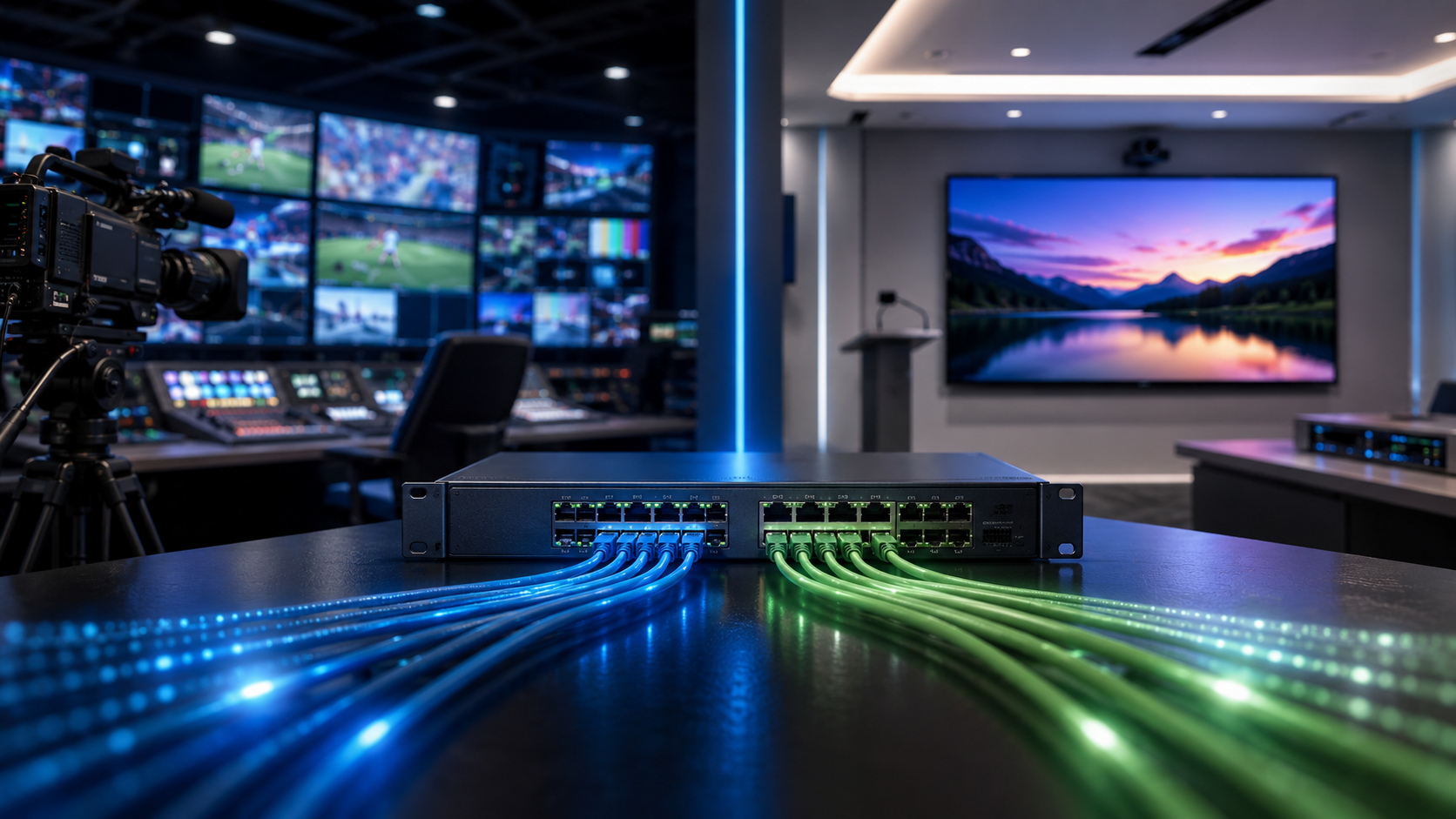
IPMX and ST 2110 both transport professional media over IP networks but differ mainly in who they serve: ST 2110 is engineered for broadcast facilities, while IPMX adapts the same core technology for pro AV environments such as corporate AV, education, and control rooms. Here’s how they diverge and where each fits.
By Adrian Pennington
Broadcast and pro AV: Two worlds, one foundation
ST 2110 is a broadcast?grade media transport standard designed for environments where every device runs in lockstep. It moves video, audio, and metadata as separate IP streams, all synchronised using PTP (Precision Time Protocol) for frame?accurate switching, multi?camera alignment, and deterministic behaviour in studios, OB trucks, and live galleries.
IPMX uses the same foundation but reshapes it for pro AV, where networks are less uniform, devices frequently change modes, and sources behave more like everyday HDMI/DisplayPort equipment. It retains the ST 2110 packet structure but adds flexibility, discovery tools, and content?protection features broadcast systems never needed.
Rob Moodey, Manager, Strategic Partnerships at Matrox Video (an ISE 2027 exhibitor), explains: “IPMX extends ST 2110 beyond broadcast into live events and wider AV. It supports uncompressed and lightly compressed video, adds profiles for highly compressed AV workflows, incorporates HDCP, and offers simpler timing.”
What is ST2110 exactly?
ST 2110 is a suite of SMPTE standards for transporting professional media over IP, covering uncompressed and compressed video, audio, and ancillary data. Broadcast deployments typically use a subset defined by JT?NM TR?1001?1, which ensures device interoperability – the version most broadcasters mean when they say “we run 2110.”
ST 2110 assumes:
- A PTP?synchronised environment
- Static video formats
- High?bandwidth networks (10–25?GbE)
- Uncompressed or lightly compressed video
- Predictable, engineered behaviour
This makes it ideal for control rooms, master control, sports production, and any workflow requiring frame accuracy.
What IPMX adds
Developed by AIMS Alliance (which exhibits at ISE) with SMPTE, AMWA and the EBU, IPMX adapts ST 2110 for pro AV and introduces:
Flexible timing models
IPMX supports synchronous and asynchronous sources, with or without PTP. Cases that are normal in pro AV but would break a traditional ST 2110 workflow include a laptop unexpectedly changing resolution during a presentation, a display forcing the source to adopt its preferred video mode, or a device entering sleep state and stopping transmitting video even though it still appears connected.
IPMX uses RTCP sender reports to help receivers adapt quickly when formats change – something ST 2110 does not support because broadcast streams are expected to remain static.
HDCP support
Broadcast systems never handle protected content, but corporate AV does. IPMX adds HDCP?equivalent protection so HDMI/DisplayPort sources can be transported securely.
Mandatory NMOS
IPMX requires NMOS, which is described by AMWA as the “special sauce” enabling connection, management, and control of IP devices from different manufacturers in a common, interoperable ecosystem. NMOS works with both ST 2110 and IPMX, locally or in the cloud.
Support for compressed video at practical bitrates
IPMX mandates JPEG XS, enabling visually lossless 4K over 1?GbE – the infrastructure most organisations already have.
Where each standard fits
ST 2110 is right for:
- Broadcast studios
- OB trucks
- Live sports production
- Master control rooms
- High?end facilities needing deterministic timing and uncompressed video
These environments justify expenditure on PTP clocks, engineered networks, and 10–25?GbE switching.
IPMX is primed for:
- Corporate AV
- Higher?education lecture theatres
- Control rooms and operations centres
- Government and enterprise environments
- Mixed IT/AV networks using standard 1?GbE switches
These spaces need flexibility, HDCP support, and plug?and?play behaviour – not broadcast?grade rigidity.
Interoperability between them
Because IPMX is built on ST 2110, the two can interoperate:
- IPMX devices can send ST 2110?compatible flows
- ST 2110 receivers can accept IPMX streams when formats match
- NMOS provides a shared control plane
- Asynchronous IPMX sources carry timing data that can be re?aligned in strict ST 2110 environments
This allows broadcast facilities to run ST 2110 in production areas and IPMX in adjacent spaces such as meeting rooms, briefing centres, or control?room extensions.
The ISE takeaway
A growing number of IPMX Certified solutions (there's a full list here) are now coming to market, so look out for them at ISE! These span the complete signal chain from encoders to LED processing platforms. IPMX Certification gives integrators and end-users confidence of verified compliance.
In summary, ST 2110 is the broadcast standard: precise, rigid, and built for engineered networks. IPMX is the pro AV adaptation: flexible, discoverable, and designed for everyday IT infrastructure. Both share the same DNA but serve different worlds.
About the author
Adrian Pennington is a journalist, editor and copywriter with over two decades' experience specialising in the production, the technology, the business and the craft of the moving image. Connect with him on LinkedIn.
Stay ahead – Stay informed.
As an AV specialist or industry leader, you recognise how crucial it is to keep up with evolving trends, new technologies, and notable happenings within the audiovisual world. That's why we're delighted to invite you to receive exclusive email updates about ISE – the world-renowned tech show for the systems integration and audiovisual industry.
When you subscribe, you'll be kept up to speed with insightful commentary on the freshest developments in AV, get early looks at what's planned for the ISE content schedule – including headline speakers – and benefit from in-depth reporting on the show's standout attractions.
Sign up now to stay at the forefront of audiovisual innovation and expertise.
Further reading
Discover broadcast solutions at ISE.
Related articles
- Is SDI finally losing the fight? – Explore why the shift from SDI to IP is transforming broadcast infrastructure, and why interoperability remains central to the transition.
- The next broadcast revolution may be invisible to viewers – Discover how software-defined architectures are replacing hardware-centric broadcast systems and creating more flexible, networked production environments.
- Tech convergence and the shift towards IP-based systems – See how IP is bringing broadcast and pro AV closer together, creating shared technologies, workflows and infrastructure requirements.
Related Content
-
) Broadcast TV isn't growing in the traditional sense. But instead, the definition of broadcasting is expanding.
Broadcast TV isn't growing in the traditional sense. But instead, the definition of broadcasting is expanding. -
) For decades, broadcasters' concerns around operational risk focused primarily on reliability. Today, a different threat is demanding attention: cybersecurity.
For decades, broadcasters' concerns around operational risk focused primarily on reliability. Today, a different threat is demanding attention: cybersecurity. -
) Traditionally, playout has relied on highly specialised hardware operating within tightly controlled facilities. That model is beginning to change.
Traditionally, playout has relied on highly specialised hardware operating within tightly controlled facilities. That model is beginning to change. -
) The technology is impressive. The question is whether audiences value it enough to justify the investment.
The technology is impressive. The question is whether audiences value it enough to justify the investment. -
) Creating content is no longer the biggest challenge facing broadcasters. Distributing it effectively is.
Creating content is no longer the biggest challenge facing broadcasters. Distributing it effectively is.
Featured Articles
-
) Spanning all eight halls at Fira de Barcelona Gran Via, ISE 2026 delivered four days of record-breaking energy, creativity, and innovation.
Spanning all eight halls at Fira de Barcelona Gran Via, ISE 2026 delivered four days of record-breaking energy, creativity, and innovation. -
) The initiative will create new opportunities for talent development, innovation and community projects across the sector
The initiative will create new opportunities for talent development, innovation and community projects across the sector -
) The Facts & Figures report for ISE 2026 is available to download.
The Facts & Figures report for ISE 2026 is available to download. -
) Bringing together startups, investors and industry leaders, the expanded show feature offers a strong platform for visibility, networking, and commercial opportunity.
Bringing together startups, investors and industry leaders, the expanded show feature offers a strong platform for visibility, networking, and commercial opportunity. -
) This new type of event brings together end users, creators and production specialists from broadcast, live events, advertising and gaming, combining creative showcases, editorial programming and netwo ...
This new type of event brings together end users, creators and production specialists from broadcast, live events, advertising and gaming, combining creative showcases, editorial programming and netwo ...
)
)
)
)
)
)
)
)
)
.png/fit-in/500x500/filters:no_upscale())
)
)
)
)
)
)
)
)
)
)
)
)
)
)
)
)
)
)

)
)
)
)
)
)
)
)
)
)
)
)
![rAVe [PUBS]](https://cdn.asp.events/CLIENT_Integrat_169E7B04_E6F3_39F6_8BE4DB27C54F731E/sites/ise-2027/media/libraries/partners/rAVe-PUBS-Google-Logo.png/fit-in/500x500/filters:no_upscale())
)
)
)
)
)
)
)
)
![[inst]ALLICHT](https://cdn.asp.events/CLIENT_Integrat_169E7B04_E6F3_39F6_8BE4DB27C54F731E/sites/ise-2027/media/libraries/partners/Inst_Allicht_Logo.png/fit-in/500x500/filters:no_upscale())
)
)
)
)
)