

Mega tours are becoming temporary cities
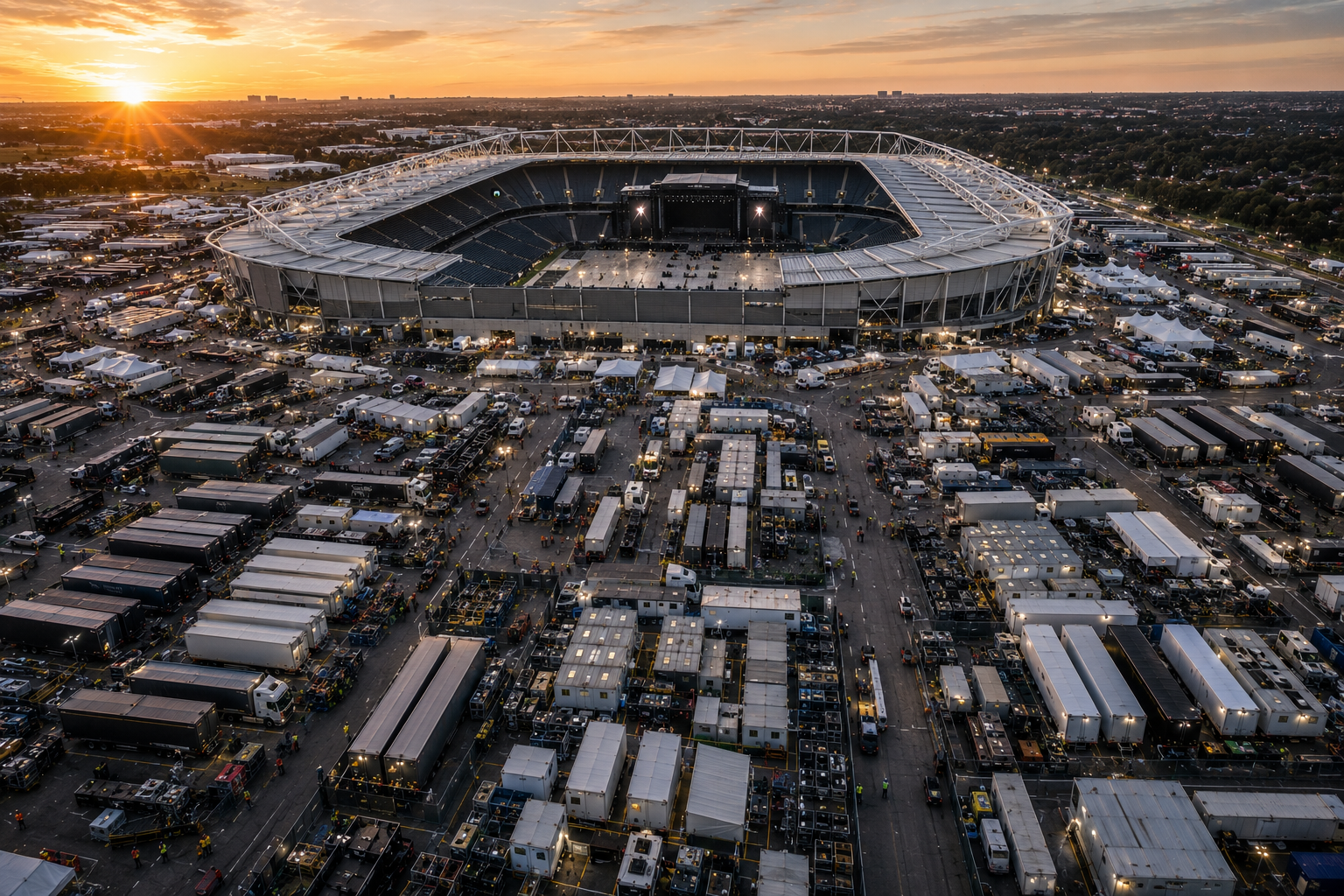
When most people look at a stadium tour, they see a spectacular performance.
Behind the scenes, organisers see a temporary city.
Today's largest live tours are no longer simply moving stages from venue to venue. They involve thousands of people, hundreds of vehicles, complex communications networks, temporary power distribution, logistics hubs, catering operations, broadcast facilities, security systems and rapidly deployable production infrastructure. For many productions, building the show has become as challenging as performing it.
This growing complexity is transforming how tours are designed, managed and delivered.
For decades, the challenge was largely one of scale. Bigger audiences required bigger stages, larger sound systems and more lighting. Today, the challenge is integration. Every department—from video production and audio to logistics, rigging, security, transport and communications—must operate as part of a single coordinated ecosystem.
That shift reflects changing audience expectations. Fans now expect immersive visual experiences, seamless connectivity, high-quality live content on social media, cashless payments, sophisticated merchandise operations and ever more ambitious stage productions. At the same time, artists and promoters are under pressure to improve sustainability, control costs and move increasingly complex productions between cities on ever tighter schedules.
Technology has become the glue holding these temporary cities together.
Modern productions rely on high-capacity networking, IP communications, wireless production systems, digital asset management and increasingly sophisticated planning software. Virtual modelling allows production teams to test staging, rigging and sightlines before a single truck leaves the warehouse. During the tour itself, real-time communications help hundreds of specialists work together across vast production sites where every minute counts.
Perhaps the biggest change is that planning now starts long before construction begins.
Many of today's largest tours spend months developing detailed digital models of venues, production layouts and workflows. Installation sequences are simulated, logistics refined and potential problems resolved virtually before arriving on site. The objective is not simply efficiency; it is reducing risk while maintaining the consistency audiences expect in every city.
Increasingly, the same technologies are also supporting greater flexibility. Productions are becoming more modular, allowing shows to adapt to different venue sizes and configurations without compromising quality. This flexibility is becoming particularly valuable as tours move between stadiums, arenas and festival sites with very different operational requirements.
The growing complexity of touring is explored in the Building for Success: How Large-Scale Tours Come Together – Now and Next session from the ISE 2026 Live Events Stage. Rather than focusing on headline-grabbing performances, the discussion examines the planning, collaboration and technical coordination required to deliver some of the world's most ambitious live productions. It offers a valuable reminder that the success of a major tour depends as much on engineering, logistics and preparation as on creative vision.
Many of the technologies developed for global tours are also influencing permanent venues. Networking infrastructure, production workflows, digital modelling and systems integration are increasingly shared across touring productions, arenas and stadiums. As a result, the distinction between touring infrastructure and venue infrastructure is becoming less clear.
Integrated Systems Europe exhibitors including INFiLED continue developing modular LED display systems designed for rapid deployment and touring reliability. Meanwhile, TAIT is advancing staging and automation technologies that support increasingly ambitious live productions, while RIEDEL Communications continues expanding communications and networking platforms that help production teams coordinate complex operations across large sites.
The biggest tours of the next decade are unlikely to be remembered solely for their spectacular performances. They will also be defined by how effectively they manage extraordinary operational complexity.
That is why large-scale touring, production infrastructure and systems integration are becoming increasingly important conversations at Integrated Systems Europe, where production professionals, venue operators and technology innovators are exploring how the next generation of live experiences will be delivered.
 Stay ahead – Stay informed.
As an AV specialist or industry leader, you recognise how crucial it is to keep up with evolving trends, new technologies, and notable happenings within the audiovisual world. That's why we're delighted to invite you to receive exclusive email updates about ISE – the world-renowned annual tech show for the systems integration and audiovisual industry.
When you subscribe, you'll be kept up to speed with insightful commentary on the freshest developments in AV, get early looks at what's planned for the ISE content schedule – including headline speakers – and benefit from in-depth reporting on the show's standout attractions.
Sign up now to stay at the forefront of audiovisual innovation and expertise.
Further reading
Find out more about live events, audio, lighting and staging at ISE
Find out more about infrastructure, control and multi-technology at ISE
Related Content
-
) How do venues improve the fan experience? By removing friction at every stage.
How do venues improve the fan experience? By removing friction at every stage. -
) Technology does not automatically make a venue smarter. The real transformation comes when tech is connected to operational and commercial objectives.
Technology does not automatically make a venue smarter. The real transformation comes when tech is connected to operational and commercial objectives. -
) Calling a new venue "future-proof" has always been risky. Today, it is becoming harder still.
Calling a new venue "future-proof" has always been risky. Today, it is becoming harder still. -
) For years, 5G was set to revolutionise live events: faster downloads, lower latency, better connectivity, smarter venues. The reality has been more complicated.
For years, 5G was set to revolutionise live events: faster downloads, lower latency, better connectivity, smarter venues. The reality has been more complicated. -
) Ticketing is becoming one of the most valuable data assets in the live events industry.
Ticketing is becoming one of the most valuable data assets in the live events industry.
Featured Articles
-
) Spanning all eight halls at Fira de Barcelona Gran Via, ISE 2026 delivered four days of record-breaking energy, creativity, and innovation.
Spanning all eight halls at Fira de Barcelona Gran Via, ISE 2026 delivered four days of record-breaking energy, creativity, and innovation. -
) The initiative will create new opportunities for talent development, innovation and community projects across the sector
The initiative will create new opportunities for talent development, innovation and community projects across the sector -
) The Facts & Figures report for ISE 2026 is available to download.
The Facts & Figures report for ISE 2026 is available to download. -
) Bringing together startups, investors and industry leaders, the expanded show feature offers a strong platform for visibility, networking, and commercial opportunity.
Bringing together startups, investors and industry leaders, the expanded show feature offers a strong platform for visibility, networking, and commercial opportunity. -
) This new type of event brings together end users, creators and production specialists from broadcast, live events, advertising and gaming, combining creative showcases, editorial programming and netwo ...
This new type of event brings together end users, creators and production specialists from broadcast, live events, advertising and gaming, combining creative showcases, editorial programming and netwo ...
)
)

)
)
)
)
)
.png/fit-in/500x500/filters:no_upscale())
)
)
)
)
)
)
)
)
)
)
)
)
)
)
)
)
)
)
)
)
)
)

)
)
)

)
)
)
)
)
)
)
)
)
)
)
)
)
![rAVe [PUBS]](https://cdn.asp.events/CLIENT_Integrat_169E7B04_E6F3_39F6_8BE4DB27C54F731E/sites/ise-2027/media/libraries/partners/rAVe-PUBS-Google-Logo.png/fit-in/500x500/filters:no_upscale())
)
)
)
)
)
)
)
)
)