

Smart offices are changing corporate real estate forever
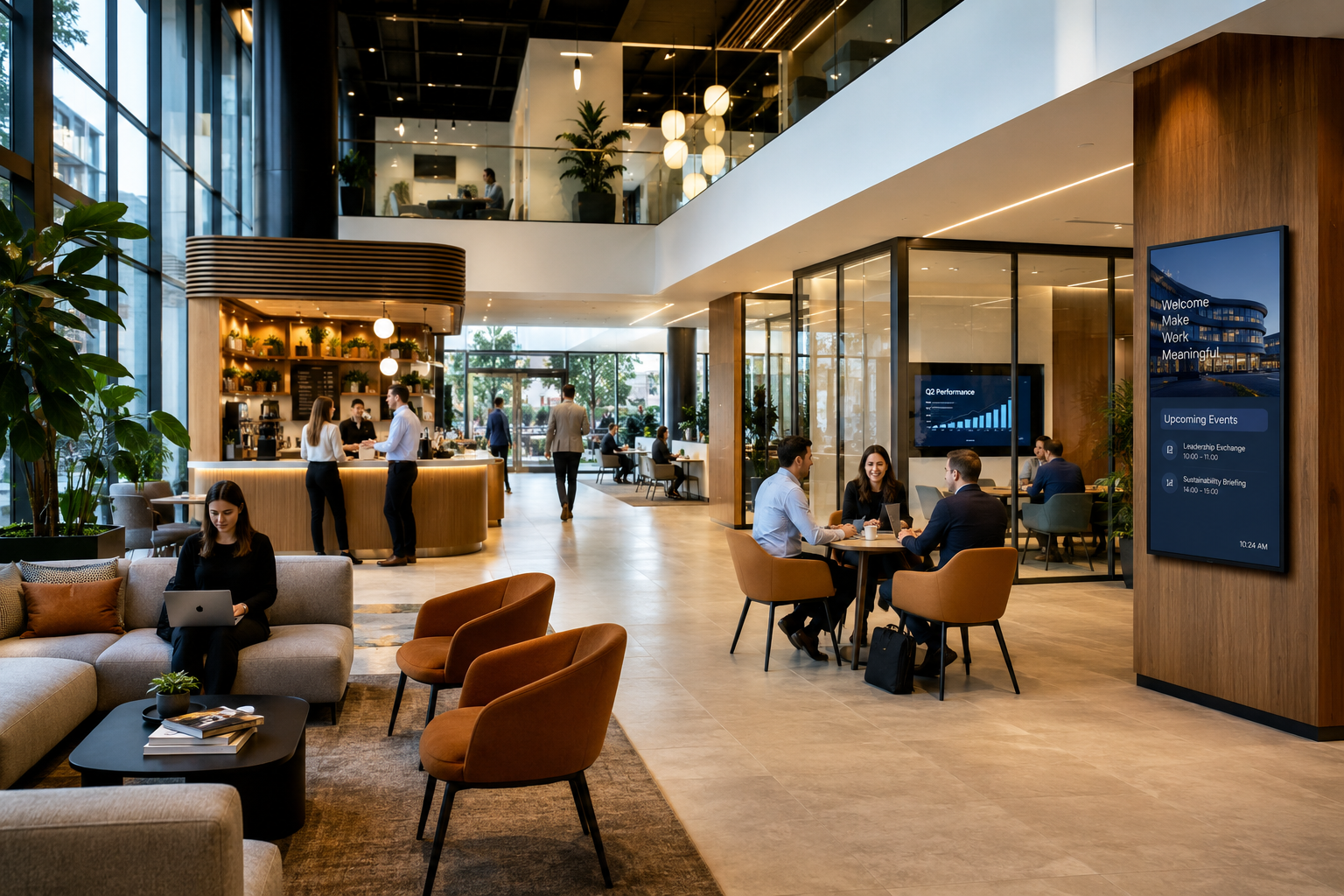
For decades, corporate real estate was largely a question of square footage.
How much space did an organisation need? Where should offices be located? How many desks could fit on each floor?
Those questions still matter. But they are no longer enough.
Hybrid work has fundamentally changed how companies think about buildings. Increasingly, organisations are discovering that the value of office space is determined less by how much of it they own and more by how effectively people use it.
That shift is forcing a rethink of corporate real estate strategies around the world.
Empty desks have become expensive. Underused meeting rooms represent wasted investment. At the same time, employees increasingly expect offices to provide experiences that cannot easily be replicated at home.
The result is a new focus on smarter environments.
Occupancy analytics, environmental monitoring, collaboration technology and digital workplace platforms are helping organisations understand how their buildings are actually being used. Real estate decisions are becoming data-driven rather than assumption-driven.
At ISE 2027, exhibitors such as Cisco, Crestron and Appspace continue to focus on technologies that connect people, spaces and workplace data into unified ecosystems.
Cisco's recent workplace initiatives have highlighted how analytics and collaboration tools can support more flexible office strategies while improving employee experience and operational efficiency. Meanwhile, ISE 2027 exhibitor Appspace has expanded its workplace platform capabilities around room booking, digital signage and employee communications, reflecting growing demand for integrated workplace management.
The implications extend beyond facilities teams.
Real estate costs, sustainability targets, employee retention and productivity are becoming increasingly interconnected. Decisions that were once handled separately are now influencing one another.
Many organisations are discovering that they do not necessarily need more office space.
They need better office space.
The most successful workplaces increasingly support collaboration, culture and flexibility rather than simply accommodating headcount.
This shift is also changing relationships between corporate real estate, HR and IT teams. Workplace technology decisions are becoming strategic business decisions.
At the same time, sustainability pressures are adding further urgency. Better utilisation can reduce energy consumption and improve overall building performance, helping organisations meet increasingly ambitious ESG goals.
The office is not disappearing.
But its role is evolving.
And the companies adapting fastest are treating buildings not as fixed assets, but as dynamic environments that must continually respond to changing employee needs.
That is why conversations around smart buildings, workplace analytics and hybrid work are becoming increasingly important at Integrated Systems Europe.
The technology already exists.
The larger challenge is organisational: how quickly can companies rethink the relationship between people and place?
Stay ahead – Stay informed.
As an AV specialist or industry leader, you recognise how crucial it is to keep up with evolving trends, new technologies, and notable happenings within the audiovisual world. That's why we're delighted to invite you to receive exclusive email updates about ISE – the world-renowned annual tech show for the systems integration and audiovisual industry.
When you subscribe, you'll be kept up to speed with insightful commentary on the freshest developments in AV, get early looks at what's planned for the ISE content schedule – including headline speakers – and benefit from in-depth reporting on the show's standout attractions.
Sign up now?to stay at the forefront of audiovisual innovation and expertise.
Learn more about unified communications and collaboration at ISE 2027.
Related Content
-
) Edge computing is the processing of data close to where it is created and used, rather than sending it to a distant data centre or cloud platform.
Edge computing is the processing of data close to where it is created and used, rather than sending it to a distant data centre or cloud platform. -
) Rather than simply protecting infrastructure or data, organisations are facing a new priority: protecting the integrity of decisions.
Rather than simply protecting infrastructure or data, organisations are facing a new priority: protecting the integrity of decisions. -
) Uptime, interoperability and cost still matter. But they no longer define whether a collaboration strategy succeeds.
Uptime, interoperability and cost still matter. But they no longer define whether a collaboration strategy succeeds. -
) The organisations creating the best employee experiences are not overwhelming people with technology. They are removing friction.
The organisations creating the best employee experiences are not overwhelming people with technology. They are removing friction. -
) The companies making the strongest case for returning to the office are not simply telling people to come back. They are giving them a reason to want to be there.
The companies making the strongest case for returning to the office are not simply telling people to come back. They are giving them a reason to want to be there.
Featured Articles
-
) Spanning all eight halls at Fira de Barcelona Gran Via, ISE 2026 delivered four days of record-breaking energy, creativity, and innovation.
Spanning all eight halls at Fira de Barcelona Gran Via, ISE 2026 delivered four days of record-breaking energy, creativity, and innovation. -
) The initiative will create new opportunities for talent development, innovation and community projects across the sector
The initiative will create new opportunities for talent development, innovation and community projects across the sector -
) The Facts & Figures report for ISE 2026 is available to download.
The Facts & Figures report for ISE 2026 is available to download. -
) Bringing together startups, investors and industry leaders, the expanded show feature offers a strong platform for visibility, networking, and commercial opportunity.
Bringing together startups, investors and industry leaders, the expanded show feature offers a strong platform for visibility, networking, and commercial opportunity. -
) This new type of event brings together end users, creators and production specialists from broadcast, live events, advertising and gaming, combining creative showcases, editorial programming and netwo ...
This new type of event brings together end users, creators and production specialists from broadcast, live events, advertising and gaming, combining creative showcases, editorial programming and netwo ...
)
)
)
)
)
)
)
)
)
)
)
.png/fit-in/500x500/filters:no_upscale())
)
)
)
)
![rAVe [PUBS]](https://cdn.asp.events/CLIENT_Integrat_169E7B04_E6F3_39F6_8BE4DB27C54F731E/sites/ise-2027/media/libraries/partners/rAVe-PUBS-Google-Logo.png/fit-in/500x500/filters:no_upscale())
)
)
)
)
)
)
)
)
)
)
)
)
)
)
)
)
)
)
)
)
)
)
)
)
)
)
)
)
)
)
)
.png/fit-in/500x500/filters:no_upscale())
)
)
)
)
)
)
)