

Why smart home technology is becoming a wellness strategy'
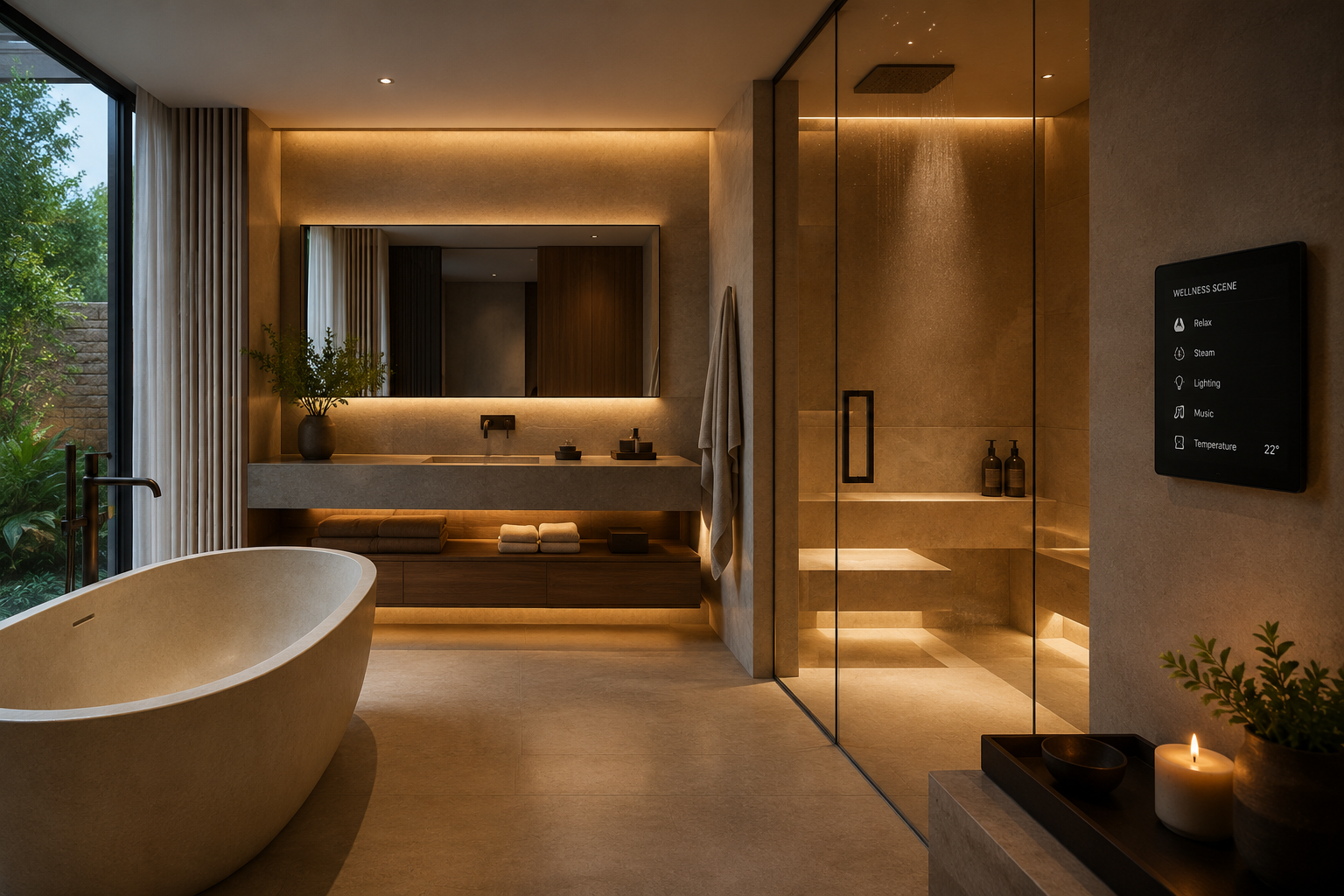
The luxury residential market is entering a new phase.
For years, smart home conversations focused on convenience, entertainment and control. Today, something much bigger is happening.
Homeowners are increasingly asking whether their homes actively support health, wellbeing and quality of life.
And that question is reshaping residential technology.
Revised 16 September 2026
Lighting that supports circadian rhythms. Intelligent climate systems that improve air quality. Acoustic design that reduces stress. Automated shading that enhances sleep. Invisible technology that creates calmer living environments.
The smart home is no longer simply becoming more connected.
It is becoming more human-centric.
For residential developers, architects and technology integrators, this creates both a major opportunity and a growing pressure point.
Because expectations are changing quickly.
High-end residential clients increasingly expect longevity, resilience and quality of life at home, as part of an overall focus on wellness.
That shift is driving new conversations between architects, interior designers, lighting consultants, integrators and smart building specialists.
Technology decisions are becoming lifestyle decisions.
At the same time, the convergence between wellness and residential technology is creating entirely new categories of intelligent living environments.
Recent projects underline how the market is evolving
Wellness is moving from an added amenity to a core element of high-end residential development, as luxury brands increasingly build health, longevity and wellbeing into the residential proposition.
They see a growing demand for homes that actively contribute to physical and mental wellbeing rather than simply delivering automation.
At ISE, exhibitors such as Basalte, Lutron, Sonance and Bang & Olufsen are focusing on technologies that blend seamlessly into architectural environments while supporting comfort, ambience and wellbeing.
Rather than technology dominating spaces visually, the focus is shifting towards calm, immersive environments where sound, lighting and control systems disappear into the architecture itself.
For example, residential audio manufacturers are increasingly focusing on invisible and design-led audio systems that blend more seamlessly into wellness-oriented residential environments.
This matters because technological excess and overt branding have been superseded by a new trend: quiet luxury, a sophisticated approach to affluence that prioritises quality over flashy branding, substance over superficial showmanship.
The homes that now feel truly premium are often the ones where the technology is least visible.
New challenges
For developers, this creates new design and integration challenges.
How do systems remain sophisticated while becoming less intrusive?
How do smart homes support healthier living without overwhelming users with interfaces and complexity?
And how can residential professionals deliver homes that remain adaptable as wellness technologies continue evolving?
These questions are pushing the industry into unfamiliar territory.
The future smart home may ultimately be judged less by how many devices it contains and more by how occupants feel when they live there.
That shift is one reason why conversations around wellness, architecture, smart buildings and residential technology are becoming increasingly important at ISE.
Because the next generation of smart homes will not simply be automated.
They will be designed around human experience.
Stay ahead – Stay informed.
As an AV specialist or industry leader, you recognise how crucial it is to keep up with evolving trends, new technologies, and notable happenings within the audiovisual world. That's why we're delighted to invite you to receive exclusive email updates about ISE – the world-renowned annual tech show for the systems integration and audiovisual industry.
When you subscribe, you'll be kept up to speed with insightful commentary on the freshest developments in AV, get early looks at what's planned for the ISE content schedule – including headline speakers – and benefit from in-depth reporting on the show's standout attractions.
Sign up now?to stay at the forefront of audiovisual innovation and expertise.
Further reading
Find out more about smart homes and buildings at ISE.
Related Content
-
) For years, one of the biggest frustrations with smart home technology has been surprisingly simple: not everything talks to everything else. Matter is designed to make that easier.
For years, one of the biggest frustrations with smart home technology has been surprisingly simple: not everything talks to everything else. Matter is designed to make that easier. -
) Why residential technology is moving beyond gadgets.
Why residential technology is moving beyond gadgets. -
) How smart building technology improves resident retention.
How smart building technology improves resident retention. -
) Today, some of the most successful luxury residential projects are being designed around experiences rather than objects.
Today, some of the most successful luxury residential projects are being designed around experiences rather than objects. -
) As homes become more connected, technology decisions are beginning to influence much more than entertainment.
As homes become more connected, technology decisions are beginning to influence much more than entertainment.
Featured Articles
-
) Spanning all eight halls at Fira de Barcelona Gran Via, ISE 2026 delivered four days of record-breaking energy, creativity, and innovation.
Spanning all eight halls at Fira de Barcelona Gran Via, ISE 2026 delivered four days of record-breaking energy, creativity, and innovation. -
) The initiative will create new opportunities for talent development, innovation and community projects across the sector
The initiative will create new opportunities for talent development, innovation and community projects across the sector -
) The Facts & Figures report for ISE 2026 is available to download.
The Facts & Figures report for ISE 2026 is available to download. -
) Bringing together startups, investors and industry leaders, the expanded show feature offers a strong platform for visibility, networking, and commercial opportunity.
Bringing together startups, investors and industry leaders, the expanded show feature offers a strong platform for visibility, networking, and commercial opportunity. -
) This new type of event brings together end users, creators and production specialists from broadcast, live events, advertising and gaming, combining creative showcases, editorial programming and netwo ...
This new type of event brings together end users, creators and production specialists from broadcast, live events, advertising and gaming, combining creative showcases, editorial programming and netwo ...
)
)

)
)
)
)
)
)
)
)
)
)
.png/fit-in/500x500/filters:no_upscale())
)
)
)
)
)
)
)
)
)
.png/fit-in/500x500/filters:no_upscale())
)
)
)
)
)
)
)
)
)
)
)
)
)
)
)
)
)
)
)

)
)
)
)
)
)
)
)
)
)
)
)
)