

Why the smart home industry is rethinking privacy
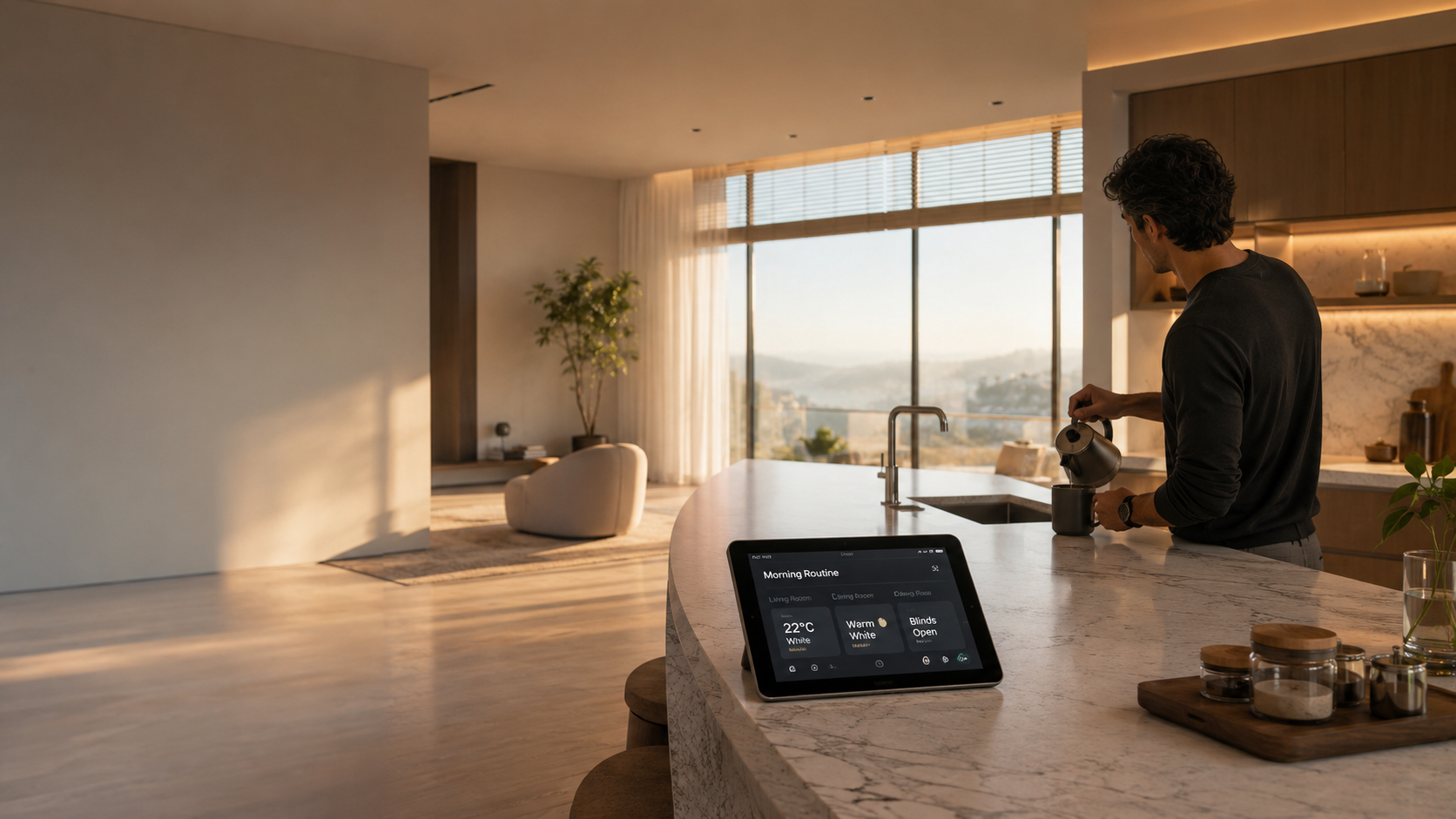
The connected home was built around data.
Now the residential technology industry is having to think much more carefully about what happens to that data, where it is processed and who can access it.
Revised 30 September 2026
Voice commands, occupancy sensors, connected cameras, smart locks and personalised automation routines can all generate information about how people live. As homes become more intelligent, that information can be used to make environments more responsive, convenient and efficient – but it also makes privacy an increasingly important consideration.
For years, the appeal of connected living was largely defined by what the technology could do. Homeowners gained seamless entertainment, remote access, automated comfort and more sophisticated security. As AI becomes more deeply embedded in residential systems, however, the conversation is broadening.
Clients may increasingly want to know not only what a system can do, but what it knows about them, where that information goes and how much control they retain over it. A recent study from Copeland revealed that 29% of homeowners have significant concerns regarding data protection and 33% are worried about it.
For residential integrators, developers, architects and other smart home professionals, these questions are becoming part of the design and specification process.
Privacy becomes part of the luxury proposition
The issue is particularly relevant in high-end residential environments, where discretion and control have always been part of the definition of luxury.
A home that automatically responds to occupancy, preferences and routines can create an exceptionally personalised experience. Yet the same capabilities can feel intrusive if the homeowner does not understand how they work or what happens to the information they generate.
This is encouraging a more mature approach to connected living, in which transparency, cybersecurity and responsible data management sit alongside convenience and performance. Privacy is no longer something to consider only after the technology has been specified; it can influence choices about system architecture from the outset.
That might mean considering which functions can be processed locally, which services genuinely require a cloud connection, how different devices communicate and what data is shared between them. It also places greater importance on the network infrastructure supporting the home.
At ISE, exhibitors illustrate different parts of this changing landscape. NETGEAR AV provides networking infrastructure that can underpin increasingly connected residential environments, while DoorBird develops IP-based access control and door communication solutions, bringing questions of secure connectivity directly to the entrance of the smart home. KNX Association, meanwhile, represents an open standard designed to enable interoperable building and home automation across products from multiple manufacturers. KNX-based smart building projects across Europe are increasingly highlighting secure interoperability and decentralised control architectures.
Privacy-focused voice control provides another example of how the market is responding. Josh.ai, demonstrated at ISE 2026 by CEO Alex Capecelatro, has made privacy a prominent part of its proposition, including an emphasis on local processing and limiting the amount of information that needs to leave the home.
Together, these different approaches point towards a wider change: privacy is becoming an architectural consideration as well as a cybersecurity one.
When does an intelligent home become too intelligent?
This raises questions that cannot be answered by technology specifications alone.
How much should a home know about the people living in it? How visible should that intelligence be? When does helpful automation begin to feel intrusive? And how can increasingly sophisticated AI deliver personalisation without making occupants uncomfortable about the information being collected?
These questions matter because the smart home is fundamentally different from many other technology environments. It is also a private space. Systems may operate in bedrooms and bathrooms as well as kitchens, living rooms and entertainment spaces, while sensors can potentially infer occupancy, routines and preferences over long periods of time.
The best response is unlikely to be less intelligence. Instead, the industry has an opportunity to make that intelligence more understandable and controllable.
For integrators, this can mean discussing privacy preferences with clients as part of the discovery process, rather than treating them as purely technical decisions. One homeowner may be comfortable with cloud-based services if they deliver particular functionality; another may place a much higher value on local control. Understanding that distinction can become part of designing a system around the individual.
Trust becomes a specification issue
As smart homes become more sophisticated, trust is likely to influence technology choices more directly. Architects, developers and integrators therefore need to consider not only whether a system performs well, but whether its approach to data is appropriate for the people who will live with it.
That changes the meaning of a successful smart home. Technical sophistication alone is not enough if occupants feel that they have lost control of their own environment. The aim should be to create technology that feels supportive rather than intrusive, providing intelligence without constantly reminding people that their behaviour can be measured.
Privacy, cybersecurity and responsible AI are therefore becoming increasingly relevant to the residential technology conversations taking place at Integrated Systems Europe. As connected devices, automation, networks and AI converge, the industry has an opportunity to decide what responsible intelligent living should look like.
The future smart home will not simply need to understand its occupants. It will need to earn their trust.
Stay ahead – Stay informed.
As an AV specialist or industry leader, you recognise how crucial it is to keep up with evolving trends, new technologies, and notable happenings within the audiovisual world. That's why we're delighted to invite you to receive exclusive email updates about ISE – the world-renowned tech show for the systems integration and audiovisual industry.
When you subscribe, you'll be kept up to speed with insightful commentary on the freshest developments in AV, get early looks at what's planned for the ISE content schedule – including headline speakers – and benefit from in-depth reporting on the show's standout attractions.
Sign up now to stay at the forefront of audiovisual innovation and expertise.
Further reading
Discover smart spaces, homes and buildings at ISE
Related Content
-
) Human centric lighting (HCL) is an approach to lighting design that considers how light affects human health, comfort, mood and performance, rather than simply providing visibility.
Human centric lighting (HCL) is an approach to lighting design that considers how light affects human health, comfort, mood and performance, rather than simply providing visibility. -
) For years, one of the biggest frustrations with smart home technology has been surprisingly simple: not everything talks to everything else. Matter is designed to make that easier.
For years, one of the biggest frustrations with smart home technology has been surprisingly simple: not everything talks to everything else. Matter is designed to make that easier. -
) Why residential technology is moving beyond gadgets.
Why residential technology is moving beyond gadgets. -
) How smart building technology improves resident retention.
How smart building technology improves resident retention. -
) Today, some of the most successful luxury residential projects are being designed around experiences rather than objects.
Today, some of the most successful luxury residential projects are being designed around experiences rather than objects.
Featured Articles
-
) Spanning all eight halls at Fira de Barcelona Gran Via, ISE 2026 delivered four days of record-breaking energy, creativity, and innovation.
Spanning all eight halls at Fira de Barcelona Gran Via, ISE 2026 delivered four days of record-breaking energy, creativity, and innovation. -
) The initiative will create new opportunities for talent development, innovation and community projects across the sector
The initiative will create new opportunities for talent development, innovation and community projects across the sector -
) The Facts & Figures report for ISE 2026 is available to download.
The Facts & Figures report for ISE 2026 is available to download. -
) Bringing together startups, investors and industry leaders, the expanded show feature offers a strong platform for visibility, networking, and commercial opportunity.
Bringing together startups, investors and industry leaders, the expanded show feature offers a strong platform for visibility, networking, and commercial opportunity. -
) This new type of event brings together end users, creators and production specialists from broadcast, live events, advertising and gaming, combining creative showcases, editorial programming and netwo ...
This new type of event brings together end users, creators and production specialists from broadcast, live events, advertising and gaming, combining creative showcases, editorial programming and netwo ...
)
)

)
)
)
)
)
)
)
)
)
)
)
)
)
)
)
)
)
)
)
)
)
)
)
)
)
)
)
)
)
)
)
)
)
)
)
)
)
)
)
)
)
)
)
)
)
)
)
)
)

)
)
)
)
)
)