
OTT didn't kill broadcast – but it did change the rules
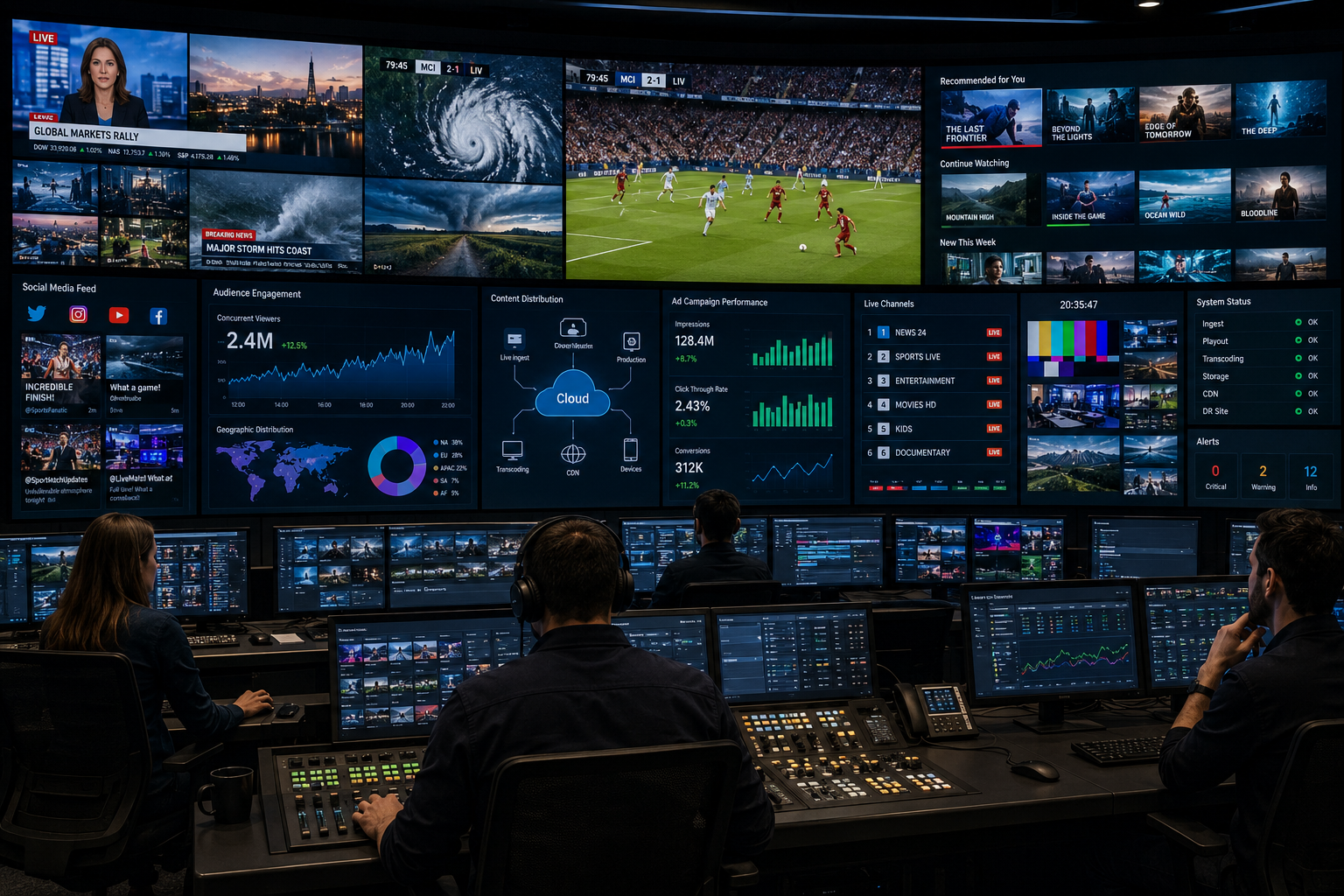
For years, the media industry framed OTT and traditional broadcasting as a winner-takes-all battle. Streaming versus linear. Digital versus legacy. Technology versus television.
That distinction is becoming much less useful. The real competition is increasingly between media businesses that can adapt to changing audience behaviour and those constrained by rigid technology and operating models.
Revised 8 October 2026
Audiences increasingly move between broadcast television, streaming services and other video platforms according to the content they want rather than the delivery technology behind it. Nielsen reported in 2025 that streaming had reached 44.8% of US television viewing, compared with a combined 44.2% for broadcast and cable. The boundaries are blurring for viewers even if they remain important technically and commercially to the industry.
Streaming has changed what audiences expect
Traditional broadcasters retain significant advantages. Premium sports rights, trusted brands, established advertising relationships and large-scale production expertise remain highly valuable. But the rise of OTT has fundamentally changed viewing habits.
Deloitte's 2025 Digital Media Trends research found that US audiences, particularly younger generations, were spreading their entertainment time more evenly across streaming video, social platforms, gaming and other forms of digital media. Only 49% of consumers surveyed had a cable or satellite TV subscription, down from 63% three years earlier, while 53% said SVOD subscriptions were the paid media and entertainment services they used most frequently.
Those changes have helped make on-demand access, personalised recommendations and multi-device availability familiar parts of the viewing experience. Content schedules still matter, particularly around live news, sport and major events, but viewers have considerably more control over what they watch, when they watch it and where.
For broadcasters, the consequences extend far beyond distribution. Production workflows, monetisation models, cloud infrastructure, advertising strategies and audience analytics all have to accommodate a much wider range of viewing behaviours.
Broadcast and streaming now have to coexist
The challenge is particularly acute around infrastructure and cost.
OTT delivery can require substantial resources for cloud processing, storage, content delivery, metadata and rights management. At the same time, established broadcasters may still have significant investments in linear distribution and production infrastructure.
Many media organisations therefore need to support both worlds simultaneously. For CTOs and media strategists, the central question is no longer whether broadcast or streaming will win. It is how to build an infrastructure flexible enough to support both.
The answer increasingly involves convergence. Streaming services are investing in live programming, including sport, while broadcasters are extending their operations across streaming and digital platforms. Production is becoming more software-defined and cloud-connected, while advertising and measurement increasingly have to work across different forms of distribution.
Audience fragmentation is reshaping media workflows
Convergence does not necessarily mean simplification. Audiences are spreading their attention across more services, platforms and forms of entertainment.
Nielsen distinguishes this audience fragmentation from media fragmentation: the former describes audiences scattering their attention across the growing number of available options. Its 2025 analysis found traditional broadcast and cable viewing in the US almost level with streaming, illustrating how viewing is now distributed across different forms of television rather than dominated by one.
Deloitte paints an even broader picture. Its research found consumers dividing an average of around six hours of daily media and entertainment time between streaming, cable or live-streaming TV, social media, user-generated content, gaming, music and podcasts. The total amount of time available is not necessarily increasing; the competition for it is.
That has practical consequences for broadcasters. Content may need to be produced, adapted and distributed for linear television, streaming services, FAST channels, social platforms, mobile apps and connected TVs, each with different technical and commercial requirements.
Flexible infrastructure becomes the advantage
This is why infrastructure capable of adapting continuously is becoming increasingly important.
At ISE 2027, exhibitors such as Grass Valley are demonstrating approaches to production that span linear, streaming and cloud environments. Its AMPP platform, for example, supports cloud, on-premises and hybrid deployment, allowing media organisations to use common production tools across different infrastructure models.
Lawo is approaching the same transition from the perspective of software-defined, IP-based broadcast infrastructure. Its HOME platform provides management and connectivity across distributed media environments, reflecting the wider move towards infrastructures in which resources can be connected and controlled more flexibly.
EVS is similarly extending established live-production workflows into more connected environments, including tools for content management, remote production and the rapid repurposing of live content for different destinations.
The significance of these developments is not that OTT is replacing broadcasting. It is that broadcasting is becoming part of a much broader, interconnected media ecosystem.
As broadcast, streaming and digital media workflows converge, competitive advantage is increasingly likely to come from flexibility: the ability to create once, adapt quickly, distribute across multiple destinations and respond as audience behaviour continues to change.
That makes the intersection of broadcast, AV, cloud and IP particularly relevant at Integrated Systems Europe 2027, where broadcasters can explore the technologies behind increasingly flexible production and distribution environments.
Stay ahead – Stay informed.
As an AV specialist or industry leader, you recognise how crucial it is to keep up with evolving trends, new technologies, and notable happenings within the audiovisual world. That's why we're delighted to invite you to receive exclusive email updates about ISE – the world-renowned tech show for the systems integration and audiovisual industry.
When you subscribe, you'll be kept up to speed with insightful commentary on the freshest developments in AV, get early looks at what's planned for the ISE content schedule – including headline speakers – and benefit from in-depth reporting on the show's standout attractions.
Sign up now to stay at the forefront of audiovisual innovation and expertise.
Further reading
Related Content
-
) IPMX and ST 2110 both transport professional media over IP networks but differ mainly in who they serve.
IPMX and ST 2110 both transport professional media over IP networks but differ mainly in who they serve. -
) Broadcast TV isn't growing in the traditional sense. But instead, the definition of broadcasting is expanding.
Broadcast TV isn't growing in the traditional sense. But instead, the definition of broadcasting is expanding. -
) For decades, broadcasters' concerns around operational risk focused primarily on reliability. Today, a different threat is demanding attention: cybersecurity.
For decades, broadcasters' concerns around operational risk focused primarily on reliability. Today, a different threat is demanding attention: cybersecurity. -
) Broadcasters face growing pressure from regulators, investors, advertisers, production partners, and audiences to demonstrate measurable environmental progress.
Broadcasters face growing pressure from regulators, investors, advertisers, production partners, and audiences to demonstrate measurable environmental progress. -
) Across the industry, a major transformation is taking place behind the scenes as traditional hardware-centric environments give way to software-defined architectures.
Across the industry, a major transformation is taking place behind the scenes as traditional hardware-centric environments give way to software-defined architectures.
Featured Articles
-
) Spanning all eight halls at Fira de Barcelona Gran Via, ISE 2026 delivered four days of record-breaking energy, creativity, and innovation.
Spanning all eight halls at Fira de Barcelona Gran Via, ISE 2026 delivered four days of record-breaking energy, creativity, and innovation. -
) The initiative will create new opportunities for talent development, innovation and community projects across the sector
The initiative will create new opportunities for talent development, innovation and community projects across the sector -
) The Facts & Figures report for ISE 2026 is available to download.
The Facts & Figures report for ISE 2026 is available to download. -
) Bringing together startups, investors and industry leaders, the expanded show feature offers a strong platform for visibility, networking, and commercial opportunity.
Bringing together startups, investors and industry leaders, the expanded show feature offers a strong platform for visibility, networking, and commercial opportunity. -
) This new type of event brings together end users, creators and production specialists from broadcast, live events, advertising and gaming, combining creative showcases, editorial programming and netwo ...
This new type of event brings together end users, creators and production specialists from broadcast, live events, advertising and gaming, combining creative showcases, editorial programming and netwo ...
)
)
)
)
)
)
)
)
)
)
)
)
)
)
)
)
)
)
)
)
)
)
)
)
)
)
)
)
)
)
)
)
)
)
)
)
)
)
)
)
)
)
)
)
)
)
)
)
)
)
)
)
.png/fit-in/500x500/filters:no_upscale())
)
)
)