
Your office isn't competing with other offices anymore
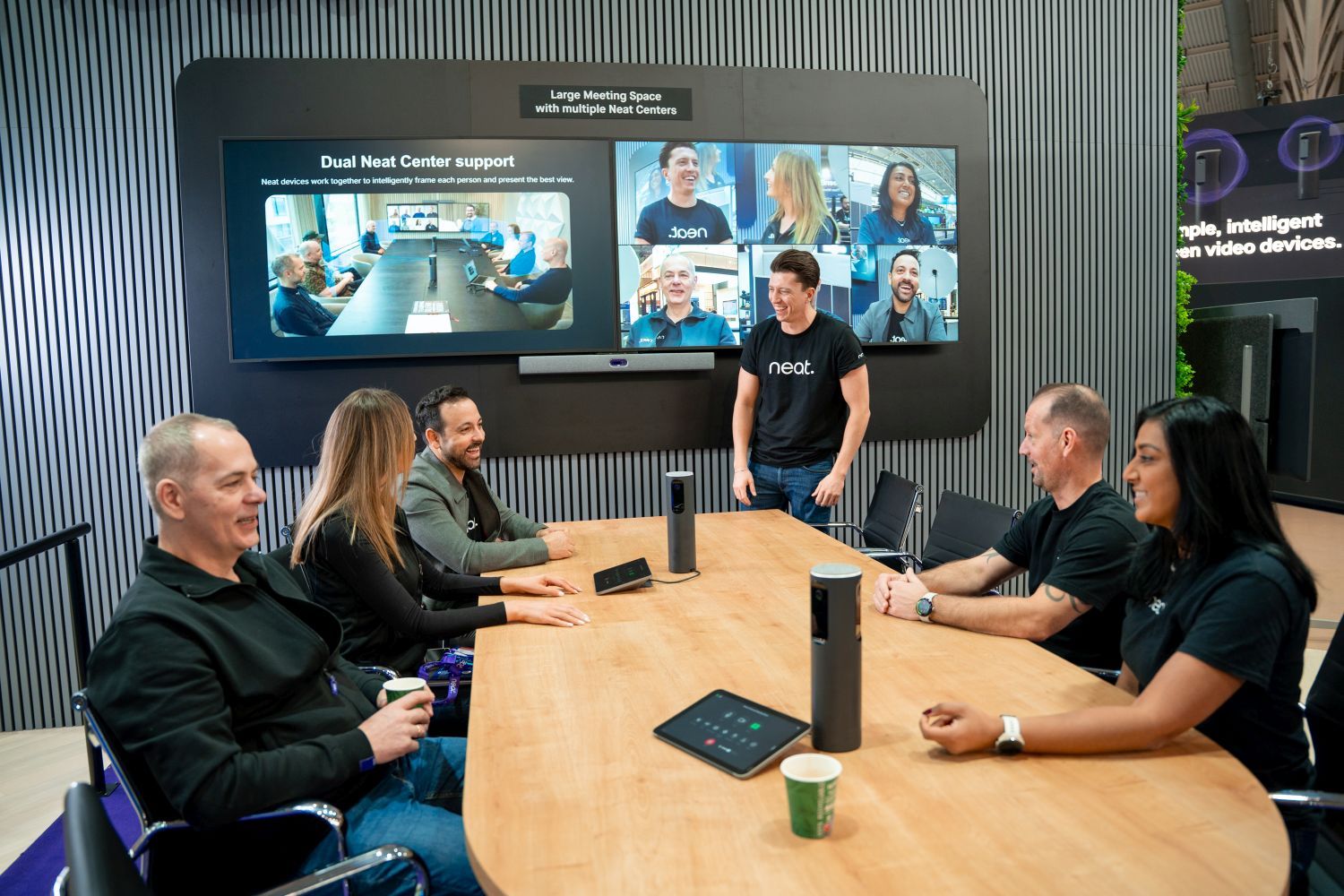
The companies making the strongest case for returning to the office are not simply telling people to come back. They are giving them a reason to want to be there.
Revised 30 September 2026
Across Europe and beyond, hybrid work has entered a more mature phase. The initial scramble to equip employees for remote collaboration has passed, and expectations have moved on. People now know that they can work effectively from home, which means the office has to offer something different: better opportunities to collaborate, communicate, create and make decisions together.
For many organisations, that changes the technology conversation. The question is no longer simply whether meeting rooms have video conferencing. It is whether the entire workplace can support productive, engaging ways of working without introducing unnecessary friction.
Poor audio, complicated room controls, inconsistent meeting experiences, fragmented collaboration platforms and a lack of reliable information about how spaces are being used can all undermine that experience. What once looked like a collection of relatively minor technology problems increasingly has implications for productivity, employee engagement and the value organisations derive from their real estate.
When workplace technology disappears
One characteristic of a successful hybrid workplace is that the technology becomes less noticeable.
Employees should not need to spend the first ten minutes of a meeting troubleshooting cameras, finding cables or working out how to share content. Increasingly, the aim is for rooms to recognise participants, optimise audio and video automatically and accommodate different collaboration platforms without requiring users to understand the technology behind them.
ISE exhibitors such as Shure, Logitech and Jabra are among the companies developing technologies for these increasingly intelligent collaboration environments. At ISE 2026, capabilities including speaker tracking, intelligent framing and AI-assisted audio optimisation demonstrated how automation is moving into everyday meeting experiences.
The significance of these developments is not simply that AI is entering the meeting room. It is that AI can help remove some of the small obstacles that make hybrid collaboration frustrating. The more effectively the technology works in the background, the more attention people can give to the meeting itself.
From office space to workplace data
The same shift is taking place at the level of the building. With organisations under pressure to make better use of expensive real estate, workplace decisions are increasingly being informed by data rather than assumptions.
Occupancy analytics, environmental sensors and integrated workplace platforms can help businesses understand which spaces people actually use, when they use them and how patterns change throughout the week. That information can then inform decisions about everything from meeting-room provision to the balance between individual and collaborative areas.
This matters because hybrid working does not necessarily mean that organisations need more office space, or even simply less of it. They need space that is better aligned with what employees come to the office to do.
A meeting room that sits empty most of the week has a cost. So does a collaboration area that is permanently oversubscribed, or a workplace designed around patterns of behaviour that no longer exist. Better data gives organisations an opportunity to adapt their environments as those patterns evolve. Hence the growing popularity of data-driven smart space solutions.
The office is now an experience
There is another change taking place. Employees increasingly encounter sophisticated, intuitive technology throughout their everyday lives, and those experiences inevitably shape their expectations of the workplace.
That does not mean every office needs to resemble a consumer technology showcase. In many cases, the opposite is true: the most effective technology is the technology people barely notice. Interfaces should be intuitive, environments should respond appropriately and communication should feel straightforward.
This is also broadening the role of workplace AV. Displays, digital signage and collaboration systems can contribute to the way people navigate buildings, access information and connect with colleagues, rather than operating as isolated technology systems. ISE exhibitor Samsung, for example, continues to develop connected display ecosystems that bring together workplace communication, content and intelligent display technologies.
As a result, workplace technology increasingly intersects with wider questions about wellbeing, inclusivity, employee engagement and organisational culture. The office is not simply somewhere work happens; it is one of the ways an organisation expresses how it wants work to happen.
Competing with somewhere much closer to home
This is why the future workplace cannot be treated purely as an IT procurement exercise. Decisions about collaboration technology, workplace data, AV infrastructure and space design increasingly support wider business objectives.
Hybrid work has given employees a powerful point of comparison: the experience of working somewhere else. For many knowledge workers, that alternative is not another company's office. It is their own home, where the commute is nonexistent, the environment is familiar and the technology may already do everything they need.
The office therefore needs to make a different proposition. It can provide the human interaction, shared experiences, spontaneous conversations and collaborative environments that are difficult to reproduce remotely – but only if the workplace itself helps rather than hinders them.
That makes the future of work increasingly relevant to the conversations taking place at Integrated Systems Europe. Across collaboration, audio, displays, smart building technology, data and workplace platforms, ISE brings together many of the technologies shaping how modern workplaces operate.
For corporate leaders, the challenge is no longer simply to equip an office with better technology. It is to create an environment that earns its place in the working week.
Stay ahead – Stay informed.
As an AV specialist or industry leader, you recognise how crucial it is to keep up with evolving trends, new technologies, and notable happenings within the audiovisual world. That's why we're delighted to invite you to receive exclusive email updates about ISE – the world-renowned tech show for the systems integration and audiovisual industry.
When you subscribe, you'll be kept up to speed with insightful commentary on the freshest developments in AV, get early looks at what's planned for the ISE content schedule – including headline speakers – and benefit from in-depth reporting on the show's standout attractions.
Sign up now to stay at the forefront of audiovisual innovation and expertise.
Related Content
-
) Edge computing is the processing of data close to where it is created and used, rather than sending it to a distant data centre or cloud platform.
Edge computing is the processing of data close to where it is created and used, rather than sending it to a distant data centre or cloud platform. -
) Rather than simply protecting infrastructure or data, organisations are facing a new priority: protecting the integrity of decisions.
Rather than simply protecting infrastructure or data, organisations are facing a new priority: protecting the integrity of decisions. -
) Uptime, interoperability and cost still matter. But they no longer define whether a collaboration strategy succeeds.
Uptime, interoperability and cost still matter. But they no longer define whether a collaboration strategy succeeds. -
) These days, the value of office space is determined less by how much of it you have, and more by how effectively people use it.
These days, the value of office space is determined less by how much of it you have, and more by how effectively people use it. -
) The organisations creating the best employee experiences are not overwhelming people with technology. They are removing friction.
The organisations creating the best employee experiences are not overwhelming people with technology. They are removing friction.
Featured Articles
-
) Spanning all eight halls at Fira de Barcelona Gran Via, ISE 2026 delivered four days of record-breaking energy, creativity, and innovation.
Spanning all eight halls at Fira de Barcelona Gran Via, ISE 2026 delivered four days of record-breaking energy, creativity, and innovation. -
) The initiative will create new opportunities for talent development, innovation and community projects across the sector
The initiative will create new opportunities for talent development, innovation and community projects across the sector -
) The Facts & Figures report for ISE 2026 is available to download.
The Facts & Figures report for ISE 2026 is available to download. -
) Bringing together startups, investors and industry leaders, the expanded show feature offers a strong platform for visibility, networking, and commercial opportunity.
Bringing together startups, investors and industry leaders, the expanded show feature offers a strong platform for visibility, networking, and commercial opportunity. -
) This new type of event brings together end users, creators and production specialists from broadcast, live events, advertising and gaming, combining creative showcases, editorial programming and netwo ...
This new type of event brings together end users, creators and production specialists from broadcast, live events, advertising and gaming, combining creative showcases, editorial programming and netwo ...
)
)
)
)
)
)
)
)
)
)
)
)
)
)
.png/fit-in/500x500/filters:no_upscale())
)
)
)
)
)
)

)
)
)
)
)
)
)
)
)
)
)
)
)
)
)
)
)
)
)
)
)
)
)
)
)
)
)
.png/fit-in/500x500/filters:no_upscale())
)
)
)
)
)
)
)