

The next cybersecurity battle won't be over data
For years, enterprise cybersecurity has followed a familiar pattern. Organisations invested in firewalls, endpoint protection, identity management and encryption to keep systems and information secure. The goal was straightforward: stop attackers gaining access to valuable assets.
That approach is still essential. But it may no longer be sufficient.
Artificial intelligence is changing not only how organisations defend themselves, but also what they need to protect. As AI becomes embedded in collaboration platforms, business applications and operational workflows, it is increasingly influencing – and in some cases making – decisions that were once left to people.
That changes the cybersecurity challenge fundamentally.
Rather than simply protecting infrastructure or data, organisations are beginning to face a new priority: protecting the integrity of decisions.
The implications stretch well beyond traditional IT departments. Corporate communications, unified communications, meeting platforms and collaboration technologies are increasingly connected to AI-powered assistants, automated workflows and intelligent business systems. As these technologies become more capable, the quality and trustworthiness of the information they consume becomes just as important as the security of the networks they run on.
These themes were explored in the session The Invisible Shield: Securing Corporate Communications at the ISE 2026 CyberSecurity Summit, which examined how AI is reshaping both the threat landscape and the way organisations need to think about trust, communications and decision-making.
The threat landscape is evolving just as quickly.
Cybercriminals are already using AI to generate highly convincing phishing campaigns, clone voices, create realistic deepfake videos and automate social engineering attacks at a scale that would have been unimaginable only a few years ago. The cost of producing convincing fake content has fallen dramatically, making sophisticated attacks accessible to far more threat actors than ever before.
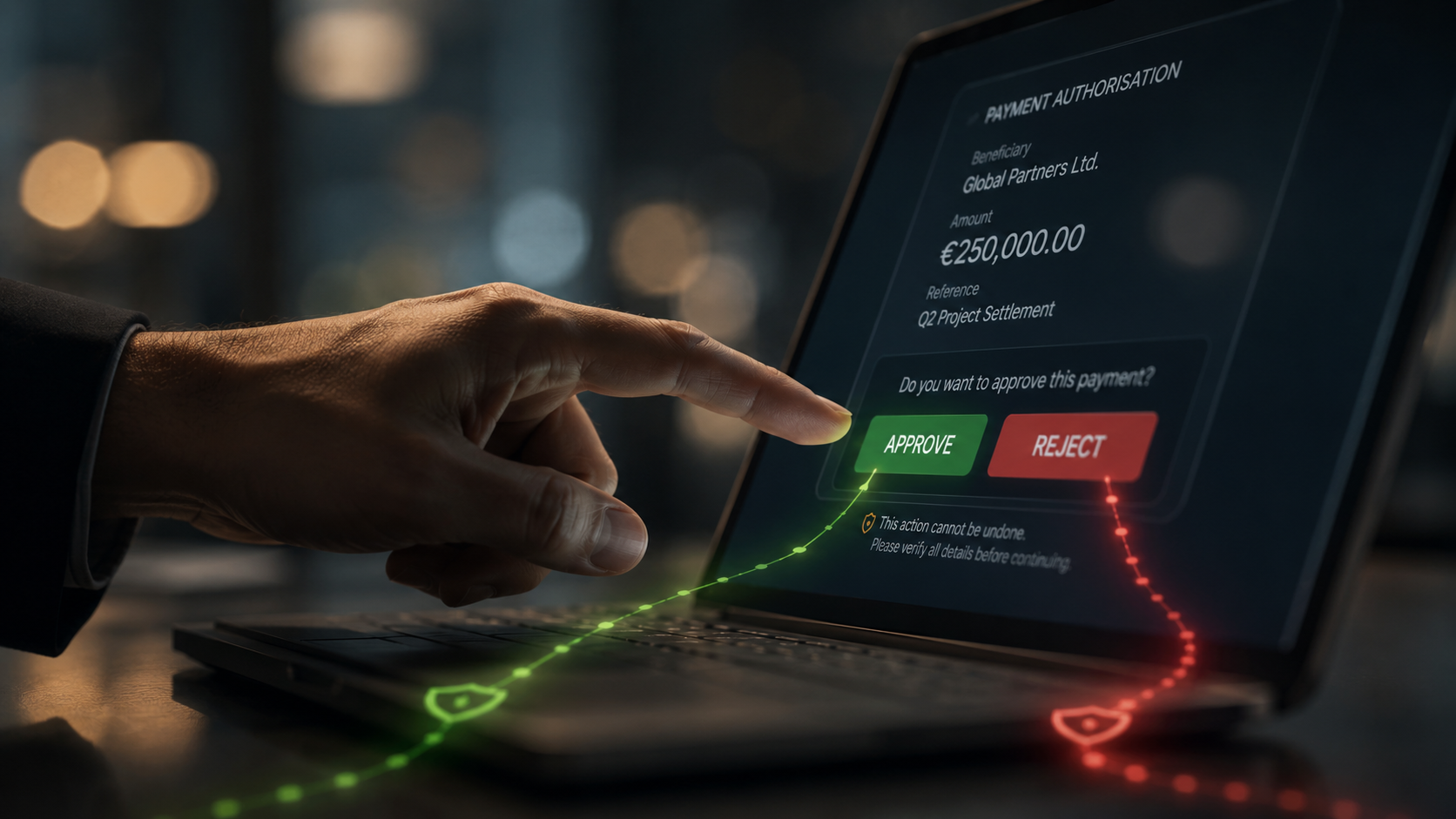
The objective is often no longer to break into a system. Instead, it is to persuade a legitimate user to make the wrong decision.
That distinction matters.
An employee who voluntarily authorises a fraudulent payment, shares confidential information during what appears to be a legitimate video call, or follows instructions from an AI-generated impersonation of a senior executive may bypass every traditional security control. The infrastructure remains secure. The human decision does not.
As organisations increasingly deploy AI agents to analyse information, recommend actions and automate routine processes, another challenge emerges. How do you know the AI itself is making trustworthy decisions?
The quality of an AI system depends on the data it receives and the models that interpret it. Manipulated training data, poisoned information sources or compromised inputs can influence recommendations long before anyone notices something is wrong. Protecting AI therefore means protecting the trustworthiness of the entire decision-making chain.
For technology leaders, this requires a broader view of cybersecurity. Strong authentication, encryption and endpoint protection remain critical, but they must be complemented by governance of AI models, validation of data sources, continuous monitoring of automated systems and ongoing investment in user awareness.
In other words, cybersecurity is becoming as much about confidence as control.
This convergence of AI, enterprise communications, AV and cybersecurity is creating entirely new conversations across the technology industry. As intelligent collaboration tools become central to how organisations operate, security can no longer be considered a specialist discipline sitting alongside communications technology. It is becoming an integral part of the user experience itself.
These are exactly the kinds of cross-disciplinary challenges being explored at ISE, where cybersecurity, AI, networking, enterprise communications and professional AV are increasingly viewed as interconnected parts of the same technology ecosystem rather than separate disciplines.
The organisations that adapt fastest will not simply build stronger digital defences. They will build systems that people – and increasingly AI – can trust to make the right decisions.
Stay ahead – Stay informed.
As an AV specialist or industry leader, you recognise how crucial it is to keep up with evolving trends, new technologies, and notable happenings within the audiovisual world. That's why we're delighted to invite you to receive exclusive email updates about ISE – the world-renowned annual tech show for the systems integration and audiovisual industry.
When you subscribe, you'll be kept up to speed with insightful commentary on the freshest developments in AV, get early looks at what's planned for the ISE content schedule – including headline speakers – and benefit from in-depth reporting on the show's standout attractions.
Sign up now to stay at the forefront of audiovisual innovation and expertise.
Further reading
Discover cybersecurity and other emerging technologies at ISE
Related Content
-
) Edge computing is the processing of data close to where it is created and used, rather than sending it to a distant data centre or cloud platform.
Edge computing is the processing of data close to where it is created and used, rather than sending it to a distant data centre or cloud platform. -
) Uptime, interoperability and cost still matter. But they no longer define whether a collaboration strategy succeeds.
Uptime, interoperability and cost still matter. But they no longer define whether a collaboration strategy succeeds. -
) These days, the value of office space is determined less by how much of it you have, and more by how effectively people use it.
These days, the value of office space is determined less by how much of it you have, and more by how effectively people use it. -
) The organisations creating the best employee experiences are not overwhelming people with technology. They are removing friction.
The organisations creating the best employee experiences are not overwhelming people with technology. They are removing friction. -
) The companies making the strongest case for returning to the office are not simply telling people to come back. They are giving them a reason to want to be there.
The companies making the strongest case for returning to the office are not simply telling people to come back. They are giving them a reason to want to be there.
Featured Articles
-
) Spanning all eight halls at Fira de Barcelona Gran Via, ISE 2026 delivered four days of record-breaking energy, creativity, and innovation.
Spanning all eight halls at Fira de Barcelona Gran Via, ISE 2026 delivered four days of record-breaking energy, creativity, and innovation. -
) The initiative will create new opportunities for talent development, innovation and community projects across the sector
The initiative will create new opportunities for talent development, innovation and community projects across the sector -
) The Facts & Figures report for ISE 2026 is available to download.
The Facts & Figures report for ISE 2026 is available to download. -
) Bringing together startups, investors and industry leaders, the expanded show feature offers a strong platform for visibility, networking, and commercial opportunity.
Bringing together startups, investors and industry leaders, the expanded show feature offers a strong platform for visibility, networking, and commercial opportunity. -
) This new type of event brings together end users, creators and production specialists from broadcast, live events, advertising and gaming, combining creative showcases, editorial programming and netwo ...
This new type of event brings together end users, creators and production specialists from broadcast, live events, advertising and gaming, combining creative showcases, editorial programming and netwo ...
)
)

)
)
)
)
)
)
)
)
)
)
)
)
)
)
)
)
)
)
)
)
)
)
)
)
)
)
)
)
)
)
)
)
)
)
)
)
)

)
)
)
)
)
)
)
)
)
)
)
)
)
)
)
)
)