

The future of digital signage depends on ecosystems, not platforms
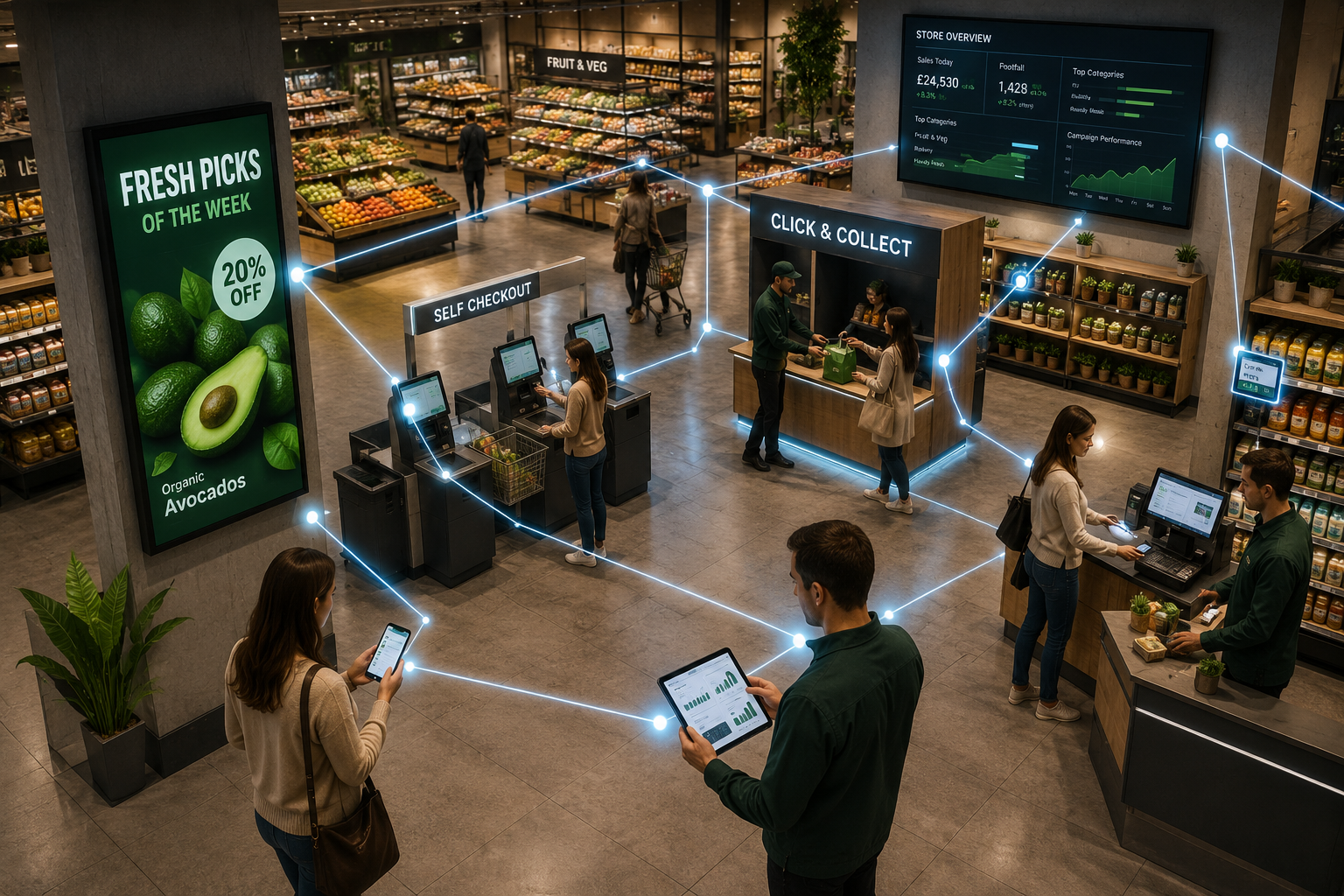
For years, success in digital signage was often measured by the capabilities of an individual platform. Buyers compared content management systems, evaluated hardware specifications and selected vendors that promised the broadest feature set. The conversation revolved around products.
Today, it is increasingly about ecosystems.
As digital signage becomes more deeply embedded within retail, corporate workplaces, transport hubs, hospitality and public spaces, no single platform can operate in isolation. Modern deployments increasingly rely on data flowing between multiple applications, cloud services and operational systems. The organisations seeing the greatest returns are often those that connect technologies effectively, rather than those that simply deploy the most capable individual products.
This shift reflects a much broader change across professional AV. As software becomes more important, interoperability becomes more valuable.
A modern digital signage network rarely consists of displays, media players and a content management system alone. It may also integrate scheduling platforms, audience analytics, retail systems, building management software, advertising technology, AI-powered content tools, security platforms and business intelligence dashboards. In many organisations, signage has become one visible layer within a much larger digital ecosystem.
That complexity creates new expectations.
Retailers increasingly want digital signage to communicate with inventory systems, loyalty programmes and point-of-sale platforms. Corporate environments expect displays to integrate with room booking software, workplace management systems and unified communications platforms. Airports, hospitals and universities often require signage to pull live operational data from multiple sources simultaneously.
The question is no longer whether a platform offers every possible feature. It is whether it can connect efficiently with everything else.
This represents an important change in how digital signage projects are designed. Historically, organisations often sought a single vendor capable of delivering an end-to-end solution. While integrated platforms remain attractive, customers are increasingly recognising that technology stacks inevitably evolve. New software is adopted. Existing systems are upgraded. Business priorities change.
In that environment, openness becomes a strategic advantage.
Vendors that provide robust APIs, support industry standards and integrate readily with third-party platforms allow customers to adapt without replacing entire infrastructures. Rather than creating isolated technology islands, they enable organisations to build flexible environments that can evolve over time.
The same trend is visible across the wider AV industry. Audio, collaboration, control, networking and analytics are all becoming more software-driven, making interoperability an increasingly important purchasing consideration. For many organisations, technology investments are now judged not only by their own capabilities, but also by how effectively they fit into a broader operational landscape.
Artificial intelligence is accelerating this transition still further.
Many of the emerging AI applications in digital signage rely on data from multiple systems. Audience measurement, content optimisation, predictive maintenance and workflow automation all become significantly more valuable when platforms can exchange information freely. Closed ecosystems risk limiting the effectiveness of these technologies before they have the opportunity to deliver meaningful business value.
The commercial landscape is evolving as well.
As retail media grows, digital signage increasingly intersects with advertising technology, campaign management, audience measurement and programmatic buying. That introduces new participants into the ecosystem, from media agencies and data providers to demand-side and supply-side platforms. Supporting those relationships requires integration at every stage of the workflow.
This changing landscape was one of the themes explored during a discussion at the Digital Signage Summit at ISE 2026, where Broadsign outlined how its own strategy is increasingly focused on interoperability and partnerships across the wider technology ecosystem. Rather than viewing every content management platform as a competitor, the company described a future in which integration between complementary technologies creates greater value for customers.
VIDEO – Digital Signage Summit ISE interview: Mats Klevjer of Broadsign talks to Florian Rotberg of invidis about interoperability, retail media and the growing importance of open technology ecosystems.
That reflects a broader direction of travel across professional AV.
As organisations continue to digitise their operations, technology decisions are becoming less about selecting a single platform and more about building resilient ecosystems that can evolve alongside changing business needs.
The future of digital signage will not belong to the platform with the longest feature list.
It will belong to the technologies that work best together.
 Stay ahead – Stay informed.
As an AV specialist or industry leader, you recognise how crucial it is to keep up with evolving trends, new technologies, and notable happenings within the audiovisual world. That's why we're delighted to invite you to receive exclusive email updates about ISE – the world-renowned annual tech show for the systems integration and audiovisual industry.
When you subscribe, you'll be kept up to speed with insightful commentary on the freshest developments in AV, get early looks at what's planned for the ISE content schedule – including headline speakers – and benefit from in-depth reporting on the show's standout attractions.
Sign up now to stay at the forefront of audiovisual innovation and expertise.
Further reading
Related Content
-
) Smart stores are using data from sensors, cameras, point-of-sale systems, digital signage and other technologies to make physical shopping more responsive to customer behaviour.
Smart stores are using data from sensors, cameras, point-of-sale systems, digital signage and other technologies to make physical shopping more responsive to customer behaviour. -
) Why continuous improvement is replacing one-off store design.
Why continuous improvement is replacing one-off store design. -
) The most successful interactive experiences are no longer defined by the technology customers use. They are defined by how actively customers participate.
The most successful interactive experiences are no longer defined by the technology customers use. They are defined by how actively customers participate. -
) Consumers can buy almost anything online. But they can't download atmosphere, personal attention or a sense of belonging. That's changing how luxury brands think about physical spaces.
Consumers can buy almost anything online. But they can't download atmosphere, personal attention or a sense of belonging. That's changing how luxury brands think about physical spaces. -
) Success in marketing communications used to be measured by reach. Today, responsiveness matters just as much.
Success in marketing communications used to be measured by reach. Today, responsiveness matters just as much.
Featured Articles
-
) Spanning all eight halls at Fira de Barcelona Gran Via, ISE 2026 delivered four days of record-breaking energy, creativity, and innovation.
Spanning all eight halls at Fira de Barcelona Gran Via, ISE 2026 delivered four days of record-breaking energy, creativity, and innovation. -
) The initiative will create new opportunities for talent development, innovation and community projects across the sector
The initiative will create new opportunities for talent development, innovation and community projects across the sector -
) The Facts & Figures report for ISE 2026 is available to download.
The Facts & Figures report for ISE 2026 is available to download. -
) Bringing together startups, investors and industry leaders, the expanded show feature offers a strong platform for visibility, networking, and commercial opportunity.
Bringing together startups, investors and industry leaders, the expanded show feature offers a strong platform for visibility, networking, and commercial opportunity. -
) This new type of event brings together end users, creators and production specialists from broadcast, live events, advertising and gaming, combining creative showcases, editorial programming and netwo ...
This new type of event brings together end users, creators and production specialists from broadcast, live events, advertising and gaming, combining creative showcases, editorial programming and netwo ...
)
)

)
)
)
)
)
)
)
)
![rAVe [PUBS]](https://cdn.asp.events/CLIENT_Integrat_169E7B04_E6F3_39F6_8BE4DB27C54F731E/sites/ise-2027/media/libraries/partners/rAVe-PUBS-Google-Logo.png/fit-in/500x500/filters:no_upscale())
)
)
)
)
)
)
)
)
)
)
)
)
)
)
)
)
)
)
)
)
)
)
)
)
)
)
![[inst]ALLICHT](https://cdn.asp.events/CLIENT_Integrat_169E7B04_E6F3_39F6_8BE4DB27C54F731E/sites/ise-2027/media/libraries/partners/Inst_Allicht_Logo.png/fit-in/500x500/filters:no_upscale())
)
)
)
)
)
)
)
)
)
)
)
)
)
)
)
)
)
)
)