

FIFA World Cup 2026: The broadcast technology blueprint for the future
UPDATE - 28 August 2026: This article was published during the opening week of FIFA World Cup 2026. Since then, FIFA and HBS have released further details showing how the production operated across the completed tournament. We have updated selected figures and links below while retaining the article's original analysis.
FIFA World Cup 2026 takes that evolution significantly further. Its legacy may extend beyond the football itself, demonstrating how distributed, software-defined production with highly centralised operations can work at unprecedented scale.
With 48 teams, 104 matches and 16 host cities spread across the United States, Canada and Mexico, the tournament represents the largest and most complex production challenge FIFA has ever faced.
To meet that challenge, FIFA and Host Broadcast Services (HBS) have created an infrastructure combining software-defined processing, private cloud architecture, SMPTE ST 2110 networking, JPEG XS contribution workflows, remote operations and centralised production.
Production moves away from the stadium
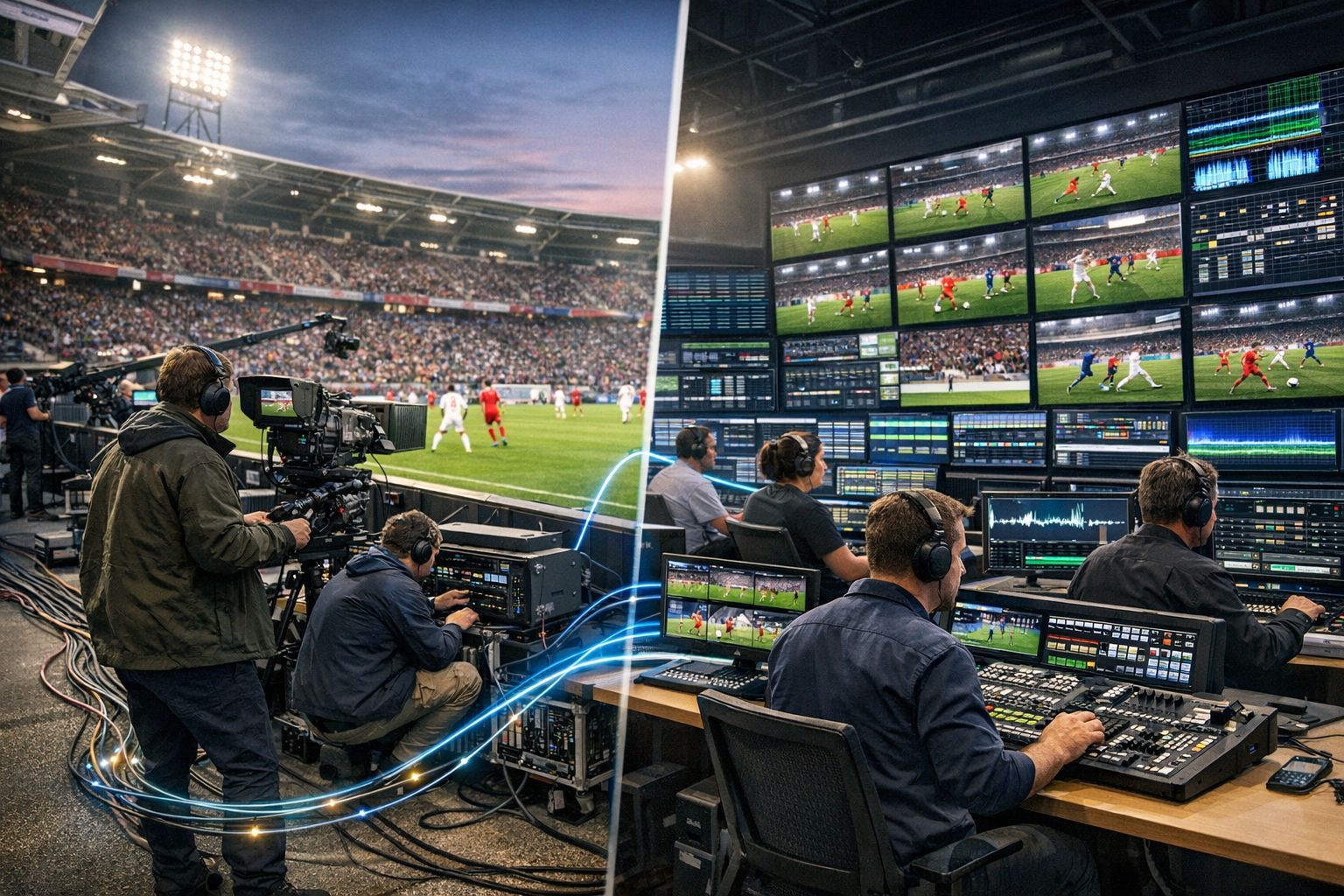
The centre of operations is FIFA's 45,000 sq m International Broadcast Centre (IBC) in Dallas. Historically, major sports events required large production teams to be deployed at every venue. In 2026, that model changed significantly.
While producers, directors and core match-production teams remained on site, many specialist functions were centralised in Dallas.
Replay operations, graphics control, audio mixing and camera shading were all performed remotely from the IBC. Dedicated galleries supported graphics, replay, audio and shading workflows, while centralised replay teams served different production groups.
The benefits extend beyond logistics. Centralisation allows specialist skills and resources to be shared across matches while helping HBS maintain consistent production standards across the tournament.
For broadcasters facing skills shortages and growing production demands, the implications are significant. Instead of asking how many specialists can be deployed at every location, production teams can increasingly consider which functions genuinely need to be at the venue.
Software replaces dedicated hardware
At the heart of the project lies an ambitious software-defined broadcast deployment.
Rather than relying on large amounts of dedicated hardware, HBS virtualised many critical broadcast functions and deployed them on approximately 60 high-performance commercial off-the-shelf servers, operating as a private cloud environment.
Functions delivered through software include:
-
Multiviewers
-
Video encoders and decoders
-
Compression and decompression
-
HDR-to-SDR conversion
-
Format conversion
-
Waveform monitoring
-
Signal processing and monitoring
The approach was largely driven by scale. During the group stages, up to six matches could be played on a single day. Supporting that level of parallel production using traditional hardware-based architectures would have required a substantial increase in equipment and engineering resources.
Instead, software-defined infrastructure allows resources to be allocated according to demand, improving utilisation and making it easier to scale the operation. FIFA's IBC Central Equipment Room demonstrates the impact: the move towards IP and software-based processing reduced its physical footprint by up to 20% compared with previous World Cups.
The tournament therefore provides a powerful example of software-defined broadcasting moving from theory to operational reality.
IP connects a production spread across a continent
The production architecture is built around a converged SMPTE ST 2110 environment spanning the venues, Dallas IBC and non-live production operation in London.
Connecting venues across three countries requires both substantial bandwidth and resilience. Each stadium is linked to Dallas through high-capacity contribution networks, with separate 100Gbps paths and redundant routing designed to support mission-critical live production.
Signal transport is then managed according to operational requirements. The Extended Stadium Feed (ESF), which serves as the primary programme feed, is transported uncompressed in UHD to preserve image quality.
Additional camera feeds use JPEG XS compression, reducing the bandwidth required while maintaining the image quality needed for broadcast production.
This IP-centric architecture enables operators in Dallas to perform specialist production functions on signals originating thousands of kilometres away.
HDR production goes remote
One of the more technically demanding workflows involves HDR production and quality control.
Venue cameras operate in HDR, but camera shading is performed remotely from Dallas using SDR monitoring environments. Dedicated HDR quality-control teams oversee the process, helping shaders maintain consistent image quality across different matches and venue conditions.
The workflow allows the production to maintain both SDR and HDR outputs while demonstrating how remote production has moved far beyond basic signal transport. Creative and technically specialised roles can now be separated from the physical location of the cameras themselves.
Audio follows the same model
Audio production has undergone a similar transformation.
Microphone feeds from the stadiums are transported back to Dallas, where teams create immersive, 5.1 surround and stereo programme outputs. Backup mixing capabilities remain at the venues, but the primary audio operation is centralised.
As with replay, graphics and camera shading, the model allows specialist resources to be concentrated at the IBC rather than duplicated at every stadium.
Capturing far more than the match
The scale of content acquisition remains enormous.
HBS developed a standard production plan using around 45 cameras for each match, with the number increasing during the knockout stages. The production also incorporates aerial and specialist camera systems to provide additional perspectives.
But today's World Cup content operation extends far beyond the live match.
Dedicated crews capture material around the tournament, including training sessions, fan experiences, team arrivals and behind-the-scenes content. Much of this material is handled by HBS's non-live production hub at Here East in London.
Around 400 people worked at the London facility across 126 edit suites, creating everything from broadcast highlights and longer-form packages to short-form social content.
The decision to locate that operation thousands of kilometres from the tournament is significant. HBS Director of Digital Johannes Franken explained that one of the key considerations was access to the right production talent. Instead of moving hundreds of people to North America, HBS moved part of the production infrastructure to where those skills were already available.
It is another example of the changing relationship between production and location.
What does this mean for the wider AV industry?
Few organisations will ever need to operate at the scale of a FIFA World Cup. But many of the principles behind the production have applications far beyond global sporting events.
Software-defined infrastructure can make resources more flexible. IP networks can connect production environments across different locations. Remote workflows can give organisations access to specialist skills without requiring everyone to be physically present. And centralised infrastructure can help maintain consistent standards across multiple venues or facilities.
These approaches are relevant not only to broadcasters, but also to live events, enterprise media and other organisations creating professional content across distributed environments.
They are also part of a wider convergence between broadcast, AV and IT that is increasingly visible at Integrated Systems Europe.
FIFA World Cup 2026 is therefore doing more than demonstrating how football can be produced at enormous scale. It provides a real-world example of a production model that is software-driven, IP-connected and less constrained by physical location.
For the broadcast and AV communities, many of the technologies shaping the future are already in operation.
Stay ahead – Stay informed.
As an AV specialist or industry leader, you recognise how crucial it is to keep up with evolving trends, new technologies, and notable happenings within the audiovisual world. That's why we're delighted to invite you to receive exclusive email updates about ISE – the world-renowned tech show for the systems integration and audiovisual industry.
When you subscribe, you'll be kept up to speed with insightful commentary on the freshest developments in AV, get early looks at what's planned for the ISE content schedule – including headline speakers – and benefit from in-depth reporting on the show's standout attractions.
Sign up now to stay at the forefront of audiovisual innovation and expertise.
Further reading
Learn more about broadcast solutions at ISE.
Related articles
The world's biggest live broadcast is about to begin – Learn how FIFA World Cup 2026 is showcasing the future of broadcast production, remote workflows, content creation and live experience technology.
Is outside broadcast heading for reinvention? – Remote production technologies, cloud-based workflows, IP networking, and software-defined infrastructures are transforming how live content is produced.
Sustainability is becoming a broadcast business issue – Discover how sustainability, energy efficiency and cloud production are reshaping broadcast operations and technology investment decisions.
Related Content
-
) Modern stadiums are no longer simply sports venues. They are connected technology ecosystems.
Modern stadiums are no longer simply sports venues. They are connected technology ecosystems. -
) The critical importance of control rooms to organisations' operations makes them a prime target for cyber criminals.
The critical importance of control rooms to organisations' operations makes them a prime target for cyber criminals.
Featured Articles
-
) Spanning all eight halls at Fira de Barcelona Gran Via, ISE 2026 delivered four days of record-breaking energy, creativity, and innovation.
Spanning all eight halls at Fira de Barcelona Gran Via, ISE 2026 delivered four days of record-breaking energy, creativity, and innovation. -
) The initiative will create new opportunities for talent development, innovation and community projects across the sector
The initiative will create new opportunities for talent development, innovation and community projects across the sector -
) The Facts & Figures report for ISE 2026 is available to download.
The Facts & Figures report for ISE 2026 is available to download. -
) Bringing together startups, investors and industry leaders, the expanded show feature offers a strong platform for visibility, networking, and commercial opportunity.
Bringing together startups, investors and industry leaders, the expanded show feature offers a strong platform for visibility, networking, and commercial opportunity. -
) This new type of event brings together end users, creators and production specialists from broadcast, live events, advertising and gaming, combining creative showcases, editorial programming and netwo ...
This new type of event brings together end users, creators and production specialists from broadcast, live events, advertising and gaming, combining creative showcases, editorial programming and netwo ...
)
)

)
)
)
)
)
)
)
)
.png/fit-in/500x500/filters:no_upscale())
.png/fit-in/500x500/filters:no_upscale())
)
)
)
)
)
)
)
)
)
)
)
)
)
)
)
)
)

)
)
)
)
)
)

)
)
)
)
)
)
)
)
)
)
)
.png/fit-in/500x500/filters:no_upscale())
)
)
)
)
)
)
)
)
)