

Every event is a media property now
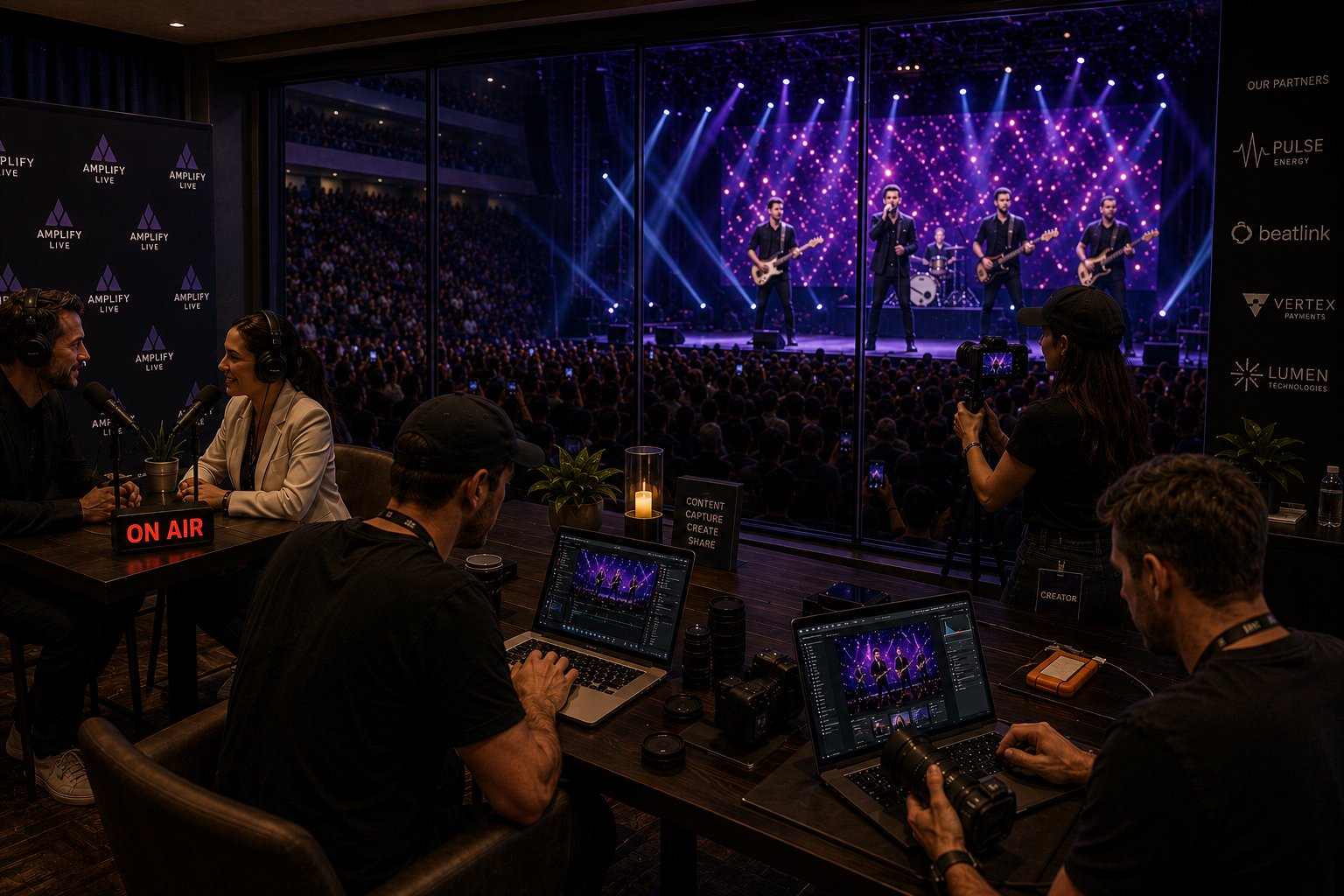
For years, live events generated revenue in familiar ways: tickets, sponsorship, hospitality and merchandise. Today, they also create another potentially valuable asset.
Content.
Updated 27 August 2026
Concerts, sports events, festivals, conferences and exhibitions can generate interviews, highlights, behind-the-scenes footage, social clips, livestreams and sponsor content. For organisers and rights holders, those assets can extend audience reach, sponsor exposure and, in some cases, revenue beyond the event itself.
Audience behaviour helps explain the opportunity. Live Nation's 2025 Living for Live study, based on 40,000 people across 15 countries, found that 94% of surveyed live-music fans post around shows. Some 86% rewatch their own videos, while 68% stream clips when they cannot attend.
UK festival audiences tell a similar story. Ticketmaster's State of Play Festivals 2025, based on research among 2,000 UK festival-goers, found that 33% consider documenting their experience part of the festival ritual.
The live experience may happen at a particular place and time. Its digital life does not have to.
From event production to content production
That creates a different challenge for event production teams.
If content is intended for multiple platforms, those requirements need to influence planning from the outset. Camera positions, graphics, audio, storage, rights management, editing and distribution may all need to support outputs beyond the screens inside the venue.
For sponsors, meanwhile, event content can create additional inventory beyond physical branding, extending exposure into broadcast, streaming and social channels. Nielsen's sponsorship measurement, for example, now puts a monetary value on sponsor exposure within televised sports content by combining brand exposure, audience data and media rates.
The result is a growing overlap between two industries that were once easier to separate: live events and broadcast.
That convergence was a recurring theme at ISE 2026. At the Broadcast AV Summit, Ross Video CEO David Ross discussed how live-event venues and other AV environments are adopting broadcast-level standards and building the people, processes and systems needed to deliver professional live content.
Capture once, publish many times
For production teams, the opportunity is not simply to record more footage. It is to think about what that footage can become.
A camera feed intended for an in-venue screen might also contribute to a livestream. The same production could generate highlights, vertical social clips, interviews, sponsor assets or material for future promotion. Different outputs have different technical and creative requirements, but planning for them together can make content capture more useful.
ISE's own Live Events Stage provided practical examples of this shift in 2026. In Behind the Screen, Jack Banks, Video Director for Mumford & Sons, explored the art of capturing live touring action in real time.
Another session, LEDing the Way, brought Banks together with Martin Kuhn of Ross Video, Tom Burford of Creative Technology and creative director Tupac Martir to examine the evolving role of video and cinematic techniques in live touring.
The message is significant for venues as well as touring productions. Content capture is no longer necessarily something that happens separately from the live show. The infrastructure used to create the audience experience can increasingly form part of a wider production workflow.
Technology is enabling the shift
The convergence is also visible in the technologies coming to market.
ISE exhibitor Ross Video used ISE 2026 to demonstrate technologies spanning live production, graphics and venue control for Broadcast AV and Sports & Entertainment. On the Live Events Stage, Ross Video's Mike Steinbrecher joined Patrick Verhey of LMG Systems to discuss how production technology is being used in ambitious immersive projects.
Panasonic Connect provides another example. Production company CPL deployed Panasonic's KAIROS IP-based live-production platform at the 2025 Camper Calling festival, following its first use at the event the previous year.
These technologies reflect a wider change in what an event production system may be asked to do. Delivering the show remains the priority, but the same infrastructure can increasingly support content for audiences who are watching somewhere else – or at another time.
The event doesn't have to end when the audience leaves
None of this means every event can turn video clips into a major new revenue stream. Nor does content automatically become valuable simply because it has been captured.
But the potential audience for an event is no longer limited to the people in the room, arena or festival field. Content can extend its reach, give sponsors additional opportunities and maintain engagement after the physical experience has ended.
That is why the convergence of live events, AV and media production matters. It was visible across the ISE 2026 Live Events Stage, the Broadcast AV Summit and the show floor, while the debut of Spark brought creators, brands, broadcasters, agencies and production specialists together to explore how content is now created across live, filmed and immersive experiences.
For event organisers and production teams, the question is therefore changing. It is no longer only how do we produce the event?
It is also: what can the event produce?
 Stay ahead – Stay informed.
As an AV specialist or industry leader, you recognise how crucial it is to keep up with evolving trends, new technologies, and notable happenings within the audiovisual world. That's why we're delighted to invite you to receive exclusive email updates about ISE – the world-renowned annual tech show for the systems integration and audiovisual industry.
When you subscribe, you'll be kept up to speed with insightful commentary on the freshest developments in AV, get early looks at what's planned for the ISE content schedule – including headline speakers – and benefit from in-depth reporting on the show's standout attractions.
Sign up now to stay at the forefront of audiovisual innovation and expertise.
Further reading
Find out more about live events, audio, lighting and staging at ISE
Related articles
- Venues are becoming live media factories — Discover how venues are building broadcast-style production capabilities to create and distribute content in real time.
- Is outside broadcast heading for reinvention? — Explore how remote production, IP and cloud workflows are changing the way live content is captured and delivered.
- Who owns the fan? — Find out why control of audience data is becoming increasingly important as live events expand across physical and digital channels.
Related Content
-
) Remote production technologies, cloud-based workflows, IP networking, and software-defined infrastructures mean that the future of OB may look vastly different from its past.
Remote production technologies, cloud-based workflows, IP networking, and software-defined infrastructures mean that the future of OB may look vastly different from its past. -
) The modern venue is no longer simply hosting live events. It is producing continuous digital content.
The modern venue is no longer simply hosting live events. It is producing continuous digital content. -
) Modern stadiums are no longer simply sports venues. They are connected technology ecosystems.
Modern stadiums are no longer simply sports venues. They are connected technology ecosystems. -
) While esports has become an established category within live events and live streaming, its growth story is still very much being written.
While esports has become an established category within live events and live streaming, its growth story is still very much being written. -
) As well as being a triumphant showcase of sporting excellence, the quadrennial event is also an international case study in the deployment of audiovisual (AV) technology.
As well as being a triumphant showcase of sporting excellence, the quadrennial event is also an international case study in the deployment of audiovisual (AV) technology.
Featured Articles
-
) Spanning all eight halls at Fira de Barcelona Gran Via, ISE 2026 delivered four days of record-breaking energy, creativity, and innovation.
Spanning all eight halls at Fira de Barcelona Gran Via, ISE 2026 delivered four days of record-breaking energy, creativity, and innovation. -
) The initiative will create new opportunities for talent development, innovation and community projects across the sector
The initiative will create new opportunities for talent development, innovation and community projects across the sector -
) The Facts & Figures report for ISE 2026 is available to download.
The Facts & Figures report for ISE 2026 is available to download. -
) Bringing together startups, investors and industry leaders, the expanded show feature offers a strong platform for visibility, networking, and commercial opportunity.
Bringing together startups, investors and industry leaders, the expanded show feature offers a strong platform for visibility, networking, and commercial opportunity. -
) This new type of event brings together end users, creators and production specialists from broadcast, live events, advertising and gaming, combining creative showcases, editorial programming and netwo ...
This new type of event brings together end users, creators and production specialists from broadcast, live events, advertising and gaming, combining creative showcases, editorial programming and netwo ...
)
)

)
)
)
)
)
)
)
.png/fit-in/500x500/filters:no_upscale())
)
)
)
)
)
)
)
)
)
)
)
)
)
)
)
)
![[inst]ALLICHT](https://cdn.asp.events/CLIENT_Integrat_169E7B04_E6F3_39F6_8BE4DB27C54F731E/sites/ise-2027/media/libraries/partners/Inst_Allicht_Logo.png/fit-in/500x500/filters:no_upscale())
)
)
)
)
)
)
)
)
)
)
)
)
)
)
)
)
)
)
)
)
)
)
)
)
)
)
)
)
)
)
)