Session: Drone advertising: from one-off spectacle to booked airtime
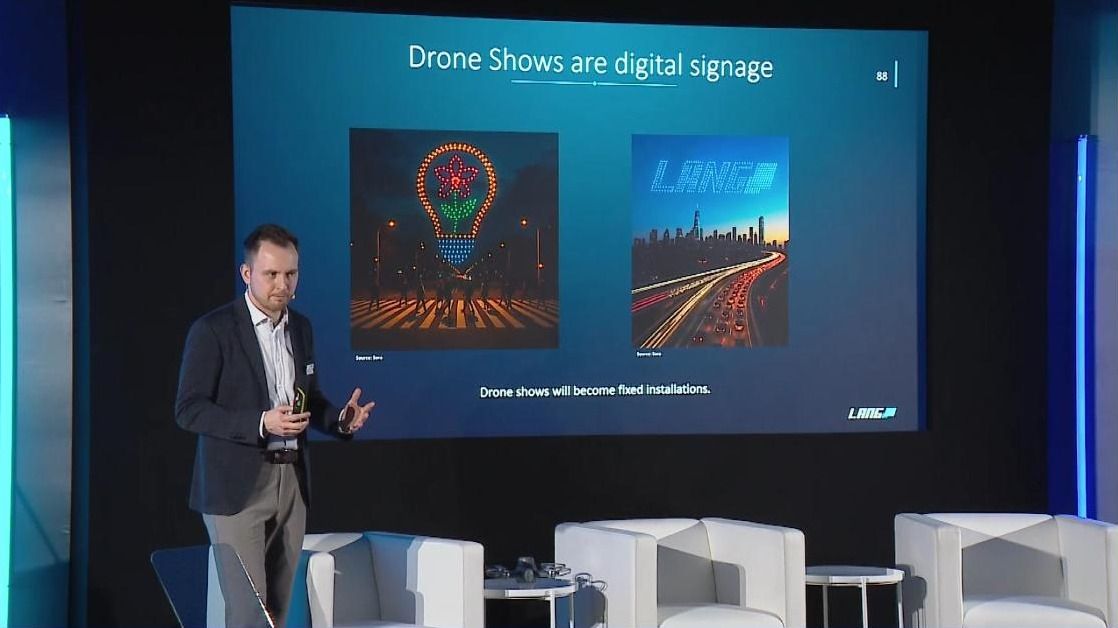
How drone shows work as advertising, what a brand can put in the sky, the value of the social media effect and why drones may become fixed installations.
- Event: ISE 2026
- From session: Drones as Digital Signage: A sustainable solution and the future of fixed installations
- Speaker: Mark Moosmayer, Director Sales, LANG AG
- Estimated read time: 9 minutes
- Watch the full session
Quick read summary
- Drone advertising is moving from one-off spectacle towards fixed sites where brands rent evening slots, says Mark Moosmayer of LANG AG.
- Shows have grown from 50 drones to 9,000 in about three and a half years, far faster than Moosmayer expected.
- A lit fleet is visible through 360 degrees, from 100 metres or two kilometres, and can carry a working QR code.
- Moosmayer judges sustainability on energy per attention created, not on raw power draw against an LED screen.
Nine thousand drones flew in a single show over Abu Dhabi, in footage that Mark Moosmayer, Director Sales at LANG AG, played to his audience at ISE 2026. About three and a half years before the session, his company had flown its first show with 50. His argument was that drone advertising has now outgrown the events calendar, and that the next step is a fixed installation selling airtime like a screen.
How fast have drone shows grown?
In three and a half years, drone shows have gone from LANG AG’s 50-drone debut to 9,000 drones at the top end. After that first show, in Lindlar, Germany, Moosmayer forecast shows of perhaps 400, 500 or even 600 drones within a few years. He was wrong by an order of magnitude. ISE has tracked the entertainment side of that growth in Drone shows continue to expand what’s possible and Drone shows reach new heights.
Drone advertising is a new pillar, not a rival to LED
Drone advertising adds to LED rather than competing with it, Moosmayer argued. He sees drone shows joining posters and LED walls in signage as "a new pillar in this vertical, not as a competition, more as in addition to the market".
What makes the sky work as a medium?
The sky works as a medium because a message there is visible from every direction, at almost any distance, and is hard to ignore. Moosmayer gave three reasons.
- Visibility: a fleet can be seen through 360 degrees, so even a flat image reads from all sides.
- Range: the message carries from 100 metres or two kilometres away.
- Novelty: the format is still new, so it earns a second look.
Walking around Cologne, his home city, he passes hundreds of analogue posters a day and perhaps 10 or 20 LED walls. By evening he would struggle to name the advertisers.
Nobody just passes by a drone show without recognizing the message.
Lego rotated its logo in the sky. The strongest example was Penny, the German supermarket chain, whose show flew beside the Rhine in central Cologne. The drones formed a QR code that people scanned from as far as a kilometre away, taking them straight to the Penny app download. That turns a spectacle into a response channel whose results can be counted.
How do drone shows work from concept to launch?
Drone shows work in four phases, and Moosmayer said the process is simpler than most people think: "it’s just drone science and it’s probably way easier than you think".
- Concept: decide what the show should say and who it is for.
- Show creation: drone show software calculates every image and movement in advance, so no pilots steer individual drones.
- Location: choose the site and obtain the permits to fly there.
- Execution: the pilot in charge starts the show with one button, and the fleet flies the sequence by itself.
What is a show worth once the drones land?
A show is worth far more than its live audience, because the social media effect keeps it working after the drones land. Quality and reach are high, but Moosmayer said the third factor is the one not to underestimate. "No matter if it’s a small show or a big one, there is a huge social media effect."
His case study was a Netflix show promoting a new series of One Piece. Hundreds of videos followed on social media. Moosmayer took only the most watched clip on each of three platforms.
| Platform | Views of the most watched clip |
|---|---|
| YouTube | about 240,000 |
| TikTok | 1.3 million |
| 170,000 |
Applying what he called a conservative multiplier, he put the earned media value of those three videos alone at over 30,000 euros. He did not name the multiplier.
Which barriers are falling, and how fast?
Space and setup time have been the two main barriers, and a new generation of drones is cutting each by half or more. Older drones were placed by hand and had their batteries fitted one by one. The new ones have fixed batteries and take off from and land in their own charging cases, six to a box.
| For a 600-drone show | Older drones | Self-charging drones |
|---|---|---|
| Launch area | about 500 square metres | about 150 square metres |
| Assistants on the crew | about eight | four |
| Setup time | the old norm | about half |
A full recharge takes about 45 minutes, or about an hour when it is freezing.
Could a city run a permanent drone site?
A city could run a permanent drone site if the fleet has a home and a schedule. Moosmayer sketched a site next to a city centre, with drone storage and a roof that opens. Each evening, at 6pm for example, the fleet would fly and land fully automatically, and the operator would rent slots to brands as a media owner does on a screen.
The obvious objection is flight time: an LED screen can run all day, and a single show cannot. His answer was Le Mans, where every car needs a team of drivers. Split 600 drones into three groups of 200, rotate them as each lands and recharges, and a site could fly all evening, or around the clock.
Should drones be judged on power or on attention?
Drones should be judged on the attention their energy buys, Moosmayer argued, not on power draw alone. By his figures, a standard LED screen uses about 1.5 kilowatts and a 200-drone show about 10 kilowatts. The better question is how many LED screens it would take to create the same attention as one large show in a city centre. His estimate was more than six.
It is about energy per attention created.
It is an estimate, not a measured study, but buyers can test it with their own audience data. The same tension runs through Iconic DOOH, advertising or attraction?
Five steps before booking a first show
Moosmayer’s examples suggest what to settle first.
- Name one goal: recall, a scan or social reach.
- Build in a measurable action, such as the QR code Penny used to drive app downloads.
- Secure the site and start the permit process before the creative is final.
- Plan for the audience online by agreeing how posted videos will be tracked and valued.
- Compare the show with screens on attention per unit of energy, not watts alone.
FAQ
- How does drone advertising differ from an LED screen? Drone advertising places a lit image in the sky, visible through 360 degrees and from up to two kilometres away. An LED screen can run around the clock. Mark Moosmayer of LANG AG sees drones as an addition to screens rather than a replacement.
- Which kit does a drone light show need? A drone light show needs a flat surface to lay out the drones, a few antennas to improve GPS precision and a ground control station. LANG AG’s Mark Moosmayer described the station as a couple of PCs running drone show software.
- Why do brands value the social media effect of a drone display? Brands value it because the videos people post keep reaching new viewers after the show ends. Mark Moosmayer of LANG AG estimated the earned media value of three clips from a Netflix One Piece show at over 30,000 euros.
- Is a drone display more energy-hungry than an LED screen? A 200-drone display uses about 10 kilowatts against about 1.5 for a standard LED screen, by Mark Moosmayer’s figures. He argues the fair measure is energy per attention created, which he believes favours a large show in a city centre.
The metric that could decide drone signage
The most useful idea in Moosmayer’s session was not the 9,000-drone fleet. It was his refusal to accept the obvious comparison. Put a 200-drone show beside one LED screen and the drones lose, by roughly six to one on power. Put it beside the number of screens needed to stop a city centre crowd and, on his estimate, the sums change.
That reframing makes the fixed-site idea plausible. A media owner cannot sell airtime in the sky on novelty for long. It can sell attention, if the attention is measured, and the tools exist: QR scans that become app downloads, and posted videos whose views can be counted and valued. The hardware has caught up too, with smaller launch areas, halved crews and fleets that rotate like drivers at Le Mans.
What remains unproven is the business model: whether brands will book a slot over the same square every evening, as they book a screen. If Moosmayer’s argument holds, the operators who can prove energy per attention created will set the price of that slot.
About the speaker
Mark Moosmayer
Director Sales, LANG AG
Moosmayer leads sales at LANG AG, which has produced drone shows for about three and a half years, supporting clients from concept and show design to permits and execution.
More on new advertising formats at ISE
Drone advertising sits where signage and emerging tech overlap.
- Signage and DooH on the ISE show floor: DooH and signage technology at the show.
- Digital Signage Summit sessions: talks on the signage and DooH market.
- Emerging technologies at ISE: drones and other new tech for AV.
- The ISE content programme: the talks worth planning your days around.
- Coming to ISE for the first time? The first-time visitor guide covers the essentials.
Featured Articles
-
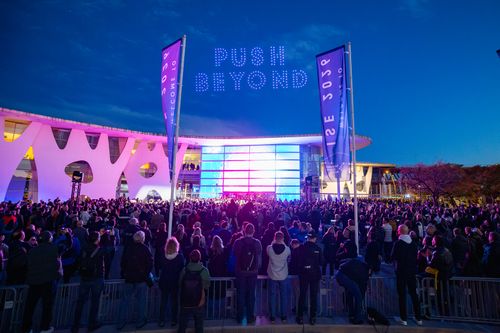 Spanning all eight halls at Fira de Barcelona Gran Via, ISE 2026 delivered four days of record-breaking energy, creativity, and innovation.
-
 The initiative will create new opportunities for talent development, innovation and community projects across the sector
-
 The Facts & Figures report for ISE 2026 is available to download.
-
 Bringing together startups, investors and industry leaders, the expanded show feature offers a strong platform for visibility, networking, and commercial opportunity.
-
 This new type of event brings together end users, creators and production specialists from broadcast, live events, advertising and gaming, combining creative showcases, editorial programming and netwo ...