

Your city's most important digital platform may not be a screen
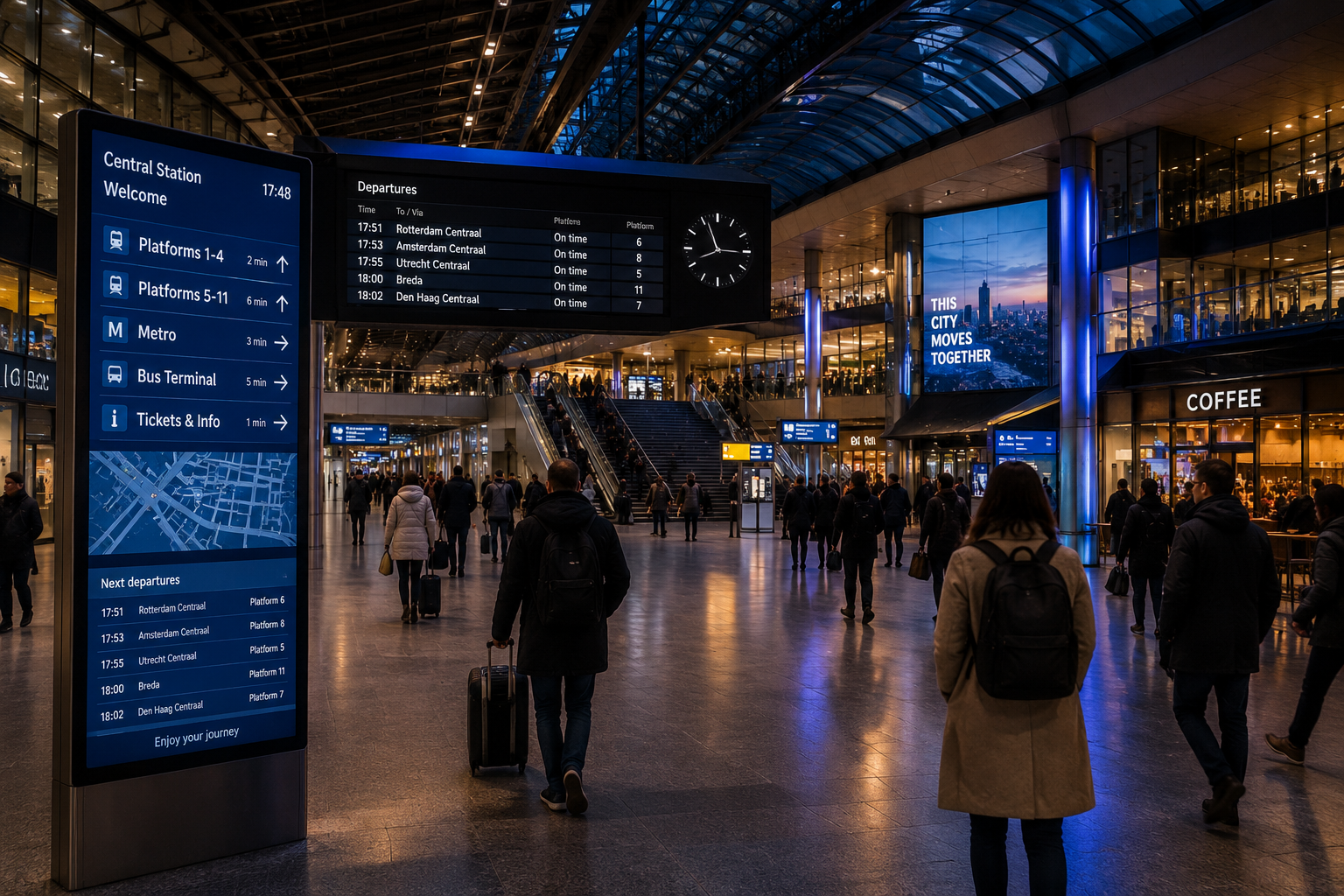
Public spaces are becoming digital environments.
Quietly, but rapidly.
Across cities, transport hubs, campuses, venues and mixed-use developments, expectations around public experience are changing dramatically.
People increasingly expect environments to be responsive, connected and intelligently managed.
They expect real-time information. Seamless navigation. Reliable connectivity. Personal safety. Dynamic communication.
And increasingly, they expect these experiences to feel intuitive rather than intrusive.
Many public environments were not designed for digital behaviour.
But they are now being asked to operate as connected ecosystems.
This is driving a profound convergence between AV technology, smart building infrastructure, data platforms and urban experience design.
At ISE 2026, exhibitors showcased integrated display ecosystems, AI-driven content management platforms and scalable smart signage solutions capable of supporting everything from transport communication to large-scale wayfinding.
Recent deployments involving ISE exhibitor Sharp have demonstrated how AI-assisted signage ecosystems and energy-efficient display technologies are being used to modernise communication infrastructure across complex public environments.
Public communication is becoming more dynamic.
Transport operators increasingly need to deliver real-time updates across distributed environments.
Venues are expected to manage crowd flow intelligently.
Cities are exploring connected infrastructure capable of supporting sustainability targets, emergency communication and citizen engagement.
The pressure is not purely technological. It is economic.
Public environments increasingly compete for attention, tourism, investment and engagement. Cities compete with other cities. Venues compete with other entertainment ecosystems. Transport hubs increasingly function as branded experience environments.
This means digital infrastructure is becoming part of place identity.
A poorly connected environment now creates reputational risk.
People notice friction immediately: Confusing navigation. Outdated information systems. Weak connectivity. Fragmented communication.
These failures shape perceptions of competence and safety.
At the same time, operators face difficult balancing acts around privacy, sustainability and operational resilience.
Connected public spaces generate vast amounts of data. Managing that responsibly is becoming as important as deploying the technology itself.
The most successful environments are likely to be those that integrate intelligence subtly.
Technology should support movement, communication and accessibility without overwhelming people.
And increasingly, those conversations are converging at ISE.
The technologies shaping the future of connected public environments no longer belong to a single industry.
They sit at the intersection of urban design, entertainment, mobility, communication and experience strategy.
Stay ahead – Stay informed.
As an AV specialist or industry leader, you recognise how crucial it is to keep up with evolving trends, new technologies, and notable happenings within the audiovisual world. That's why we're delighted to invite you to receive exclusive email updates about ISE – the world-renowned tech show for the systems integration and audiovisual industry.
When you subscribe, you'll be kept up to speed with insightful commentary on the freshest developments in AV, get early looks at what's planned for the ISE content schedule – including headline speakers – and benefit from in-depth reporting on the show's standout attractions.
Sign up now to stay at the forefront of audiovisual innovation and expertise.
Related Content
-
) The largest and greatest of all outdoor screens are prestigious assets for cities. They bring buildings to life and display campaigns that transcend the label of mere 'advertising'.
The largest and greatest of all outdoor screens are prestigious assets for cities. They bring buildings to life and display campaigns that transcend the label of mere 'advertising'. -
) The digital signage market never stands still. Platforms, sustainability, instore retail media and market consolidation are four areas where rapid change is taking place.
The digital signage market never stands still. Platforms, sustainability, instore retail media and market consolidation are four areas where rapid change is taking place.
Featured Articles
-
) Spanning all eight halls at Fira de Barcelona Gran Via, ISE 2026 delivered four days of record-breaking energy, creativity, and innovation.
Spanning all eight halls at Fira de Barcelona Gran Via, ISE 2026 delivered four days of record-breaking energy, creativity, and innovation. -
) The initiative will create new opportunities for talent development, innovation and community projects across the sector
The initiative will create new opportunities for talent development, innovation and community projects across the sector -
) The Facts & Figures report for ISE 2026 is available to download.
The Facts & Figures report for ISE 2026 is available to download. -
) Bringing together startups, investors and industry leaders, the expanded show feature offers a strong platform for visibility, networking, and commercial opportunity.
Bringing together startups, investors and industry leaders, the expanded show feature offers a strong platform for visibility, networking, and commercial opportunity. -
) This new type of event brings together end users, creators and production specialists from broadcast, live events, advertising and gaming, combining creative showcases, editorial programming and netwo ...
This new type of event brings together end users, creators and production specialists from broadcast, live events, advertising and gaming, combining creative showcases, editorial programming and netwo ...
)
)

)
)
)
)
)
)
)
)
)
)
)
)
![rAVe [PUBS]](https://cdn.asp.events/CLIENT_Integrat_169E7B04_E6F3_39F6_8BE4DB27C54F731E/sites/ise-2027/media/libraries/partners/rAVe-PUBS-Google-Logo.png/fit-in/500x500/filters:no_upscale())
)
)
)
)
)
)
.png/fit-in/500x500/filters:no_upscale())
)
)
)
)
)
)
)
)
)
)
)
)
)
)
)
)
)
)
)
)
)
)
)
)
)
)
)
)
)
)
)
)
)
)