

Beyond screens: when AV meets hospitality robotics
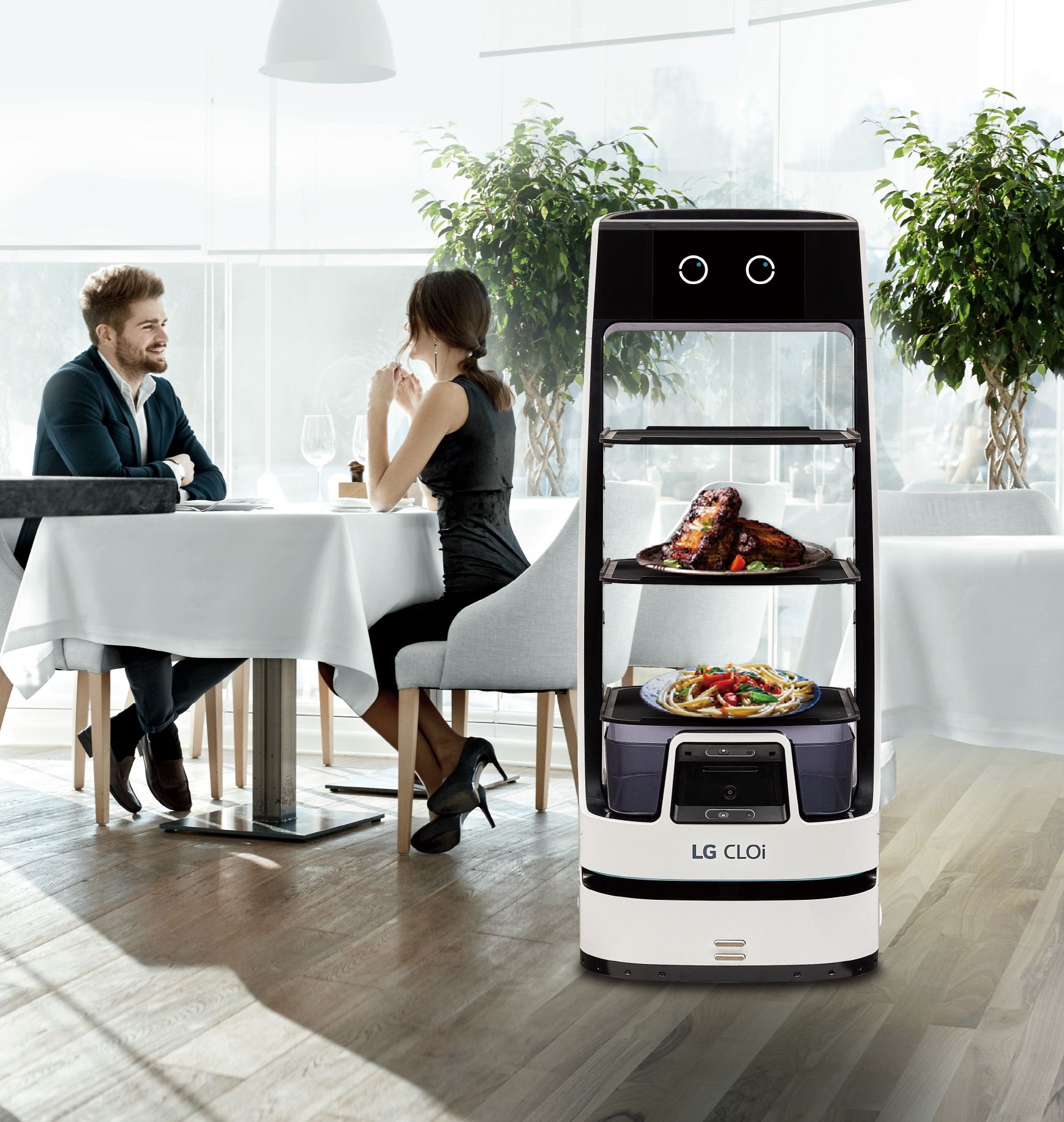
Nowhere is this shift clearer than in the rapid evolution of delivery and operational robots. Multi-compartment autonomous delivery platforms, capable of navigating properties, communicating with elevators and operating independently across multiple floors, are moving deeper into hotel infrastructure. A leading example is LG's CLOi Door-type ServeBot, developed with the Marriott Design Lab. Its four secure compartments, AI-driven navigation and integration with Otis OID-enabled elevators enable autonomous travel without staff escort, reducing wait times and freeing teams to focus on higher-value interaction. Camera sensors confirm successful delivery; fleet coordination supports up to twenty units operating simultaneously; and six-wheel independent suspension ensures stable movement on uneven flooring.
The category is advancing rapidly through cloud-coordinated robotics ecosystems that unify delivery, logistics and guest-facing services under a shared software layer. This direction is reinforced by LG's acquisition of Bear Robotics, whose strengths in fleet management, cloud control and software orchestration now underpin LG's expanding commercial robotics portfolio and accelerate its shift toward scalable, platform-based hotel automation.
Cleaning automation is also evolving through autonomous corridor and meeting-room vacuuming systems capable of navigating long, complex pathways while protecting interior finishes. This includes technologies found in LG's CLOi Vacuum Robot, also developed with the Marriott Design Lab, which travels precisely along skirting boards without marking walls. After extensive pilots across Westin, Marriott and Sheraton properties, its rollout signals the move from experimental deployments to essential hotel infrastructure.
Beyond LG, a wave of specialised providers is broadening the landscape. Advanced LiDAR-based navigation, enabling precise mapping, obstacle detection and autonomous lift integration, continues to mature across the sector – a capability widely adopted in platforms from Pudu Robotics for hotel and restaurant delivery.
Multi-modal indoor perception, combining LiDAR (where laser pulses are used to map surroundings), cameras and environmental sensors for more informed navigation, is becoming increasingly common – notably advanced by UBTECH Robotics, whose expressive interfaces support more guest-friendly interaction.
Durable, long-runtime service platforms, engineered for high-traffic environments requiring predictable all-day performance, are emerging from providers such as Segway Robotics, drawing on micromobility engineering.
And quiet, design-led modular delivery systems suited to boutique hotels and serviced residences are also gaining traction. These solutions prioritise aesthetics, minimal noise and compact footprints for more intimate, design-conscious environments. YIU Robots is a leading example, focusing on elegant form factors, low-noise operation and seamless integration with elevators and building-management platforms to ensure discreet, predictable movement through guest spaces.
Together, these developments point to a sector shifting from manual, labour-intensive processes to orchestrated environments where robotics, AV systems and intelligent controls operate as a unified layer. The conversation is moving beyond “what robots can do” to “how hotels will be redesigned around them” – from back-of-house workflows to guest-facing experiences, and from automated logistics to dynamic, sensor-rich smart spaces. As these technologies converge, hotel stakeholders are rethinking operational and architectural models around autonomous, interoperable systems.
Hospitality is now entering a phase where robotics delivers consistent, measurable value, becoming the connective tissue of next-generation properties – efficient, predictable, scalable and increasingly central to how modern hotels deliver comfort, convenience and memorable experiences.
Stay informed!
ISE 2026 takes place in Barcelona on 3-6 February 2026. For more updates on robotics and other industry megatrends, and to discover more about ISE 2026 as details are released, sign up for updates.
Don't miss out – join our community today and keep up to speed with all the latest industry trends.
Featured Articles
-
) Spanning all eight halls at Fira de Barcelona Gran Via, ISE 2026 delivered four days of record-breaking energy, creativity, and innovation.
Spanning all eight halls at Fira de Barcelona Gran Via, ISE 2026 delivered four days of record-breaking energy, creativity, and innovation. -
) The initiative will create new opportunities for talent development, innovation and community projects across the sector
The initiative will create new opportunities for talent development, innovation and community projects across the sector -
) The Facts & Figures report for ISE 2026 is available to download.
The Facts & Figures report for ISE 2026 is available to download. -
) Bringing together startups, investors and industry leaders, the expanded show feature offers a strong platform for visibility, networking, and commercial opportunity.
Bringing together startups, investors and industry leaders, the expanded show feature offers a strong platform for visibility, networking, and commercial opportunity. -
) This new type of event brings together end users, creators and production specialists from broadcast, live events, advertising and gaming, combining creative showcases, editorial programming and netwo ...
This new type of event brings together end users, creators and production specialists from broadcast, live events, advertising and gaming, combining creative showcases, editorial programming and netwo ...
)
)

)
)
)
)
)
)
)
)
)
)
)
![rAVe [PUBS]](https://cdn.asp.events/CLIENT_Integrat_169E7B04_E6F3_39F6_8BE4DB27C54F731E/sites/ise-2027/media/libraries/partners/rAVe-PUBS-Google-Logo.png/fit-in/500x500/filters:no_upscale())
)
)
)

)
)
.png/fit-in/500x500/filters:no_upscale())
)
)
)
)
)
)
)
)
)
)
)
)
)
)
)
)
)
)
)
)
)
)
)
)
)
)
)
)
)
)
)
)
)
)
)
)
)