

Why hiding technology is changing how luxury homes are designed
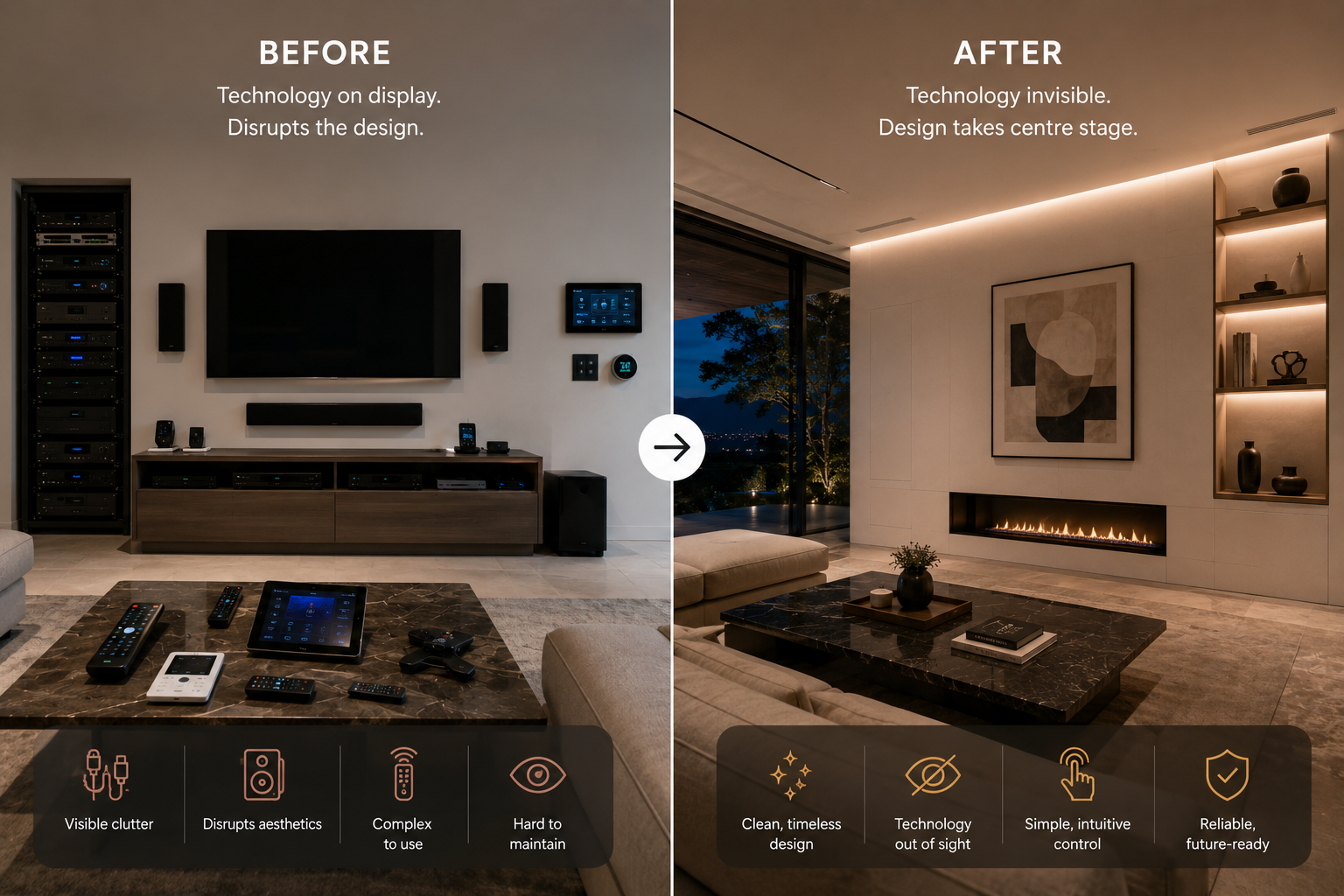
For many interior designers, the challenge with technology in luxury homes is straightforward: clients want the experience, but that does not mean they want to see the equipment delivering it.
Revised 9 October 2026
Helen Bygraves, co-founder of Hill House Interiors, commented: “We always want the wow factor on our projects – amazing sound from hidden places, clarity, and ambience. But as interior designers, we don't want to see the tech.”
Bygraves was speaking about Serengeti Living, a collaborative installation showcased at Decorex 2025 that combined interior design with integrated lighting, shading, audio and control.
That tension – between wanting more technology and seeing less of it – is becoming increasingly important in high-end residential design.
It is also creating a bigger role for the technology integrator.
The smart home market is moving further into the design conversation
The professional smart home remains a substantial UK market. CEDIA's newly released 2026 Professional Smart Home Market Analysis estimates its value at £2.2 billion, while 67% of integration firms expect their revenues to increase, according to reporting on the new research.
The figures point to a sizeable specialist industry – but the opportunity for residential technology is not simply about putting more devices into homes. Increasingly, it is about integrating technology without compromising what architects and interior designers are trying to achieve.
Spending on the home more broadly remains substantial. The 2025 UK Houzz & Home Renovation Trends Study, based on responses from 1,060 UK homeowners, found that median renovation spend reached £21,440 in 2024, while the highest-spending 10% invested £169,000 or more. Among those who renovated, 39% upgraded their electrical systems.
Those investments create opportunities for AV, lighting, shading and control – but also make coordination increasingly important. Speakers need positions; displays need sightlines; lighting requires fixtures and controls; shading needs pockets and power; networks require cabling and access points.
The more discreet the finished installation is expected to be, the earlier many of those decisions need to be made.
Invisible technology is becoming a design problem
That changes the meaning of “invisible technology”.
Sometimes invisibility is literal: loudspeakers installed behind finished surfaces, recessed controls, concealed displays or equipment hidden in dedicated racks.
In other cases, the technology remains visible but is deliberately subordinated to the architecture. Small-aperture speakers can align with lighting fixtures. Keypads can complement finishes rather than interrupt them. Shading can disappear into ceiling pockets until it is needed.
Recent projects show how far this approach can go. In a 2026 Sonance Design Award-winning residence, integrator GHT Group installed more than 100 James Small Aperture loudspeakers across the 18,000 sq ft property, including kitchens, bedrooms, bathrooms, offices and entertaining spaces.
The important detail is not simply that the speakers were small. According to the project case study, small-aperture lighting had already been specified throughout the home, and the audio solution was chosen partly because its visual footprint could complement that lighting.
Here, audio specification became part of the interior design rather than something added to it.
Another Sonance Design Award-winning residential project faced a different problem. A lounge featured a curved plaster barrel ceiling that ruled out conventional ceiling loudspeakers. The solution used invisible in-wall speakers instead, while elsewhere in the property a subwoofer grille was incorporated into custom baseboard millwork.
These are manufacturer case studies, but they illustrate something significant: technology decisions are increasingly becoming architectural decisions.
Hiding technology requires earlier collaboration
There is a paradox here. Making technology less noticeable can require the technology specialist to become involved much earlier.
An invisible loudspeaker cannot simply be added once the walls are finished. A concealed shade requires space within the architecture. A flush control interface has implications for wall construction and finishes. Lighting, AV, networking, HVAC and electrical systems increasingly share infrastructure and influence one another.
That makes coordination between integrators, architects, interior designers, lighting designers and other specialists increasingly important.
The Serengeti Living project created by home integration firm Homeplay offered a practical example. The interior scheme combined Lutron lighting and shading, Sonance invisible audio and Control4 automation. Rather than treating these as separate technology packages, the project team considered how they would contribute to the overall experience of the interior.
Technology integrator Amir Pourrahimi of IndigoZest described the principle simply: “When a technology integrator works properly with an interior designer, you always get the best end user experience.”
That is perhaps the more important trend behind invisible technology. The objective is not invisibility for its own sake. It is to stop individual systems fighting for attention.
Smart technology is moving into the renovation conversation
There are signs that this approach is extending beyond the very top of the residential market.
Houzz's research into UK renovation priorities found that the proportion of surveyed renovators installing app- or device-controlled motorised blinds, curtains or shutters increased from 2% in 2023 to 8% in 2024.
It is only one category, and it does not mean that every renovation is becoming a fully integrated smart home. But it illustrates how technologies that affect both the appearance and operation of a room are entering mainstream renovation decisions.
For architects and interior designers, that makes understanding residential technology increasingly useful before the design is fixed. For integrators, the reverse is equally important: understanding design intent is becoming part of delivering a successful technical solution.
Invisible isn't always the answer
There is another approach that complicates the story.
For years, much of the high-end residential AV industry has pursued invisibility: smaller apertures, hidden speakers, concealed displays and controls designed to recede into the architecture.
But good integration does not necessarily mean hiding everything.
ISE 2027 exhibitor K-array takes both approaches within its residential audio range. Some solutions are designed to disappear into walls, ceilings or joinery, while others can remain visible but be specified in custom RAL colours or premium metallic finishes to work with the surrounding interior. Its Koral loudspeakers, for example, can be surface-mounted or fully recessed behind a flush grille finished to match the wall.
That points towards a more nuanced definition of design-led technology. The question is no longer simply: how can this technology be hidden?
It is: what should disappear, what should remain visible, and how should both contribute to the room?
When good technology stops looking like technology
That distinction matters for the future of residential integration.
Sometimes the best solution will be an invisible speaker behind plaster, a concealed shade or equipment housed entirely out of sight. Elsewhere, the right answer may be a beautifully finished loudspeaker or control interface that earns its place in the interior.
What connects the two approaches is intent.
Technology should not arrive at the end of the project and force compromises onto a finished design. If AV, lighting, shading, control and network infrastructure are considered alongside architecture and interiors from an early stage, they can become part of the experience of the home rather than additions to it.
The irony of the increasingly connected luxury home is that its technology may become harder to spot. But achieving that result requires technology – and the people responsible for it – to become involved earlier, not later.
At ISE 2027, the Residential & Smart Building Technology Zone brings together the technologies and expertise behind this convergence, giving integrators, architects and designers the opportunity to explore how AV, lighting, control and other building systems can become part of the architecture rather than additions to it.
Stay ahead – Stay informed.
As an AV specialist or industry leader, you recognise how crucial it is to keep up with evolving trends, new technologies, and notable happenings within the audiovisual world. That's why we're delighted to invite you to receive exclusive email updates about ISE – the world-renowned annual tech show for the systems integration and audiovisual industry.
When you subscribe, you'll be kept up to speed with insightful commentary on the freshest developments in AV, get early looks at what's planned for the ISE content schedule – including headline speakers – and benefit from in-depth reporting on the show's standout attractions.
Sign up now to stay at the forefront of audiovisual innovation and expertise.
Further reading
Related Content
-
) For years, one of the biggest frustrations with smart home technology has been surprisingly simple: not everything talks to everything else. Matter is designed to make that easier.
For years, one of the biggest frustrations with smart home technology has been surprisingly simple: not everything talks to everything else. Matter is designed to make that easier. -
) Why residential technology is moving beyond gadgets.
Why residential technology is moving beyond gadgets. -
) How smart building technology improves resident retention.
How smart building technology improves resident retention. -
) Today, some of the most successful luxury residential projects are being designed around experiences rather than objects.
Today, some of the most successful luxury residential projects are being designed around experiences rather than objects. -
) As homes become more connected, technology decisions are beginning to influence much more than entertainment.
As homes become more connected, technology decisions are beginning to influence much more than entertainment.
Featured Articles
-
) Spanning all eight halls at Fira de Barcelona Gran Via, ISE 2026 delivered four days of record-breaking energy, creativity, and innovation.
Spanning all eight halls at Fira de Barcelona Gran Via, ISE 2026 delivered four days of record-breaking energy, creativity, and innovation. -
) The initiative will create new opportunities for talent development, innovation and community projects across the sector
The initiative will create new opportunities for talent development, innovation and community projects across the sector -
) The Facts & Figures report for ISE 2026 is available to download.
The Facts & Figures report for ISE 2026 is available to download. -
) Bringing together startups, investors and industry leaders, the expanded show feature offers a strong platform for visibility, networking, and commercial opportunity.
Bringing together startups, investors and industry leaders, the expanded show feature offers a strong platform for visibility, networking, and commercial opportunity. -
) This new type of event brings together end users, creators and production specialists from broadcast, live events, advertising and gaming, combining creative showcases, editorial programming and netwo ...
This new type of event brings together end users, creators and production specialists from broadcast, live events, advertising and gaming, combining creative showcases, editorial programming and netwo ...
)
)

)
)
)
)
)
)
)
![rAVe [PUBS]](https://cdn.asp.events/CLIENT_Integrat_169E7B04_E6F3_39F6_8BE4DB27C54F731E/sites/ise-2027/media/libraries/partners/rAVe-PUBS-Google-Logo.png/fit-in/500x500/filters:no_upscale())
)
)
)
)
)
)
)
)

)
)
)
)
)
)
)
)
)
)
)
)
)
)
)
)
)
)
)
)
)
)
)
)
)
)
)
)
)
)
)
)
)
)
)
)
)