

Session: Arena acoustics: how Stockholm made 100 metres feel close
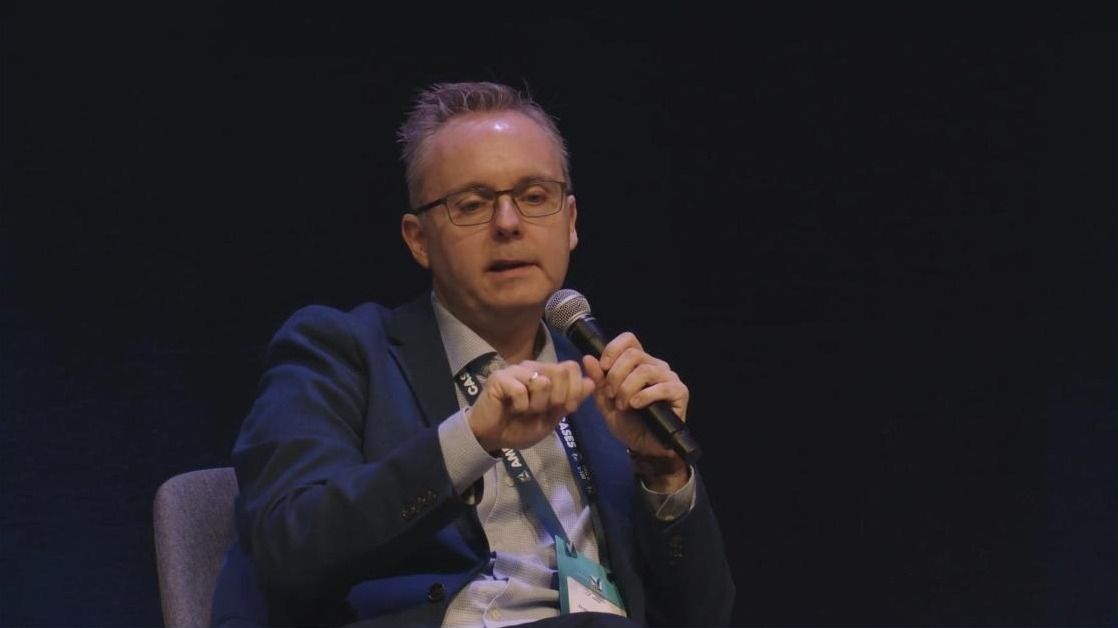
How a Stockholm arena got a movable acoustic ceiling and an enhancement system with 84 speakers and 72 microphones, installed in two weeks by Stouenborg ApS.
- Event: ISE 2026
- From session: Venue of the Future
- Speakers:
- Todd Staszko, Editor, MONDO-DR
- Anders Jørgensen, Project Executive, Stouenborg ApS
- Estimated read time: 8 minutes
- Watch the full session
Quick read summary
- Arena acoustics in a vast Stockholm hockey arena were fixed in two layers: a movable acoustic ceiling, then a system carrying crowd sound between ends.
- Supporters behind one goal could not hear rivals about 100 metres away, so the brief was a room that felt small.
- The enhancement system runs 84 ceiling speakers and 72 microphones inline, capturing sound in each zone and sending it to the rest.
- Stouenborg ApS pre-assembled and labelled every part in Copenhagen, turning a job that normally takes about three months into a two-week install.
Every arena operator knows the sound of a crowd that cannot hear itself. The noise is huge where you stand and thin everywhere else, so the two ends of the bowl feel like separate events. That was the state of the arena acoustics in a 1989 ice hockey venue in Stockholm. Supporters behind one goal sang at their rivals behind the other, and the chants died in the space between them.
Anders Jørgensen, Project Executive at Danish integration and consultancy firm Stouenborg ApS, described how his team fixed it at ISE 2026. The Venue of the Future session was moderated by Todd Staszko, Editor of MONDO-DR. The answer came in two layers, a new ceiling and an electroacoustic system, and the installation on site took two weeks.
Why were the arena acoustics failing the home crowd?
The room was too large and too reverberant for crowd sound to carry. Jørgensen put it at 85 metres high, with a volume of about 600,000 cubic metres, and it had not had an extensive upgrade in many years. The acoustics were not necessarily bad, he said, but they were poor, and many sports events had moved to smaller venues around Stockholm.
The client asked for an atmosphere rather than a number: how to turn a huge arena into an intimate experience, where fans had the feeling of being in a small arena. Jørgensen agreed that the fan experience has moved a long way since the arena opened, with concerts, smaller shows and something happening in every break. It is the same pressure ISE has looked at in why bigger venues need to feel smaller.
How far did the reverberation time have to come down?
Down to roughly four seconds, Jørgensen said. The first tool was a new acoustic ceiling, which is also the rigging ceiling and moves back and forward so the arena’s dome can still be enjoyed when it is open.
Jørgensen gave the ceiling’s developers much of the credit. Without that passive work, he said, the audience enhancement system would not have been as successful as it is today. The order matters: control the room first, then add electronics.
What does active acoustics add once the room is under control?
It moves the crowd’s sound to the places that cannot hear it. Stouenborg ApS installed Constellation, an electroacoustic system from Meyer Sound, with roughly 84 speakers in the ceiling, 72 microphones and processing racks throughout the arena.
Constellation normally changes how reverberant a room sounds. Here it adds no reverb, because the arena already has enough. In Jørgensen’s words, "it’s an inline system, which means that we capture sound and we distribute sound to each zone". Each zone’s sound goes, timed correctly, to all the others, so a chant from behind one goal reaches the far end still sounding like part of the same crowd.
The bowl is unusually shallow, so microphones 35 metres up were too far from the lower rows. The team put 16 microphones on the central LED cube to capture rows zero to 20.
Two weeks for a three-month install
The on-site window was two weeks, for a job Jørgensen would normally expect to take about three months. In that time the team had to run 10 kilometres of cable and install almost 100 speakers and 72 microphones.
So the work moved to Denmark. Everything that could be pre-assembled was built in Stouenborg’s Copenhagen warehouse, hung on wheeled wagons and driven to Stockholm in containers. The team borrowed its method from aviation, where every action is crosschecked.
So we are able to say, now everything’s been pre angled, everything’s been done. We know exactly how it will perform.
The ceiling made that discipline essential. Jørgensen compared its shape to a Pringle, curving in two directions, so no speaker or bracket angle matches another: "So everything is completely unique, and that meant we had to treat everything unique".
One speaker, seven stages, from model to ceiling
Every speaker passed through the same seven stages, each designed to remove a decision from the two weeks on site.
| Stage | What happened to the speaker | Why |
|---|---|---|
| Model | Placed in Revit with Meyer Sound’s precision model, plus brackets, cables and every bolt | Some gaps to the acoustic panels were only 2.5 centimetres |
| Pre-angle | Set to its own angle and labelled in Copenhagen | No two ceiling positions match |
| Crosscheck | Checked against the plan before it left | No time to correct mistakes in Stockholm |
| Ship | Hung on a wheeled wagon and driven to Sweden | It arrives ready to fly |
| Hang | Four people on the position at 35 metres, a team on top of the ceiling | Cherry pickers cannot reach it all |
| Document | Ground crew checks the angle and records it | Each part must go to the right place |
| Tune | Angles fine tuned once the ceiling takes the load | The steel cable ceiling moves under load |
The clearance is the reason for the model. Each acoustic panel weighs about 100 kilos, and as Jørgensen put it, "So you have 40 tons of acoustic panels in that ceiling". A panel that hits a speaker as it opens or closes will damage it. The fine tuning alone took about 300 hours, and a year of planning sat behind the two weeks on site.
The signal path was chosen for the same two-week schedule. Jørgensen said the team picked analogue over networked audio because it was not certain a network could run smoothly in so short a time. Interference in a room this big is easier to tackle with analogue.
Can the same venue acoustics serve a touring concert?
Yes, with little setup. The system accepts six discrete inputs from a touring front of house console, through Spacemap Go in the Constellation platform. The engineer picks one of six presets, each placing the sound differently in the room.
Artists have used it for one or two songs. Jørgensen described a performer on a centre stage with an acoustic guitar and the overhead system on, an effect he said gives the audience goosebumps. It fits a wider point ISE has made, that the best venues are no longer built for one purpose.
The approach also travels beyond Stockholm. Other venues do not need a ceiling that rolls on and off, Jørgensen said, but they do need to tackle the acoustics first. Copenhagen has an arena with reverb of about three seconds where a system like this would be easy to deploy.
FAQ
- Is active acoustics the same thing as acoustic panels? No. Acoustic panels absorb sound and shorten reverb, while an electroacoustic system uses microphones, processing and loudspeakers to capture and redistribute sound. In the Stockholm arena, Stouenborg ApS used both.
- How low does reverberation time need to be before an arena enhancement system works? There is no single figure, but the room has to be brought under control first. Anders Jørgensen of Stouenborg ApS said the Stockholm arena came down to roughly four seconds, and an arena in Copenhagen at about three seconds would be easy to equip.
- Why did Stouenborg ApS choose analogue rather than networked audio in Stockholm? The team chose analogue for reliability on a two-week installation. Anders Jørgensen said it was not certain a network could run smoothly in that time, and interference in a very large room is easier to tackle with analogue.
Two weeks on site, a year in the model
The Stockholm job is easy to describe as a sound system, and that undersells it. The speakers and microphones are what fans hear, but the result came from two earlier decisions: fix the room before adding electronics, and know every part before reaching the site.
The first is a lesson for anyone selling enhancement into a reverberant venue. Jørgensen was clear that the system would not have worked as well without the ceiling, and that rooms which already have good acoustics are the easy wins. An integrator who leads with speakers in an untreated room is starting at the wrong end.
The second is a lesson for every project with a short window. Two weeks on site was only possible because a year of planning, a Revit model down to the bolt and about 300 hours of angle tuning came first.
For operators who want a big crowd to feel like a small one, that is the real brief. Better venue acoustics start long before install day. In Stockholm, they started with knowing that every speaker would clear a moving 100 kilo panel, some by 2.5 centimetres, before any left Copenhagen.
About the speakers
Todd Staszko
Editor, MONDO-DR
Staszko edits MONDO-DR, a magazine focused on the fixed install world, and moderated this session.
Anders Jørgensen
Project Executive, Stouenborg ApS
Jørgensen works for Stouenborg ApS, a Danish integration and consultancy firm that specialises in large-scale projects.
Explore venue audio at ISE
Arena sound and venue design are a big part of ISE.
- Pro audio and staging at ISE: listening suites, demo rooms and outdoor audio.
- Talks and summits across ISE: keynotes, summits and free-to-attend stages in one place.
- Never been to ISE? Plan your visit with the guide for new attendees.
Featured Articles
-
 Spanning all eight halls at Fira de Barcelona Gran Via, ISE 2026 delivered four days of record-breaking energy, creativity, and innovation.
-
 The initiative will create new opportunities for talent development, innovation and community projects across the sector
-
 The Facts & Figures report for ISE 2026 is available to download.
-
 Bringing together startups, investors and industry leaders, the expanded show feature offers a strong platform for visibility, networking, and commercial opportunity.
-
 This new type of event brings together end users, creators and production specialists from broadcast, live events, advertising and gaming, combining creative showcases, editorial programming and netwo ...