
AI will not replace editors – but it is rewriting post-production
Updated 2 September 2026
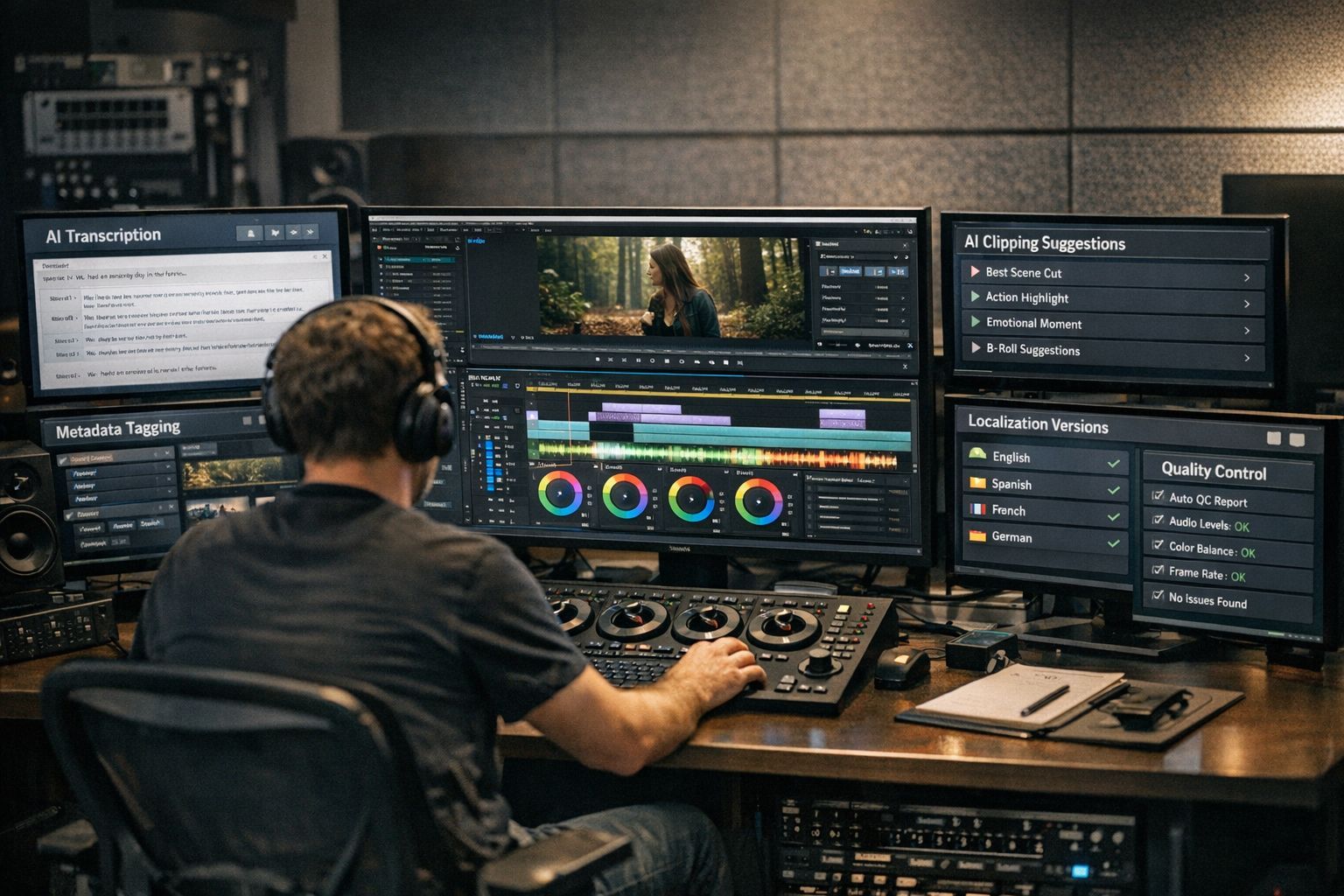
Tasks that once demanded hours of manual work – transcribing interviews, searching footage, creating rough cuts, generating captions and finding particular shots – can increasingly be accelerated by AI. At the same time, generative tools are beginning to move beyond workflow assistance and into the content itself.
That raises a more useful question than whether AI will replace editors: where should automation end and editorial judgement begin?
AI is moving into the edit suite
The shift is already visible in mainstream professional editing tools.
Adobe Premiere can automatically transcribe source footage and allow an editor to construct a rough cut by manipulating the resulting text. Its Media Intelligence tools can search footage using visual content, transcripts and metadata, while Translate Captions automates multilingual caption creation. Generative Extend goes further, using generative AI to add frames to existing video or audio clips.
Blackmagic Design is taking a similar approach in DaVinci Resolve 20. Its AI IntelliScript can match dialogue against a script and automatically assemble a timeline, while other AI-assisted features include multicamera switching based on speaker detection, animated subtitles and audio mixing assistance.
These are significant changes because they target some of the most time-consuming parts of post-production. But they do not remove the need to decide what the story should be, which performance matters, where a cut should fall or whether an automatically generated result is editorially appropriate.
Adobe's own Text-Based Editing workflow makes that distinction clear: AI can help create the rough cut, after which the editor returns to conventional editing tools for trimming, pacing, colour, audio and graphics.
The real opportunity may be scale
For broadcasters and media companies, the attraction is not simply making one edit faster.
A single production may now need to feed linear television, streaming platforms, websites, social channels and mobile services. Each destination can require different durations, formats, captions, languages and versions.
That makes repetitive post-production work an obvious target for automation. AI-assisted transcription, search, captioning and content preparation can potentially help creative teams spend less time finding and processing material and more time deciding how it should be used.
This is where AI could become a multiplier rather than simply a cost-cutting tool. The same editorial team may be able to extract more usable content from the same source material and prepare it for more destinations.
It also connects post-production directly to the wider transformation of broadcasting. As production, media management and distribution become more software-defined, AI is becoming another layer within those workflows rather than a standalone application.
Generative AI changes the question again
The boundary becomes less comfortable when AI starts creating material rather than organising it.
Adobe's Generative Extend can already generate additional frames and ambient audio to extend an existing clip. In the Premiere beta, its newer Generative Media Tool can generate video and sound effects directly within the editing timeline.
That creates possibilities, but also questions around provenance, editorial transparency and appropriate use. In news and factual broadcasting especially, the distinction between assisting an editor with existing material and generating material that did not previously exist is fundamental.
Governance therefore needs to evolve alongside the technology. The European Broadcasting Union has argued for AI governance built around trust, information integrity and accountability, particularly as AI becomes more deeply embedded in the relationship between media organisations and their audiences.
For production leaders, AI strategy consequently cannot be based only on whether a tool saves time. They also need to know what the system is doing, where material came from, how outputs are checked and which decisions continue to require human oversight.
The editor's role may become more editorial
None of this makes the editor less important. It could, however, change what editors spend their time doing.
If software can search hours of footage, produce transcripts, assemble preliminary sequences and generate multiple versions, the value of the human editor shifts further towards judgement: understanding narrative, performance, emotion, context, accuracy and audience.
That does not mean every existing role or workflow will remain unchanged. Automation inevitably raises questions about skills, staffing and the division of work between people and machines. But current professional tools point towards a model in which AI handles an expanding range of tasks within the post-production workflow while people retain responsibility for the finished editorial product.
The distinction matters. Automating part of editing is not the same as automating the editor.
From AI experiments to AI workflows
The next challenge for broadcasters may therefore be integration rather than experimentation.
AI is already appearing throughout professional production software, and the number of potential applications is considerable. At the ISE 2026 Broadcast AV Summit, AI strategist Maria Ingold presented an AI in Media Taxonomy mapping more than 150 enterprise use cases across the creator, experience and streaming economies.
That breadth makes choosing where not to automate almost as important as identifying where AI can help.
For media organisations, the strongest approach is unlikely to be adding AI wherever possible. It will be identifying the parts of post-production where automation creates genuine value, while maintaining human control where creativity, accuracy and editorial responsibility matter most.
That conversation will be increasingly relevant at Integrated Systems Europe 2027, where exhibitors including Blackmagic Design will bring together the production, software, IP and AI technologies behind the changing media workflow.
AI may be learning to perform more of the edit. Deciding what is worth watching remains a much harder problem.
Stay ahead – Stay informed.
As an AV specialist or industry leader, you recognise how crucial it is to keep up with evolving trends, new technologies, and notable happenings within the audiovisual world. That's why we're delighted to invite you to receive exclusive email updates about ISE – the world-renowned tech show for the systems integration and audiovisual industry.
When you subscribe, you'll be kept up to speed with insightful commentary on the freshest developments in AV, get early looks at what's planned for the ISE content schedule – including headline speakers – and benefit from in-depth reporting on the show's standout attractions.
Sign up now to stay at the forefront of audiovisual innovation and expertise.
Further reading
Discover Broadcast Solutions at ISE 2027.
Related articles
- The end of ‘one feed for everyone' – Explore how AI, automation and software-defined workflows are helping broadcasters adapt content for different audiences, platforms and viewing experiences.
- Getting content everywhere is harder than making it – Discover why creating more versions of content is only part of the challenge as broadcasters manage increasingly complex multi-platform distribution workflows.
- The next broadcast revolution may be invisible to viewers – See how software-defined infrastructure is changing the production environments into which AI-powered tools and automated workflows are increasingly being integrated.
Related Content
-
) A digital twin is a live virtual model of a real‑world space, system or workflow, continuously updated with data so it behaves like its physical counterpart.
A digital twin is a live virtual model of a real‑world space, system or workflow, continuously updated with data so it behaves like its physical counterpart. -
) IPMX and ST 2110 both transport professional media over IP networks but differ mainly in who they serve.
IPMX and ST 2110 both transport professional media over IP networks but differ mainly in who they serve. -
) Broadcast TV isn't growing in the traditional sense. But instead, the definition of broadcasting is expanding.
Broadcast TV isn't growing in the traditional sense. But instead, the definition of broadcasting is expanding. -
) For decades, broadcasters' concerns around operational risk focused primarily on reliability. Today, a different threat is demanding attention: cybersecurity.
For decades, broadcasters' concerns around operational risk focused primarily on reliability. Today, a different threat is demanding attention: cybersecurity. -
) Broadcasters face growing pressure from regulators, investors, advertisers, production partners, and audiences to demonstrate measurable environmental progress.
Broadcasters face growing pressure from regulators, investors, advertisers, production partners, and audiences to demonstrate measurable environmental progress.
Featured Articles
-
) Spanning all eight halls at Fira de Barcelona Gran Via, ISE 2026 delivered four days of record-breaking energy, creativity, and innovation.
Spanning all eight halls at Fira de Barcelona Gran Via, ISE 2026 delivered four days of record-breaking energy, creativity, and innovation. -
) The initiative will create new opportunities for talent development, innovation and community projects across the sector
The initiative will create new opportunities for talent development, innovation and community projects across the sector -
) The Facts & Figures report for ISE 2026 is available to download.
The Facts & Figures report for ISE 2026 is available to download. -
) Bringing together startups, investors and industry leaders, the expanded show feature offers a strong platform for visibility, networking, and commercial opportunity.
Bringing together startups, investors and industry leaders, the expanded show feature offers a strong platform for visibility, networking, and commercial opportunity. -
) This new type of event brings together end users, creators and production specialists from broadcast, live events, advertising and gaming, combining creative showcases, editorial programming and netwo ...
This new type of event brings together end users, creators and production specialists from broadcast, live events, advertising and gaming, combining creative showcases, editorial programming and netwo ...
)
)

)
)
)
)
)
)
)
)
)
)
)
)
)
)
)
)
)
)
)
)

)
)
)
)
)
)
)
)
)
)
)
)
)
)
)
)
)
)
)
)
)
)
)
)
)
)
)
)

)
)
)
)