

How is AI changing smart homes?
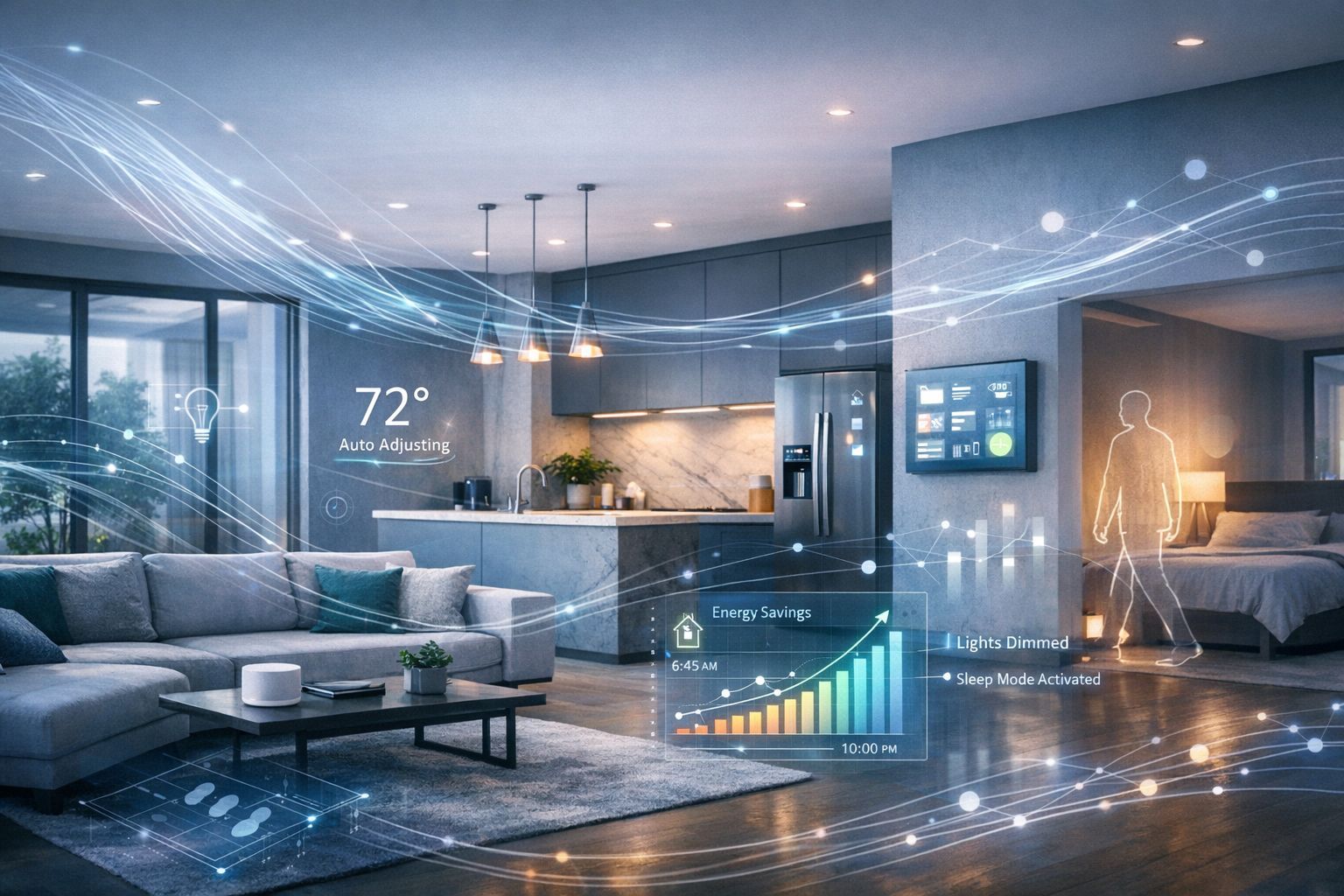
Artificial intelligence is changing smart homes by allowing residential systems to do more than follow pre-programmed commands. AI can analyse information about occupancy, behaviour and system performance to make automation more adaptive, helping homes respond more intelligently to the people who live in them.
This article was originally published on 10 June 2026; revised 3 September 2026
That distinction matters. Traditional home automation might lower the blinds and adjust the lighting at a predetermined time. An AI-enabled system can potentially use information about occupancy, environmental conditions and previous behaviour to determine when an adjustment is appropriate.
Some of these capabilities are already appearing in residential technology, while others remain at an earlier stage. Together, however, they point towards a significant change in what homeowners may eventually expect from an intelligent home.
From automation to adaptation
AI in the home is not entirely new. Voice assistants have long used technologies such as natural language processing, while connected security products increasingly use computer vision to distinguish between people, animals and objects.
What is changing is the potential to apply intelligence across more of the residential environment.
ISE exhibitor KNX Association, for example, identifies voice control, energy monitoring and intelligent security among areas where AI is already influencing smart homes. It describes systems that can analyse energy consumption and recommend changes, while occupancy information can be used to adjust lighting and heating.
The longer-term opportunity is to connect these capabilities. Instead of lighting, climate, security and entertainment behaving as separate automated systems, AI could help them respond to a richer understanding of what is happening throughout the home.
That creates the possibility of a home that requires less explicit instruction from its occupants.
AI is changing how people control their homes
One example comes from Josh.ai, which specialises in AI-powered control for professionally installed smart homes. In 2026, the company introduced AI X OS, using AI across voice, text and touch control, and demonstrated how natural-language instructions could be used to configure aspects of a home. These developments point towards a broader shift from rigid, pre-programmed control towards residential systems that can be more easily personalised and adapted over time.
Energy management could be another important application
AI also has potential where the objective is less visible: reducing unnecessary energy consumption.
A connected home can already collect information from smart meters, occupancy sensors, lighting, shading and HVAC systems. AI can analyse patterns within that information and help systems make better decisions about when energy is required.
KNX, for example, describes scenarios in which energy monitoring is combined with intelligent control to adjust lighting and heating according to occupancy, or coordinate household consumption with electricity generated by solar panels.
For residential integrators, this broadens the smart-home conversation. Energy management, battery storage, EV charging and renewable generation increasingly sit alongside AV, lighting and climate control as parts of a connected residential ecosystem.
More intelligence means more questions about privacy
The benefits come with an important trade-off. For a home to learn about its occupants, it needs information. Depending on the application, that might include occupancy patterns, voice interactions, camera data, temperature preferences or information about when particular rooms and systems are used.
That makes privacy, cybersecurity and data governance increasingly important design considerations. The question is not simply whether AI can personalise a residential environment, but how much information should be collected to achieve that personalisation, where it should be processed and who should have access to it.
For integrators and designers, these considerations need to form part of conversations with clients rather than being treated purely as technical details.
The integrator's role may become more important, not less
It would be easy to assume that increasingly intelligent technology reduces the need for professional integration. The opposite may prove true.
A home containing adaptive lighting, intelligent climate control, energy management, AI-enhanced security and personalised entertainment still needs a robust network and carefully designed system architecture. Professionals also need to decide what should be automated, what should remain under direct human control and what happens when an intelligent system makes the wrong decision.
AI therefore shifts some of the integrator's value away from programming individual commands and towards designing the rules, boundaries and experiences of an intelligent environment.
That also makes collaboration with architects and interior designers increasingly important. Technology that learns and adapts still has to complement the architecture, remain intuitive and respect the people living with it.
What comes next for AI in the smart home?
The direction of travel is towards residential technology that requires less active management. Homes may increasingly combine information from multiple systems to adapt lighting, temperature, energy use, security and entertainment according to context. But fully autonomous homes that reliably anticipate occupants' needs remain a future ambition rather than today's norm; KNX itself distinguishes today's capabilities from more speculative visions of fully automated living. (KNX)
The more immediate change is subtler: AI is adding another layer of intelligence to systems that residential professionals already design and integrate.
That transition is increasingly relevant to Integrated Systems Europe (ISE), where residential technology sits alongside home automation, lighting control, energy management, security, networking and smart building systems. The ISE 2026 audience data illustrates the breadth of that ecosystem: visitors reported interests ranging from home automation and smart building technology to security, energy management and HVAC control.
The show's content programme is similarly broad. ISE 2026 included the CEDIA Smart Home Technology Conference and Smart Home Technology Stage alongside sessions devoted to AI, Smart Spaces, cybersecurity and sustainability. That convergence matters because AI in the home is unlikely to develop as a separate technology category; its influence will increasingly be felt across the systems that create the residential experience.
For integrators, architects and designers, the opportunity isn't simply to put more AI into homes. It is to determine where intelligence genuinely makes living simpler, more comfortable and more efficient – and where it doesn't.
That may be the more meaningful definition of an intelligent home.
Stay ahead – Stay informed.
As an AV specialist or industry leader, you recognise how crucial it is to keep up with evolving trends, new technologies, and notable happenings within the audiovisual world. That's why we're delighted to invite you to receive exclusive email updates about ISE – the world-renowned tech show for the systems integration and audiovisual industry.
When you subscribe, you'll be kept up to speed with insightful commentary on the freshest developments in AV, get early looks at what's planned for the ISE content schedule – including headline speakers – and benefit from in-depth reporting on the show's standout attractions.
Sign up now to stay at the forefront of audiovisual innovation and expertise.
Further reading
Discover Smart Spaces, Homes and Buildings at ISE 2027
Related articles
- Why the future smart home must feel simpler, not more complex – Discover why increasingly sophisticated residential technology needs to reduce complexity for homeowners rather than add to it.
- Why smart homes still go wrong – even when the technology is right – Explore why intelligent technology still depends on good system design, integration and collaboration to deliver a seamless experience.
- The smart home is growing up – Find out why residential technology is moving beyond individual gadgets towards integrated systems focused on comfort, wellbeing, security and simplicity.
Related Content
-
) For years, one of the biggest frustrations with smart home technology has been surprisingly simple: not everything talks to everything else. Matter is designed to make that easier.
For years, one of the biggest frustrations with smart home technology has been surprisingly simple: not everything talks to everything else. Matter is designed to make that easier. -
) Why residential technology is moving beyond gadgets.
Why residential technology is moving beyond gadgets. -
) How smart building technology improves resident retention.
How smart building technology improves resident retention. -
) Today, some of the most successful luxury residential projects are being designed around experiences rather than objects.
Today, some of the most successful luxury residential projects are being designed around experiences rather than objects. -
) As homes become more connected, technology decisions are beginning to influence much more than entertainment.
As homes become more connected, technology decisions are beginning to influence much more than entertainment.
Featured Articles
-
) Spanning all eight halls at Fira de Barcelona Gran Via, ISE 2026 delivered four days of record-breaking energy, creativity, and innovation.
Spanning all eight halls at Fira de Barcelona Gran Via, ISE 2026 delivered four days of record-breaking energy, creativity, and innovation. -
) The initiative will create new opportunities for talent development, innovation and community projects across the sector
The initiative will create new opportunities for talent development, innovation and community projects across the sector -
) The Facts & Figures report for ISE 2026 is available to download.
The Facts & Figures report for ISE 2026 is available to download. -
) Bringing together startups, investors and industry leaders, the expanded show feature offers a strong platform for visibility, networking, and commercial opportunity.
Bringing together startups, investors and industry leaders, the expanded show feature offers a strong platform for visibility, networking, and commercial opportunity. -
) This new type of event brings together end users, creators and production specialists from broadcast, live events, advertising and gaming, combining creative showcases, editorial programming and netwo ...
This new type of event brings together end users, creators and production specialists from broadcast, live events, advertising and gaming, combining creative showcases, editorial programming and netwo ...
)
)

)
)
)
)
)
)
)
)
)
)
)
)
)
)
)
)
)
)
)
)

)
)
)
)
)
)
)
)
)
)
)
)
)
)
)
)
)
)
)
)
)
)
)
)
)
)
)
)

)
)
)
)