

Accessibility technology is becoming experience technology
Updated 9 September 2026
That matters because accessibility is not a marginal requirement. The World Health Organization estimates that 1.3 billion people – around 16% of the global population – experience significant disability. And many more people encounter temporary or situational barriers, from hearing a stadium announcement in a noisy concourse to navigating an unfamiliar arena in a second language.
For venue operators, the opportunity is to stop thinking about accessibility technology as a separate layer and start designing experiences that work for the widest possible audience from the outset.
Regulation is raising the stakes
There is still a powerful compliance imperative.
The European Accessibility Act (EAA) has applied to specified products and services in the EU since June 2025. Its scope includes areas directly relevant to the wider visitor journey, including e-commerce, payment services, electronic communications and elements of passenger transport information.
For live-events businesses, that reinforces a broader change already taking place: accessibility increasingly needs to be considered across the digital as well as the physical experience.
A wheelchair-accessible entrance does not create an accessible journey if buying the ticket, finding information or interacting with digital services introduces another barrier.
Accessibility starts before the audience arrives
The visitor experience now begins on a screen.
Ticket purchasing, travel information, event updates and venue apps can all determine whether someone can attend confidently and independently. Once inside, the same principle extends to navigation, announcements, concessions, content and the performance itself.
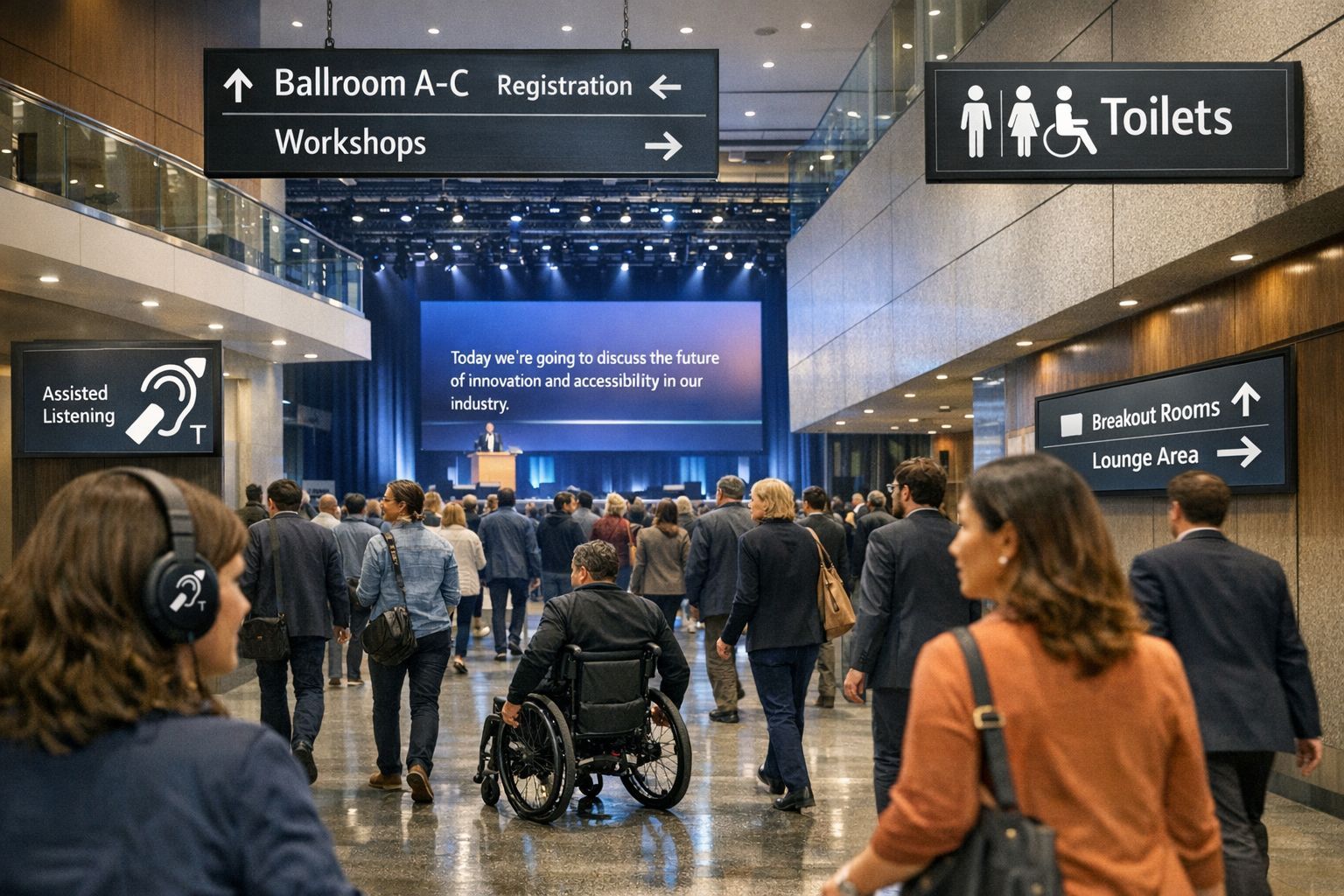
Digital signage can combine visual information with clear wayfinding. Captioning can make spoken content available visually. Assistive listening technologies can deliver clearer audio to people who need it, while accessible interfaces can make services easier to navigate.
The important shift is from providing a collection of individual "accessibility features" to considering the complete audience journey.
Designing for accessibility can improve experiences for everyone
Some of the most useful accessibility measures have benefits far beyond their original audience.
Captions can help someone with hearing loss, but they can also help a visitor understand speech in a noisy environment. Clear visual wayfinding can support people with cognitive or visual accessibility requirements while also helping international visitors navigate an unfamiliar venue. Simple interfaces can be valuable to someone using assistive technology – and to almost anyone trying to use a service quickly.
This is the principle of inclusive design: rather than creating a standard experience and then adapting it for particular groups, designers consider a wider range of needs from the beginning.
ISE 2026 explored precisely this approach during Accessible AV Designs for Classrooms at AVIXA Xchange LIVE. Although this discussion was focused on education and meeting spaces rather than venues, the underlying principle applies across AV: accessibility should be built into system design, with intuitive interfaces capable of supporting different needs and ways of interacting.
Integration is the next challenge
Making individual technologies accessible is only part of the job. They also need to work together.
A venue may have accessible ticketing, assistive listening, digital signage and an app, yet still create a fragmented experience if information is inconsistent between them.
This is where the wider move towards integrated venue technology becomes important. Connecting communications, AV, digital signage and operational systems can allow information to be delivered in different formats without creating entirely separate workflows.
It also changes accessibility from something owned by one team into a shared consideration spanning IT, AV, operations, customer experience and venue design.
Integrated Systems Europe 2027 exhibitors are developing technologies that address accessibility from several directions. AI-Media provides AI-powered captioning, translation and multilingual voice technologies that can make spoken content available across languages and formats. Listen Technologies, meanwhile, specialises in assistive listening, with solutions including Auri, developed with Ampetronic and based on Auracast broadcast audio, which can deliver clear audio to venue-provided receivers or compatible personal devices such as hearing aids and earbuds. Together, technologies such as these show how accessibility is becoming an integral part of the wider AV experience rather than a specialist layer added afterwards.
Accessibility should be designed in, not added on
Retrofitting accessibility after a system has been specified can create compromises. Considering it at the design stage gives teams more freedom to think about interfaces, content, audio, displays and physical spaces as parts of one experience.
That doesn't mean every visitor needs the same solution. Quite the opposite. The goal is to provide different ways of accessing the same information or experience without making any one of them feel secondary.
For technology teams, that means asking accessibility questions early: Can important information be seen as well as heard? Are interfaces straightforward to navigate? Can content be captioned? Does wayfinding work for different users? What happens when someone cannot interact with a system in the way its designer expected?
Those questions can expose weaknesses that affect far more people than those traditionally considered when discussing accessibility.
Inclusive design is becoming part of good AV design
At Integrated Systems Europe, technologies including audio, digital signage, displays, control, communications and intelligent building systems increasingly converge around a common objective: making spaces work better for the people using them.
Accessibility belongs within that conversation.
The next generation of accessible venues will not simply contain more assistive technologies. They will be designed so that audiences have multiple, intuitive ways to navigate, understand and participate in an experience.
Compliance remains essential. But the bigger ambition is better: design an experience that fewer people have to ask to be adapted for them.
 Stay ahead – Stay informed.
As an AV specialist or industry leader, you recognise how crucial it is to keep up with evolving trends, new technologies, and notable happenings within the audiovisual world. That's why we're delighted to invite you to receive exclusive email updates about ISE – the world-renowned annual tech show for the systems integration and audiovisual industry.
When you subscribe, you'll be kept up to speed with insightful commentary on the freshest developments in AV, get early looks at what's planned for the ISE content schedule – including headline speakers – and benefit from in-depth reporting on the show's standout attractions.
Sign up now to stay at the forefront of audiovisual innovation and expertise.
Further reading
Discover audio, lighting and staging at ISE
Discover multi-technology, infrastructure and control at ISE
Related articles
- Five ways technology can improve the fan experience – Discover how removing friction from ticketing, wayfinding, concessions and the event itself can create a better experience for every visitor.
- Why bigger venues need to feel smaller – Explore how innovative acoustic design and immersive audio can make large arenas feel more intimate, inclusive and connected.
- The network is becoming the most important AV device – See why robust network infrastructure increasingly underpins the connected services and technologies that make modern spaces easier to use.
Related Content
-
) How do venues improve the fan experience? By removing friction at every stage.
How do venues improve the fan experience? By removing friction at every stage. -
) Technology does not automatically make a venue smarter. The real transformation comes when tech is connected to operational and commercial objectives.
Technology does not automatically make a venue smarter. The real transformation comes when tech is connected to operational and commercial objectives. -
) Calling a new venue "future-proof" has always been risky. Today, it is becoming harder still.
Calling a new venue "future-proof" has always been risky. Today, it is becoming harder still. -
) Why the biggest live productions now resemble infrastructure projects rather than concert tours.
Why the biggest live productions now resemble infrastructure projects rather than concert tours. -
) Ticketing is becoming one of the most valuable data assets in the live events industry.
Ticketing is becoming one of the most valuable data assets in the live events industry.
Featured Articles
-
) Spanning all eight halls at Fira de Barcelona Gran Via, ISE 2026 delivered four days of record-breaking energy, creativity, and innovation.
Spanning all eight halls at Fira de Barcelona Gran Via, ISE 2026 delivered four days of record-breaking energy, creativity, and innovation. -
) The initiative will create new opportunities for talent development, innovation and community projects across the sector
The initiative will create new opportunities for talent development, innovation and community projects across the sector -
) The Facts & Figures report for ISE 2026 is available to download.
The Facts & Figures report for ISE 2026 is available to download. -
) Bringing together startups, investors and industry leaders, the expanded show feature offers a strong platform for visibility, networking, and commercial opportunity.
Bringing together startups, investors and industry leaders, the expanded show feature offers a strong platform for visibility, networking, and commercial opportunity. -
) This new type of event brings together end users, creators and production specialists from broadcast, live events, advertising and gaming, combining creative showcases, editorial programming and netwo ...
This new type of event brings together end users, creators and production specialists from broadcast, live events, advertising and gaming, combining creative showcases, editorial programming and netwo ...
)
)

)
)
)
)
)
)
)
)
)
)
)
)
)
)
)
)
)
)
)
)
)
)
)
)
)
.png/fit-in/500x500/filters:no_upscale())
)
)
)
)
)
)
)
)
)
)
)
)
)
)
)
)
)
)
.png/fit-in/500x500/filters:no_upscale())
)
)
)
)
)
)
)
)
)