

5G is finally changing live events ' but not in the way you think
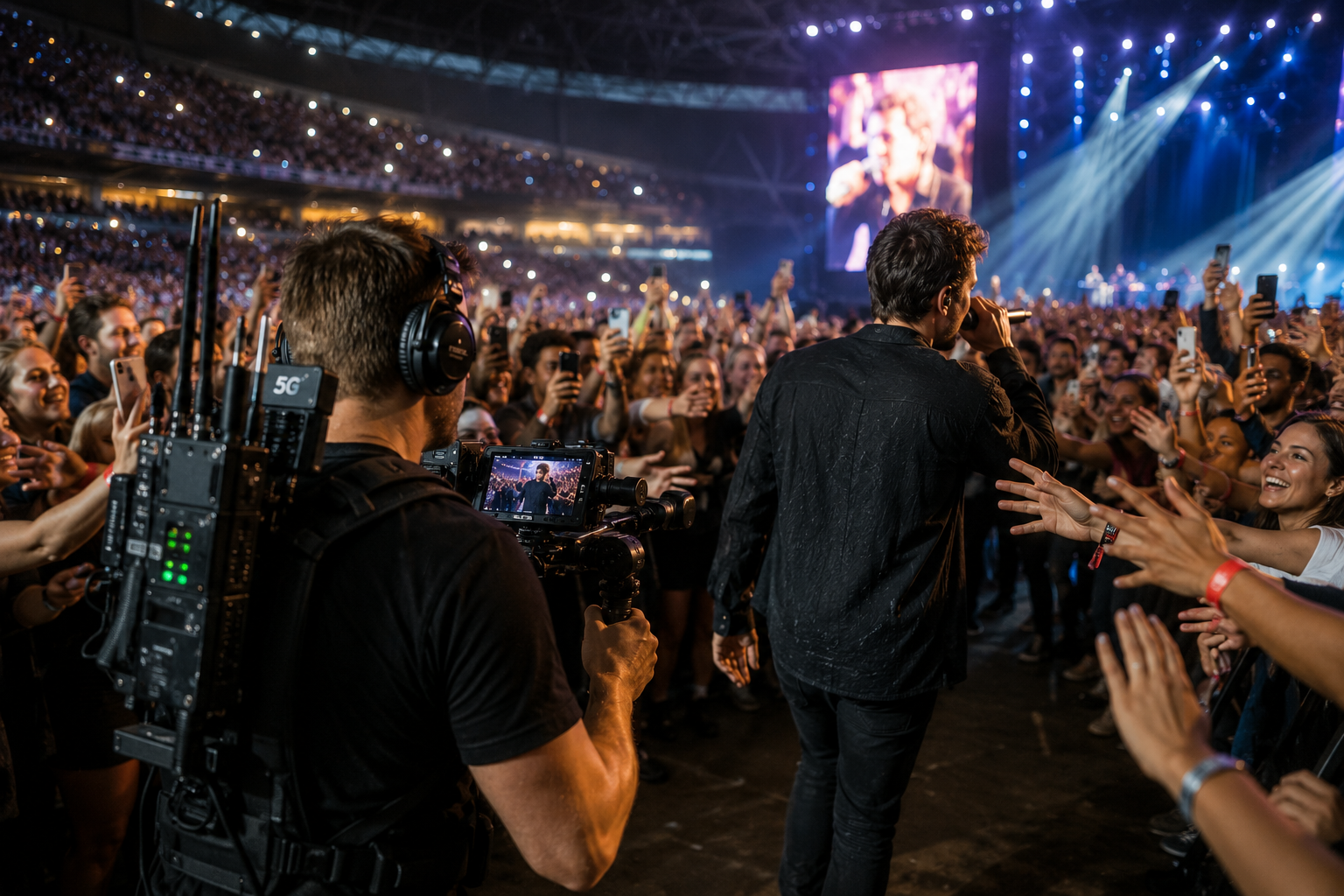
For years, 5G was promoted as the technology that would revolutionise live events. Faster downloads. Lower latency. Better connectivity. Smarter venues.
The reality has been more complicated.
Despite years of anticipation, most concertgoers still don't buy tickets because a venue has 5G coverage, and few event organisers would claim the technology alone has transformed audience experiences. Yet behind the scenes, 5G is quietly becoming one of the most important enablers of modern event production.
Its real impact isn't about replacing Wi-Fi or giving fans faster access to social media. It is about creating more agile, connected and resilient production environments capable of supporting increasingly complex live experiences.
Today's events generate unprecedented volumes of data. High-definition video feeds, real-time audience analytics, digital signage, cashless payments, security systems, production communications and mobile applications all compete for network capacity. As venues become more digitally connected, reliable low-latency connectivity has evolved from a convenience into critical infrastructure.
This is particularly evident at large sporting events and festivals. Temporary venues often require production teams to build sophisticated communications and content delivery systems in locations with limited fixed infrastructure. Historically, this has meant deploying extensive fibre networks and temporary cabling, adding cost, complexity and installation time.
Private 5G networks are beginning to offer an alternative.
Rather than replacing permanent infrastructure, they provide flexible connectivity for cameras, wireless production equipment, intercom systems, monitoring, security and operational communications. Production teams can deploy resources more quickly while maintaining the reliability required for live broadcasting and audience safety.
The technology is also supporting new creative possibilities. Wireless cameras have greater freedom of movement. Augmented reality experiences become easier to deliver. Real-time audience interaction can be integrated into performances, while production teams gain more flexibility in where equipment and personnel are located.
For venue operators, the commercial implications are equally significant.
Improved connectivity enables richer mobile experiences, more efficient crowd management, enhanced operational monitoring and better audience analytics. Sponsors also benefit from more personalised engagement opportunities, while organisers gain valuable insights into visitor behaviour throughout the event lifecycle.
However, 5G is not a universal solution.
Many venues continue to rely on hybrid networking strategies that combine fibre, Wi-Fi, private mobile networks and cloud services. Questions remain around spectrum availability, deployment costs, cybersecurity and integration with existing infrastructure. For many operators, success depends less on adopting 5G itself than on understanding where it delivers genuine operational value.
The organisations making the greatest progress are treating connectivity as part of a wider digital transformation strategy rather than a standalone technology project. Network infrastructure is increasingly viewed as the foundation upon which production, audience engagement, venue operations and commercial innovation all depend.
Integrated Systems Europe exhibitors including Riedel Communications are helping event organisers develop highly connected communications infrastructures that support increasingly mobile production environments. Meanwhile, Cisco continues expanding enterprise networking solutions that enable venues to manage growing demands for secure, resilient connectivity, while LiveU is advancing IP-based contribution technologies that allow live video to be transmitted reliably over bonded cellular and 5G networks.
As live events become more connected, the conversation is shifting away from whether 5G matters and towards how it fits within a broader technology ecosystem. The venues that gain the greatest advantage are likely to be those that integrate connectivity into every aspect of their operational and audience strategies.
That is one reason why networking, IP infrastructure and wireless production technologies are becoming increasingly important discussions at Integrated Systems Europe, where venue operators, production companies and technology leaders are exploring how connected infrastructure will shape the next generation of live experiences.
 Stay ahead – Stay informed.
As an AV specialist or industry leader, you recognise how crucial it is to keep up with evolving trends, new technologies, and notable happenings within the audiovisual world. That's why we're delighted to invite you to receive exclusive email updates about ISE – the world-renowned annual tech show for the systems integration and audiovisual industry.
When you subscribe, you'll be kept up to speed with insightful commentary on the freshest developments in AV, get early looks at what's planned for the ISE content schedule – including headline speakers – and benefit from in-depth reporting on the show's standout attractions.
Sign up now to stay at the forefront of audiovisual innovation and expertise.
Further reading
Find out more about live events, audio, lighting and staging at ISE
Related Content
-
) How do venues improve the fan experience? By removing friction at every stage.
How do venues improve the fan experience? By removing friction at every stage. -
) Technology does not automatically make a venue smarter. The real transformation comes when tech is connected to operational and commercial objectives.
Technology does not automatically make a venue smarter. The real transformation comes when tech is connected to operational and commercial objectives. -
) Calling a new venue "future-proof" has always been risky. Today, it is becoming harder still.
Calling a new venue "future-proof" has always been risky. Today, it is becoming harder still. -
) Why the biggest live productions now resemble infrastructure projects rather than concert tours.
Why the biggest live productions now resemble infrastructure projects rather than concert tours. -
) Ticketing is becoming one of the most valuable data assets in the live events industry.
Ticketing is becoming one of the most valuable data assets in the live events industry.
Featured Articles
-
) Spanning all eight halls at Fira de Barcelona Gran Via, ISE 2026 delivered four days of record-breaking energy, creativity, and innovation.
Spanning all eight halls at Fira de Barcelona Gran Via, ISE 2026 delivered four days of record-breaking energy, creativity, and innovation. -
) The initiative will create new opportunities for talent development, innovation and community projects across the sector
The initiative will create new opportunities for talent development, innovation and community projects across the sector -
) The Facts & Figures report for ISE 2026 is available to download.
The Facts & Figures report for ISE 2026 is available to download. -
) Bringing together startups, investors and industry leaders, the expanded show feature offers a strong platform for visibility, networking, and commercial opportunity.
Bringing together startups, investors and industry leaders, the expanded show feature offers a strong platform for visibility, networking, and commercial opportunity. -
) This new type of event brings together end users, creators and production specialists from broadcast, live events, advertising and gaming, combining creative showcases, editorial programming and netwo ...
This new type of event brings together end users, creators and production specialists from broadcast, live events, advertising and gaming, combining creative showcases, editorial programming and netwo ...
)
)

)
)
)
)
)
)
)
)
)
)
)
)
)

)
)
)
)

.png/fit-in/500x500/filters:no_upscale())
)
)
)
)
)
)
)
)
)
)
)
)
)
)
)
)
.png/fit-in/500x500/filters:no_upscale())
)
)
)
)
)
)
)
)
)
)
)
)
)
)
)
![rAVe [PUBS]](https://cdn.asp.events/CLIENT_Integrat_169E7B04_E6F3_39F6_8BE4DB27C54F731E/sites/ise-2027/media/libraries/partners/rAVe-PUBS-Google-Logo.png/fit-in/500x500/filters:no_upscale())
)
)
)