

Session: Social robots at home: inside Barcelona's 600-robot bet on elderly care
How Group Saltó deploys social robots in homes, nursing homes and day centres, what the software does and what makes a home deployment work, from ISE 2026.
- Event: ISE 2026
- From session: The New Era of Social Robotics: Turning vision into real-world impact
- Speaker: Jordi Cabau, CTIO, Group Saltó
- Estimated read time: 8 minutes
- Watch the full session
Quick read summary
- Social robots are moving from pilots to city scale in Barcelona, where 600 robots are joining homes and nursing homes during 2026.
- Group Saltó’s early pilots showed older users preferred a taller, more mobile robot.
- The robots link to Barcelona City Council’s Telecare service, so an operator answering an alarm call can drive the robot and see the room.
- Because the AI is probabilistic, Group Saltó monitors every interaction to meet the EU AI Act and protect older users.
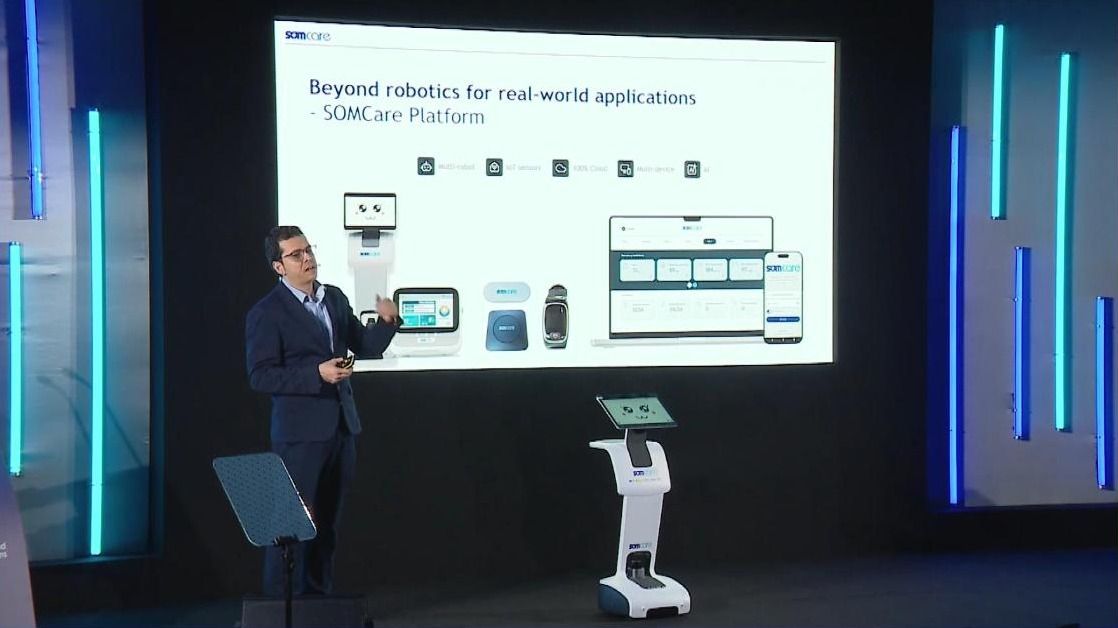
A Temi robot shared the stage with Jordi Cabau at ISE 2026 in Barcelona on 5 February 2026. Cabau, CTIO of Group Saltó, had brought it to show what social robots look like once they leave the lab and enter the home of an older person who lives alone.
His company has spent seven years on that move. It now runs robots in private homes, nursing homes and daily care centres, and is working on a Barcelona City Council project for 600 robots linked to the council’s Telecare service. Most of its lessons are about service design rather than hardware.
Why did Barcelona go looking for a robot?
Barcelona went looking because so many of its older residents live on their own.
In Barcelona, there are more than 90,000 people that are living alone at home.
In 2019 the Mobile World Capital Foundation set a challenge to find which technology could help older people keep living at home, and Group Saltó answered it. According to Cabau, its 250 people cover large-scale IT maintenance, care software and the robotics group that deploys it.
What is a social robot?
A social robot is an autonomous or semi-autonomous machine that moves around and interacts with people, Cabau said. The Temi on stage can follow a person, map a room so it knows several locations in a home, and be operated autonomously or remotely through an app. A robot that moves through a home can go to the person rather than wait for them, and most of the services Cabau described depend on that.
The taller robot won the early pilots
Older users chose the hardware, not the engineers. Group Saltó’s first pilots used a smaller robot that did not move around very autonomously. It "turned out that, uh, elderly preferred a higher robot." The team moved to the Temi, whose current version has a bigger screen and moves smoothly through a house, even in narrow spaces. Asking users early changed the product.
What do elderly care robots do at home and in care centres?
In a private home, elderly care robots give families and care professionals a way to check in when nobody else is there. Through the app, a family member can personalise interactions, see what is happening or schedule questions for the robot to ask their relative.
Consent comes first. In every deployment, Cabau said, the older person signs an agreement so they know a family member can connect remotely.
In daily care centres and nursing homes, care robots take on structured, repeatable moments. The robot greets everyone at the morning welcome, and professionals set what it does each day or week. Nursing homes also play bingo with it. "The robot can sing the numbers, and they help them with the memory exercises," Cabau said.
Six hundred social robots are joining Barcelona’s Telecare service
Barcelona City Council has launched a project to provide 600 robots to users in private homes and nursing homes, and Group Saltó is integrating them with the council’s Telecare service.
Telecare already answers calls from personal alarm buttons. With the robot linked in, the operator who responds can also drive the robot remotely and see what it sees. Cabau said this gives the council more information and lets it act more proactively. Results are expected during 2026.
What runs behind the robot?
A software platform runs behind it, and most of the service lives there. Professionals use a web back end with a calendar and scheduler to decide what each robot does and when, including reminders from a son’s birthday to taking medicine.
The platform connects other devices too. A second device with integrated health devices monitors vital signs. IoT (internet of things) sensors add context: put a sensor on the fridge door and the platform learns when someone goes to the kitchen.
An operator view shows where each robot is, what it is doing and the KPIs for the whole deployment. For an AV or IT team the shape is familiar: a fleet of networked endpoints managed from one platform.
Why does every conversation need watching?
Every conversation needs watching because the AI behind it does not always answer the same way. Cabau tied this to the EU AI Act, the European Union’s law on artificial intelligence. Probabilistic systems, he said, "don’t produce the same results every day," so Group Saltó monitors interactions to keep unexpected information away from an older person. Not every interaction uses generative AI, and each type is handled accordingly.
For anyone specifying AI for vulnerable users, decide who watches the conversations before deciding what the robot will say.
What made the home deployments work?
Preparation made them work, and it started with people rather than hardware.
Putting a robot into a house, it’s not very common.
Group Saltó starts by explaining to each older person how to interact with the robot and what it will do for them. Care professionals get agreed goals and the KPIs they will record. A questionnaire captures each person’s preferences so they can be built into the schedule.
After launch, a dedicated support team watches what every robot does, and with whom, every day. Older users’ suggestions feed a co-design process that shapes what the service does next.
Could one platform run every kind of robot?
Group Saltó is building towards it. Cabau’s team wants its platform to orchestrate robots with different jobs, such as logistics in a hospital or support in education, from one place.
Asked whether buyers can develop their own features, Cabau said everyone "can use their own software," and developers can use the platform’s API to orchestrate interactions. For integrators, that makes the robot another programmable endpoint, much like the hospitality robotics now meeting AV.
Which lessons carry over to AV and IT integrators?
Robots for elderly people succeed or fail on mapping, connectivity, consent, monitoring and support, the same disciplines an integrator brings to any networked room. Care buyers should ask a supplier how AI interactions are monitored, whether the API is open and who responds when a robot stops working.
For a wider view, read why home robotics is the next frontier for integrators and how robotics is quietly becoming the next AV platform.
FAQ
- How do care robots connect to a telecare alarm? In Barcelona, Group Saltó is integrating 600 robots with Barcelona City Council’s Telecare service. When an older person presses a personal alarm button, the operator who responds can drive the robot remotely and see what it sees.
- Why is AI on social robots monitored so closely? Jordi Cabau of Group Saltó said the AI used on social robots is probabilistic, so it does not produce the same results every time. To meet the EU AI Act, Group Saltó monitors these interactions so that older users do not receive unexpected information.
- Can buyers run their own software on a Temi robot? Yes, on the platform Group Saltó described at ISE 2026. Jordi Cabau said the company deploys its own software but customers can use theirs, and developers can connect through an API.
- Should a care provider ask older users before choosing a robot? Group Saltó’s experience suggests it should. Its first pilots used a smaller robot, but older users preferred a taller one, which led the company to the Temi robot.
The robot is the smallest part of the service
Group Saltó’s seven years come down to one finding: the robot is the smallest part of the service. Everything that makes it useful sits around it. That means a scheduler, health devices and fridge-door sensors. It also means a support team that checks every robot daily, a signed consent form and monitoring that stops a probabilistic AI saying the wrong thing to a vulnerable person.
Barcelona is about to test that model across a city. When 600 robots are wired into the Telecare service, an alarm call stops being only a voice on a phone. The operator can drive the robot into the room and look.
That changes the job of everyone around the device. For care providers, it means budgeting for onboarding, monitoring and support, not only units. For integrators, care homes and private flats join the list of places where networked endpoints need mapping, connectivity and someone watching the dashboard.
The results due during 2026 will show whether an operator who can see through a robot’s eyes acts more proactively, as Cabau expects. That answer will decide how far social robots travel beyond Barcelona’s homes and nursing homes.
About the speaker
Jordi Cabau
CTIO, Group Saltó
Cabau leads technology at Group Saltó, which has worked on social robots for older people and care professionals since 2019.
More on robotics at ISE
Social and service robots are one of ISE’s fastest-moving topics.
- Robotics, drones and XR at ISE: robotics, AI and drones on the show floor.
- The wider ISE programme: summits, Megatrends and the free ISE Open stages.
- New to ISE? Get your bearings with the first-time visitor guide.
Featured Articles
-
 Spanning all eight halls at Fira de Barcelona Gran Via, ISE 2026 delivered four days of record-breaking energy, creativity, and innovation.
-
 The initiative will create new opportunities for talent development, innovation and community projects across the sector
-
 The Facts & Figures report for ISE 2026 is available to download.
-
 Bringing together startups, investors and industry leaders, the expanded show feature offers a strong platform for visibility, networking, and commercial opportunity.
-
 This new type of event brings together end users, creators and production specialists from broadcast, live events, advertising and gaming, combining creative showcases, editorial programming and netwo ...