

How smart stores are using data to improve experiences
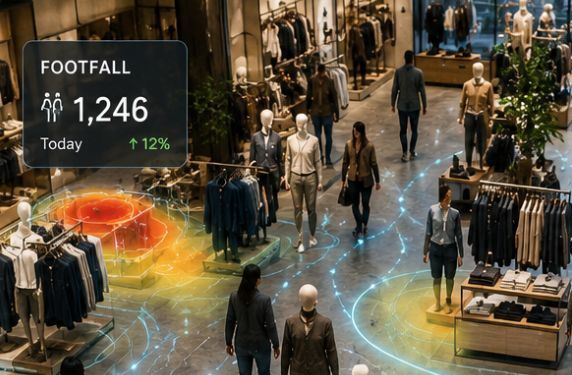
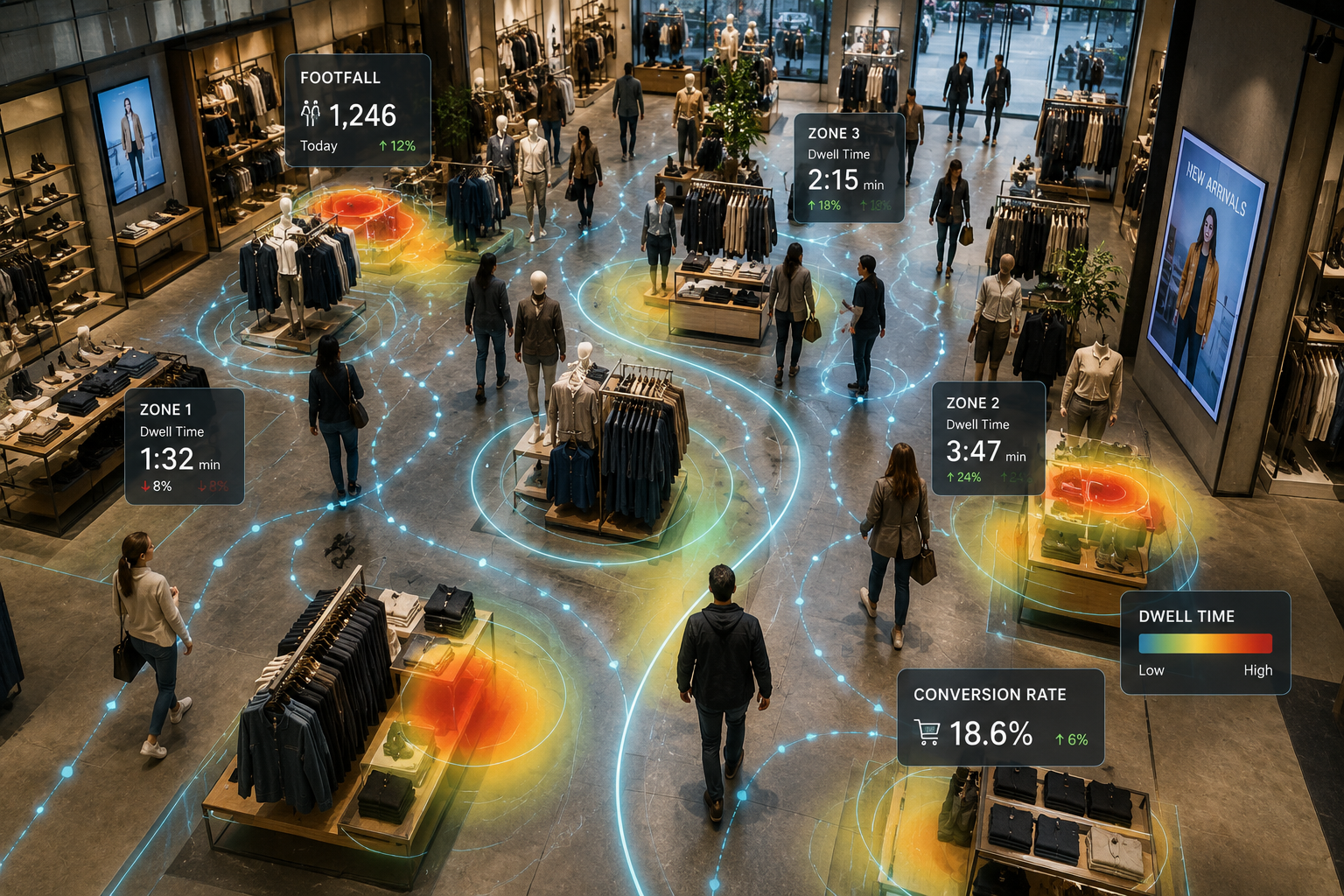 Smart stores are using data from sensors, cameras, point-of-sale systems, digital signage and other connected technologies to understand what happens between a customer entering and leaving a store. By analysing footfall, dwell time, customer flow, transactions and operational performance, retailers can improve layouts, staffing, content and service – making physical shopping more responsive to how customers actually behave.
Online retailers have enjoyed this visibility for years.
They can see which pages customers visit, where they linger, what they search for and where they abandon a purchase. Almost every interaction produces information that can be measured and used to refine the experience.
Physical retail has traditionally involved much more guesswork.
A store might know how many transactions it completed and how much revenue it generated. But what about the people who entered and bought nothing? Which displays attracted attention? Where did customers spend time? Did a queue cause them to leave?
Smart store technology is beginning to fill in those gaps.
Retail analytics is making customer behaviour more visible
Modern retail analytics can combine information from multiple sources to build a much richer picture of what is happening inside a store.
Footfall counters establish how many people enter. Sensors and video analytics can identify patterns of movement and dwell time. Point-of-sale data reveals what converts into a purchase, while inventory systems provide another layer of context.
The value comes from connecting those signals.
High footfall but low sales may point to a conversion problem. Strong dwell time around a product category could influence merchandising decisions. Consistently busy periods can help managers schedule more staff when customers actually need assistance.
This isn't simply about collecting more data. It is about asking better questions.
Data can change the store itself
One of the most interesting consequences is that the physical store becomes less fixed.
Traditionally, decisions about layouts, displays and customer journeys might remain largely unchanged until the next refurbishment. With better data, retailers can identify what is and isn't working much sooner.
That could mean relocating products because customer-flow data reveals an overlooked area. Staffing can be aligned more closely with demand. Digital signage content can change according to location, time or context rather than following the same schedule everywhere.
AI adds another dimension. By identifying patterns across increasingly large datasets, it can help retailers move from understanding what happened towards anticipating what might happen next.
The principle is similar to digital commerce: measure, learn and improve. The difference is that the optimisation is now happening in a physical environment.
The Cisco Store shows data-driven retail in action
A recent example comes from the Cisco Store, which Cisco uses as both a functioning retail environment and a technology testbed. In April 2026, the company described how it had integrated data from Meraki sensors, customer analytics and point-of-sale transactions through Splunk, allowing previously separate data streams to be correlated in real time.
The results demonstrate why that matters. Cisco reported using footfall, demographic and sales data to rethink store layouts and create more targeted experiences, producing a 20–30% increase in dwell time in high-interest zones. It also reported a 66% reduction in energy costs, while greater visibility reduced point-of-sale and network resolution times from hours to minutes.
Cisco is a confirmed ISE 2027 exhibitor, and the example illustrates a broader shift: store data can influence both what customers experience and how efficiently the environment operates.
Smart stores need connected AV
This has important implications for AV technology.
Digital signage can become part of a feedback loop in which content is deployed, its impact measured and future communications refined. Sensors can provide context about how spaces are being used. Connected displays and content platforms allow changes to be implemented rapidly across individual stores or entire estates.
At ISE 2027, exhibitors including Cisco, BrightSign and Navori Labs reflect different parts of this increasingly connected retail environment, spanning infrastructure, digital signage, content management and analytics.
The opportunity isn't to make every shop resemble a technology demonstration.
It is to use data to make better decisions: where to put products, when to deploy staff, what information to show and where friction can be removed from the customer journey.
Online retail taught businesses how valuable it is to understand customer behaviour. Smart stores are bringing some of that intelligence into the physical world – and giving retailers new ways to make every visit work better.
Frequently Asked Questions
What is a smart store?
A smart store uses connected technologies such as sensors, analytics, AI, digital signage and networked systems to improve retail operations and the customer experience.
What data can retailers collect in physical stores?
Depending on the technologies deployed and applicable privacy requirements, retailers can analyse information such as footfall, dwell time, customer-flow patterns, sales conversion, inventory levels and operational performance.
How can retail analytics improve the customer experience?
Analytics can reveal where customers encounter friction, which areas attract attention and when stores are busiest. Retailers can use those insights to improve layouts, staffing, product availability and communications.
How does digital signage use retail data?
Connected digital signage can use contextual and operational data to make content more relevant to a particular location, audience, time or situation, while engagement data can help retailers assess and refine campaigns.
Stay ahead – Stay informed.
As an AV specialist or industry leader, you recognise how crucial it is to keep up with evolving trends, new technologies, and notable happenings within the audiovisual world. That's why we're delighted to invite you to receive exclusive email updates about ISE – the world-renowned annual tech show for the systems integration and audiovisual industry.
When you subscribe, you'll be kept up to speed with insightful commentary on the freshest developments in AV, get early looks at what's planned for the ISE content schedule – including headline speakers – and benefit from in-depth reporting on the show's standout attractions.
Sign up now?to stay at the forefront of audiovisual innovation and expertise.
Further reading
Find out more about digital signage at ISE
Learn more about why retail professionals should come to ISE
Related articles:
-
The best retailers now think like software companies – Discover why leading retailers are adopting a continuous cycle of testing, measuring and improving the physical store.
-
How AI Is reshaping customer engagement – Explore how AI is helping organisations make customer interactions more relevant, responsive and personalised.
-
Interactive retail is no longer about touchscreens – See how retailers are moving beyond standalone interactive displays to create more intuitive, connected ways to engage shoppers.
-
The store is becoming a digital experience platform – Find out how connected technologies are turning physical stores into dynamic environments that can adapt to customers, content and changing business needs.
-
Why stores are turning into media experiences – Discover why retailers are increasingly using content, AV and digital media to make the physical store a destination in its own right.
Related Content
-
) Why continuous improvement is replacing one-off store design.
Why continuous improvement is replacing one-off store design. -
) For years, success in digital signage was often measured by the capabilities of an individual platform. Today, it is increasingly about ecosystems.
For years, success in digital signage was often measured by the capabilities of an individual platform. Today, it is increasingly about ecosystems. -
) The most successful interactive experiences are no longer defined by the technology customers use. They are defined by how actively customers participate.
The most successful interactive experiences are no longer defined by the technology customers use. They are defined by how actively customers participate. -
) Consumers can buy almost anything online. But they can't download atmosphere, personal attention or a sense of belonging. That's changing how luxury brands think about physical spaces.
Consumers can buy almost anything online. But they can't download atmosphere, personal attention or a sense of belonging. That's changing how luxury brands think about physical spaces. -
) Success in marketing communications used to be measured by reach. Today, responsiveness matters just as much.
Success in marketing communications used to be measured by reach. Today, responsiveness matters just as much.
Featured Articles
-
) Spanning all eight halls at Fira de Barcelona Gran Via, ISE 2026 delivered four days of record-breaking energy, creativity, and innovation.
Spanning all eight halls at Fira de Barcelona Gran Via, ISE 2026 delivered four days of record-breaking energy, creativity, and innovation. -
) The initiative will create new opportunities for talent development, innovation and community projects across the sector
The initiative will create new opportunities for talent development, innovation and community projects across the sector -
) The Facts & Figures report for ISE 2026 is available to download.
The Facts & Figures report for ISE 2026 is available to download. -
) Bringing together startups, investors and industry leaders, the expanded show feature offers a strong platform for visibility, networking, and commercial opportunity.
Bringing together startups, investors and industry leaders, the expanded show feature offers a strong platform for visibility, networking, and commercial opportunity. -
) This new type of event brings together end users, creators and production specialists from broadcast, live events, advertising and gaming, combining creative showcases, editorial programming and netwo ...
This new type of event brings together end users, creators and production specialists from broadcast, live events, advertising and gaming, combining creative showcases, editorial programming and netwo ...
)
)

)
)
)
)
)
)
)
)
)
)
)
)
)
)
)
)
)
)
)
)
![rAVe [PUBS]](https://cdn.asp.events/CLIENT_Integrat_169E7B04_E6F3_39F6_8BE4DB27C54F731E/sites/ise-2027/media/libraries/partners/rAVe-PUBS-Google-Logo.png/fit-in/500x500/filters:no_upscale())
)
)
)
)
)
)
)
)
)
)
)
)
)
)
)
)
)
)
)
)
)

)
)
)
)
)
)
)
)
)
)
)
)