

What roles does a games engine play in pro AV?
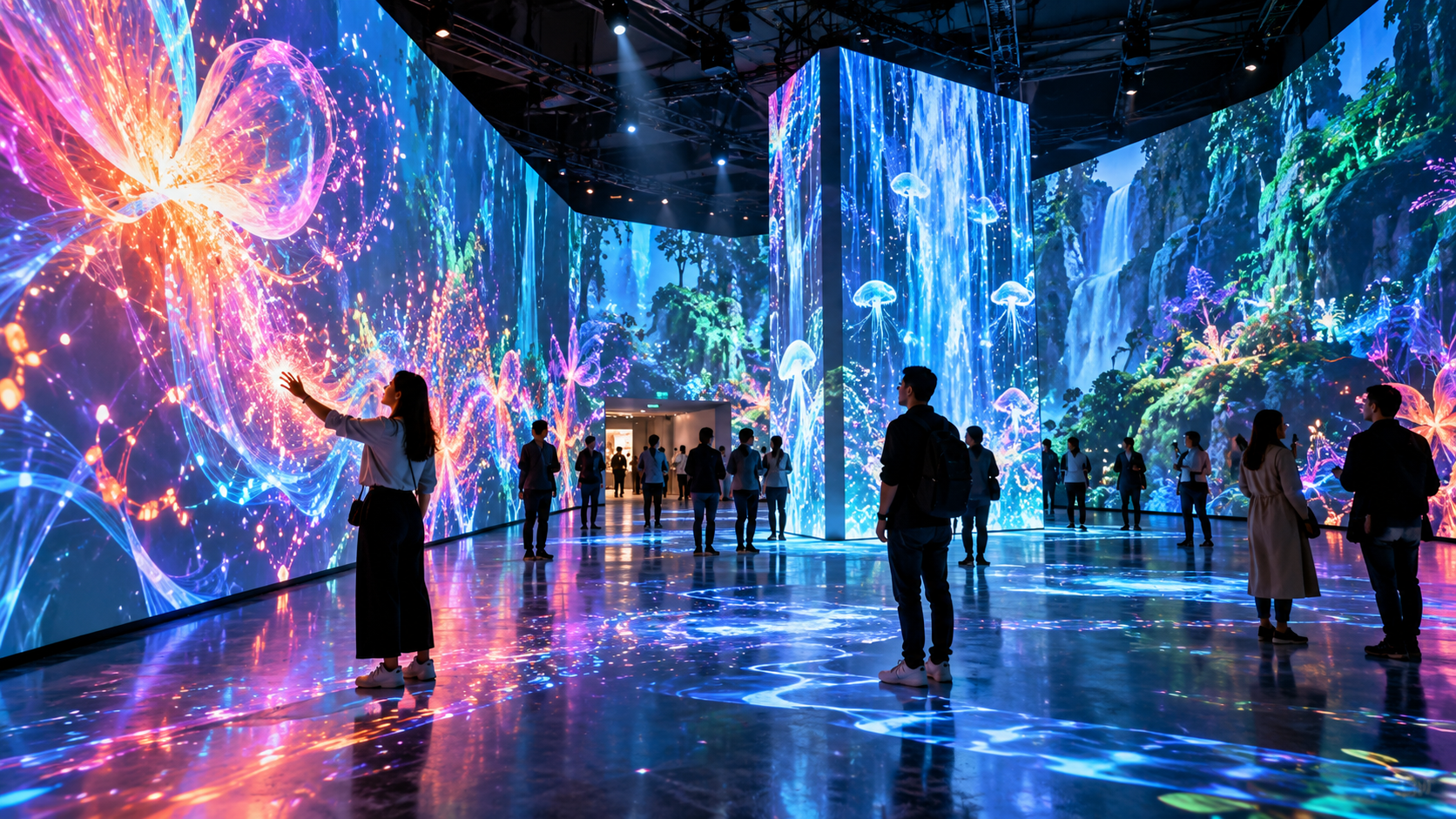
Games engines have become one of the most important technologies in professional AV. They are used to create real-time graphics, interactive experiences, virtual environments and simulations that help organisations communicate, entertain and engage audiences in new ways.
By Adrian Pennington
“Game engine technology has transformed immersive installations by enabling artists to create dynamic, explorable 3D worlds on flat surfaces, unlocking new possibilities for depth, composition, audience immersion and creative expression,” says Gemma Campbell, Creative Services Manager (EMEA) at Disguise. “All this while allowing experiences to be easily scaled and adapted across different venues.”
Real-time content creation
Traditional media workflows typically produce finished video that cannot easily adapt once created. Games engines generate graphics as they are needed, allowing scenes to respond immediately to user actions, sensor data, changing conditions or live events.
The IAMT identified game engines as the focal point that has driven convergence between the video game industry and broadcast media and entertainment.
This toolset is becoming integral to pro AV applications ranging from digital twins to immersive attractions and connected vehicles.
“The growing demand for live interactive visual content in a variety of market verticals is driven by a demand for more experiential media and is supporting demand for real-time video content created with game engine technology,” states the IAMT.
Virtual production
Outside of gaming, the highest-profile application for the technology is virtual production. Digital environments rendered in the games engine can be displayed on LED walls and updated in real time as cameras move through a scene. Because backgrounds respond naturally to camera position and perspective, productions can capture convincing environments and effects in-camera (ICVFX) without relying entirely on location shooting or extensive VFX after filming.
Digital twins
Digital twins have emerged as one of the most significant enterprise applications for games engines. Unlike a static three-dimensional model, a digital twin can incorporate data from sensors and connected systems and update continuously to reflect real-world conditions. Games engines provide the visual layer that makes these systems understandable. Buildings, transport networks, factories and urban infrastructure can all be represented visually, making complex operational information easier to interpret.
For example, the opportunity to repurpose 3D models created in the computer-aided design process of automotive manufacturing into game engine pipelines enables efficient use of high-quality assets for test driving simulations.
Esports
Competitive gaming has developed into a sophisticated media business that combines the demands of live broadcasting, digital distribution and entertainment production. Viewers expect polished presentation, advanced graphics and immersive experiences.
Games engines help make this possible by powering virtual sets, data visualisations, and graphics packages. Real-time rendering allows production teams to create content that responds instantly to gameplay, making broadcasts more engaging and easier for audiences to follow.
Experiential content
Museums, visitor attractions, brand activations, entertainment venues and public installations are all looking for ways to create memorable experiences. Rather than presenting information through fixed displays, they want experiential environments that react to visitors and encourage participation.
Games engines enable immersive storytelling across multiple screens, projection systems, LED volumes, mobile devices and extended-reality platforms. Because content can respond dynamically to audience behaviour, visitors become active participants rather than passive observers.
This capability is helping drive the broader growth of the experience economy, where engagement and interaction are often considered as important as the content itself.
Games engine versus rendering engine
Games engines should not be confused with rendering engines. A rendering engine focuses on generating visual output. Its primary task is producing images by calculating lighting, materials, shadows and VFX.
A games engine extends these capabilities. It also contains systems for animation, audio, interaction, physics simulation, asset management and scripting. In simple terms, a rendering engine creates pictures, while a games engine provides the framework needed to build and operate an interactive virtual world.
Platforms from vendors such as Disguise and Vizrt provide users with the flexibility to build workflows and switch between render engines without needing to reconfigure their creative assets.
Convergent job skills
As game engine technology has matured to become more streamlined, accessible and adaptable across industries, new types of skill and job role are emerging.
“There is growing demand for previsualisation artists and creative technologists who can combine artistic expertise with an understanding of workflows, hardware and display technologies,” Campbell says.
At ISE you can learn how to actively foster this cross-disciplinary collaboration to accelerate production, improve quality, unlock new techniques and push the boundaries of what is creatively possible.
About the author
Adrian Pennington is a journalist, editor and copywriter with over two decades' experience specialising in the production, the technology, the business and the craft of the moving image. Connect with him on LinkedIn.
Stay ahead – Stay informed.
As an AV specialist or industry leader, you recognise how crucial it is to keep up with evolving trends, new technologies, and notable happenings within the audiovisual world. That's why we're delighted to invite you to receive exclusive email updates about ISE – the world-renowned annual tech show for the systems integration and audiovisual industry.
When you subscribe, you'll be kept up to speed with insightful commentary on the freshest developments in AV, get early looks at what's planned for the ISE content schedule – including headline speakers – and benefit from in-depth reporting on the show's standout attractions.
Sign up now to stay at the forefront of audiovisual innovation and expertise.
Further reading
Discover emerging technologies at ISE
Related articles
What is a digital twin?
Discover how live virtual models use real-time data to represent physical environments, helping organisations understand and manage complex systems.
What is an immersive experience?
Explore the technologies that turn audiences from passive observers into active participants in digital environments.
Esports: the game has only just begun
Discover how competitive gaming is developing as a live entertainment and broadcast market, creating new opportunities for professional AV technology.
Featured Articles
-
 Spanning all eight halls at Fira de Barcelona Gran Via, ISE 2026 delivered four days of record-breaking energy, creativity, and innovation.
-
 The initiative will create new opportunities for talent development, innovation and community projects across the sector
-
 The Facts & Figures report for ISE 2026 is available to download.
-
 Bringing together startups, investors and industry leaders, the expanded show feature offers a strong platform for visibility, networking, and commercial opportunity.
-
 This new type of event brings together end users, creators and production specialists from broadcast, live events, advertising and gaming, combining creative showcases, editorial programming and netwo ...