

Why do so many venues fall behind before they're even finished?
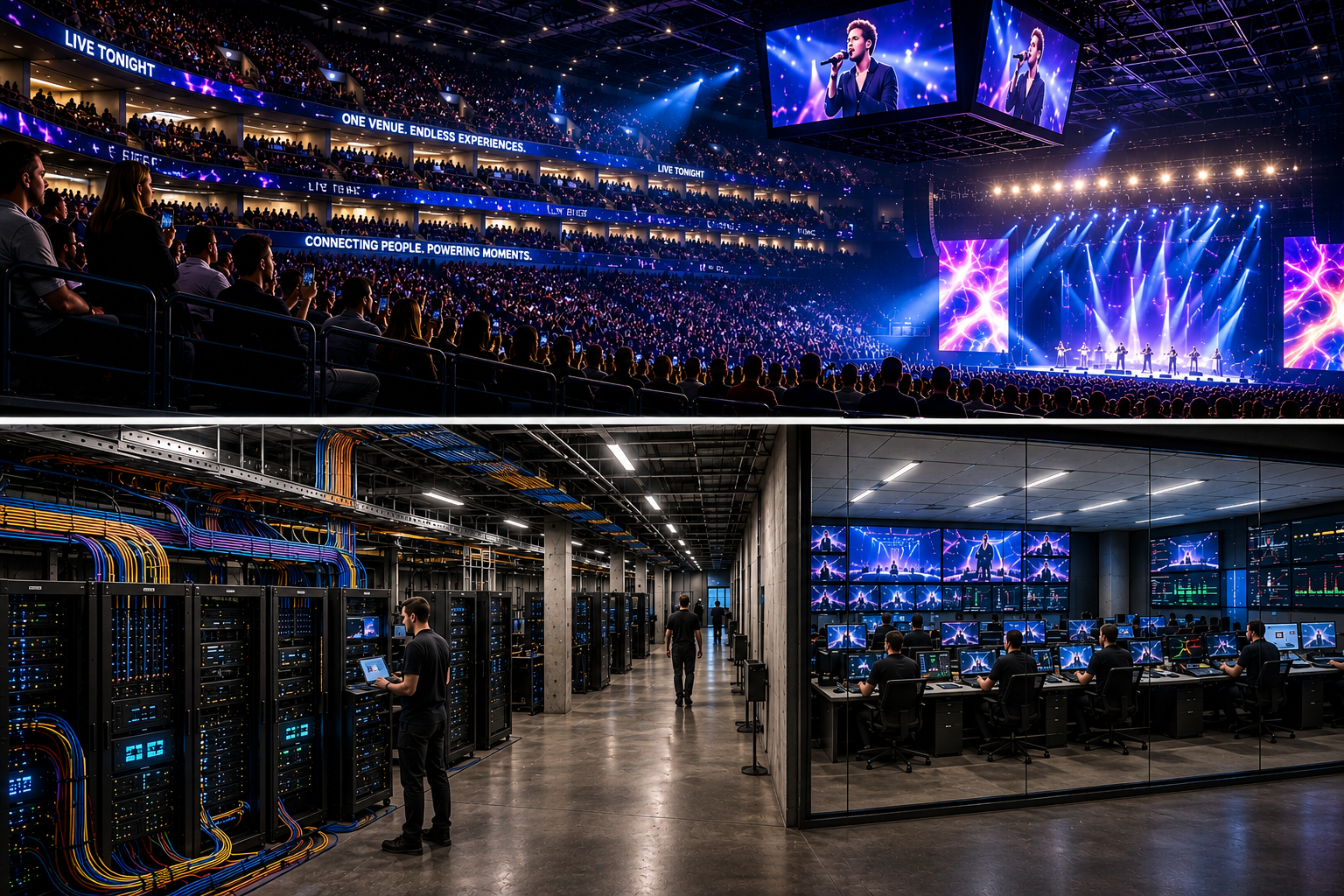
New stadiums, arenas and theatres can fall behind technologically before they are even finished because buildings and technology operate on very different timescales.
Updated 9 September 2026
A major venue may take years to plan and construct, while networking, AV, software and audience expectations continue evolving throughout that period. Future-ready venue design therefore depends less on predicting which products will be needed at opening and more on creating flexible infrastructure that can accommodate change.
Calling a new venue "future-proof" has always been risky. Today, it is becoming harder still.
A display, processor or control system specified early in a project may have moved on significantly by the time the building opens. New production workflows emerge. Bandwidth requirements increase. Software changes. Meanwhile, operators discover new ways of using their venues that may never have appeared in the original brief.
The challenge is not simply choosing the latest technology. It is reconciling long construction cycles with much shorter technology cycles.
Future-proof venue design starts with infrastructure
Trying to predict the exact technology a venue will need a decade from now is unlikely to work. Designing infrastructure that allows technology to change is a more practical objective.
That puts greater emphasis on elements audiences may never see: network capacity, fibre and cabling pathways, power provision, equipment spaces, IP architecture and the ability for different systems to exchange information.
AV-over-IP can play an important role because it makes signal distribution less dependent on fixed point-to-point connections. The choice of architecture matters too. Commercial Integrator notes that open AV-over-IP platforms can provide greater interoperability and hardware freedom, while closed ecosystems trade some of that flexibility for tighter manufacturer control.
For a venue expected to operate for decades, that is more than a technical decision. It can affect how easily systems can be expanded, reconfigured or replaced later.
Multi-use venues make flexibility even more important
Technology planning is becoming harder because the purpose of the venue itself may change.
An arena designed primarily for sport may also need to accommodate concerts, esports, conferences, exhibitions, hospitality and content production. Each places different demands on displays, audio, connectivity, broadcast infrastructure and production workflows.
A current example comes from Coventry Building Society Arena. In August 2026, Coventry City FC and the arena announced a ten-year partnership with Legends Global, backed by joint investment of more than £15 million over the next three years. The ambition is to develop the site as a 365-day destination for sport, live music, exhibitions, conferences and hospitality.
It demonstrates why venue technology cannot be planned solely around the event format that dominates when the original brief is written. The business model itself can evolve.
Build for expansion, not permanence
There is a useful lesson here from ISE 2027 exhibitors LANG AG and NETGEAR.
LANG originally created a permanent two-switch AV-over-IP network so its engineers could test ST 2110 and IPMX equipment without repeatedly building temporary networks. As its requirements grew, so did the infrastructure. The network expanded from two switches to four, then ten and eventually 22 switches across multiple buildings, supporting testing, training, meeting and production environments.
The value lies not simply in its scale but in the way it evolved. LANG's Sven Bauschke describes being able to make changes across different buildings because they are part of the same network – flexibility that the company's previous traditional infrastructure could not provide.
A stadium or arena is clearly a very different environment, but the principle translates. Requirements changed, the network expanded, and the underlying architecture was able to accommodate that growth.
That shifts the idea of future-proofing away from permanence. The more useful objective is upgradeability.
Venue technology planning needs to start earlier
Achieving that flexibility also changes when AV decisions need to be made.
AV, IT and digital infrastructure cannot be left until a building is largely designed and treated as equipment that will simply be installed into finished spaces. Decisions made much earlier about architecture, cable routes, networks, power and equipment spaces can determine what becomes possible later.
Commercial and operational teams also need a voice. What events might the venue host? Could it become a broadcast or content-production environment? How might sponsorship change? What digital services could audiences expect? How quickly will spaces need to switch between different uses?
Those are business questions, but increasingly they have infrastructure consequences.
This is particularly important as AV and IT continue to converge. A venue's network may ultimately need to carry or connect everything from digital signage and production video to audio, control, ticketing and audience-facing digital services. Designing each technology as an isolated system can make future changes much harder.
ISE 2027 exhibitors including Luminex Network Intelligence are helping venues build high-performance network infrastructures designed to support increasingly connected AV environments. At the visual layer, Brompton Technology develops LED video processing technologies that give venues and production teams greater flexibility in deploying large-format displays, while Stage Precision provides software that connects and controls multiple production technologies within a unified environment. Together, these technologies illustrate an important principle of future-ready venue design: flexibility depends not on any single product, but on an infrastructure in which networks, displays and production systems can evolve as requirements change.
The best future-proofing strategy is to expect change
At ISE 2027, technologies relevant to this challenge span the show floor, from networked AV and control to professional audio, large-format displays and live production.
But for venue owners, architects, consultants and technology teams, the bigger question comes before individual products are selected: how easily will this venue accommodate technologies and uses that haven't been specified yet?
No venue can be genuinely future-proof. Displays will be replaced, software will evolve and audience expectations will change.
The goal should therefore be to make change part of the design. A venue built around accessible, scalable infrastructure may still need significant technology investment throughout its life – but it is far less likely to find that the building itself stands in the way.
Frequently asked questions
What does future-proofing a venue mean?
Future-proofing does not mean installing technology that will never become obsolete. It means designing networks, cabling, power, equipment spaces and other infrastructure so technology can be upgraded or replaced without extensive redesign.
Why should AV technology be considered early in venue design?
Early decisions about network capacity, cable pathways, equipment locations and power provision can determine how easily AV systems can be installed, expanded and upgraded later.
How does AV-over-IP help venues adapt?
AV-over-IP distributes audio and video using network infrastructure rather than relying entirely on dedicated point-to-point connections. Depending on the architecture chosen, this can make systems easier to expand and reconfigure as requirements change.
Why do multi-use venues need flexible technology?
Sport, concerts, conferences, esports and other events can require very different audio, display, production and connectivity workflows. Flexible infrastructure makes it easier for a venue to accommodate those changing requirements.
 Stay ahead – Stay informed.
As an AV specialist or industry leader, you recognise how crucial it is to keep up with evolving trends, new technologies, and notable happenings within the audiovisual world. That's why we're delighted to invite you to receive exclusive email updates about ISE – the world-renowned annual tech show for the systems integration and audiovisual industry.
When you subscribe, you'll be kept up to speed with insightful commentary on the freshest developments in AV, get early looks at what's planned for the ISE content schedule – including headline speakers – and benefit from in-depth reporting on the show's standout attractions.
Sign up now to stay at the forefront of audiovisual innovation and expertise.
Further reading
Find out more about live events, audio, lighting and staging at ISE
Find out more about infrastructure, control and multi-technology at ISE
Related articles
- Smart stadiums are about business, not buildings – Discover how connected technology can help stadiums increase utilisation, improve operations and create new commercial opportunities.
- The best venues are no longer built for one purpose – Explore why flexibility is becoming essential as venues move between sport, concerts, conferences, esports and other event formats.
- The network is becoming the most important AV device – Find out why connectivity is becoming the foundation for increasingly sophisticated AV environments.
- Venues are becoming live media factories – See why more venues are developing production and content capabilities to reach audiences far beyond the building itself.
Related Content
-
) How do venues improve the fan experience? By removing friction at every stage.
How do venues improve the fan experience? By removing friction at every stage. -
) Technology does not automatically make a venue smarter. The real transformation comes when tech is connected to operational and commercial objectives.
Technology does not automatically make a venue smarter. The real transformation comes when tech is connected to operational and commercial objectives. -
) Why the biggest live productions now resemble infrastructure projects rather than concert tours.
Why the biggest live productions now resemble infrastructure projects rather than concert tours. -
) For years, 5G was set to revolutionise live events: faster downloads, lower latency, better connectivity, smarter venues. The reality has been more complicated.
For years, 5G was set to revolutionise live events: faster downloads, lower latency, better connectivity, smarter venues. The reality has been more complicated. -
) Ticketing is becoming one of the most valuable data assets in the live events industry.
Ticketing is becoming one of the most valuable data assets in the live events industry.
Featured Articles
-
) Spanning all eight halls at Fira de Barcelona Gran Via, ISE 2026 delivered four days of record-breaking energy, creativity, and innovation.
Spanning all eight halls at Fira de Barcelona Gran Via, ISE 2026 delivered four days of record-breaking energy, creativity, and innovation. -
) The initiative will create new opportunities for talent development, innovation and community projects across the sector
The initiative will create new opportunities for talent development, innovation and community projects across the sector -
) The Facts & Figures report for ISE 2026 is available to download.
The Facts & Figures report for ISE 2026 is available to download. -
) Bringing together startups, investors and industry leaders, the expanded show feature offers a strong platform for visibility, networking, and commercial opportunity.
Bringing together startups, investors and industry leaders, the expanded show feature offers a strong platform for visibility, networking, and commercial opportunity. -
) This new type of event brings together end users, creators and production specialists from broadcast, live events, advertising and gaming, combining creative showcases, editorial programming and netwo ...
This new type of event brings together end users, creators and production specialists from broadcast, live events, advertising and gaming, combining creative showcases, editorial programming and netwo ...
)
)

)
)
)
)
)
![[inst]ALLICHT](https://cdn.asp.events/CLIENT_Integrat_169E7B04_E6F3_39F6_8BE4DB27C54F731E/sites/ise-2027/media/libraries/partners/Inst_Allicht_Logo.png/fit-in/500x500/filters:no_upscale())
)
)
)
)
)
)
)
)
)
)
)
)
)
)
)
)
)
)
)
)
)
)
)
)
)
)
)
)
)
)
)
)

)
)
)
)
)
)
)
)
)
)
)
)
)
)
)