Session: Humanoid robots in AV: why we give machines a face, and who is really steering
Why we build robots to look like us, how autonomous trade show robots really are, and what two LANG AG experts advise AV teams planning robots at events.
- Event: ISE 2026
- From session: Why Robots Look Human: From culture to AV
- Speakers:
- Hannah Shellswell, Director of Training, Boost
- Rebekka Gingell, Manager Event Technology, LANG AG
- Francesco Elsing, Director Emerging Technologies, LANG AG
- Estimated read time: 8 minutes
- Watch the full session
Quick read summary
- Humanoid robots look human because people read human traits into machines, a habit film taught us long before real robots existed.
- Rebekka Gingell of LANG AG argued that most AV robots do not need a face, because their job is to be an interface.
- Francesco Elsing of LANG AG said both robots on stage were remote controlled, so the operator’s skill set the limit.
- At CES, Elsing counted about three robotics exhibitors one year and more than 100 the next, but only two were autonomous.
- The panel split on what reaches our homes first: Elsing expects household helpers within five years, Gingell expects robot pets.
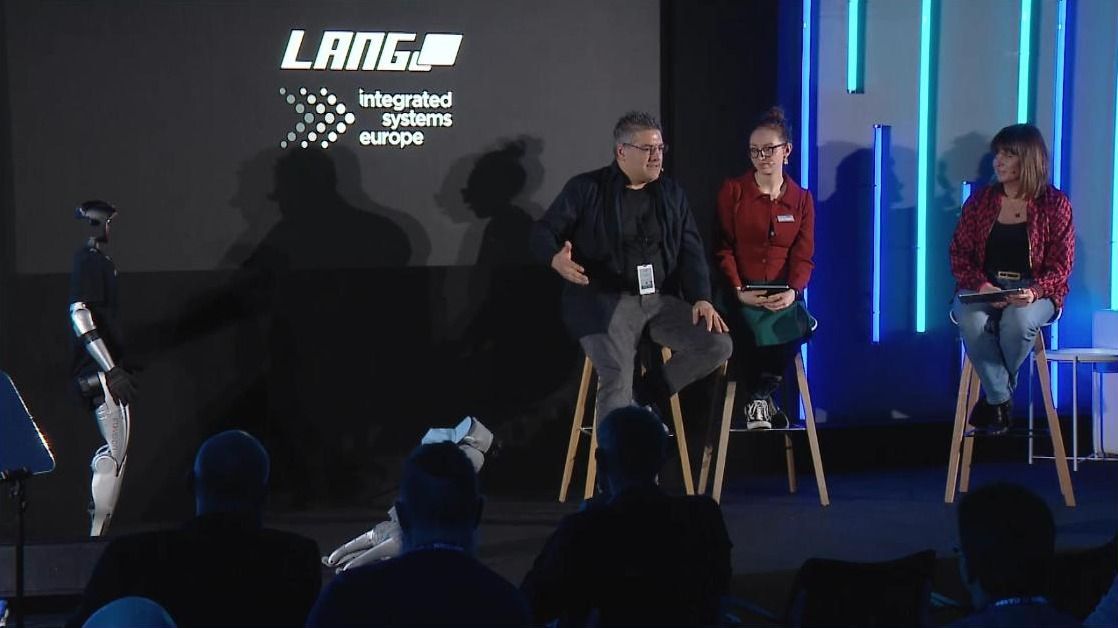
"So maybe the real question isn’t why do robots look human? But what does that say about us?" Rebekka Gingell, Manager Event Technology at LANG AG, put that to the room at the end of her opening talk. Beside her stood two machines from Unitree Robotics: a quadruped dog and one of the humanoid robots now turning up on AV stands.
The panel, moderated by Hannah Shellswell, Director of Training at Boost, closed the Megatrends programme at ISE 2026. It set Gingell’s cultural history against the engineering view of her colleague Francesco Elsing, Director Emerging Technologies at LANG AG.
Why do humanoid robots look human in the first place?
Humanoid robots look human because people read human traits into things, and a familiar shape makes a machine easier to trust. Gingell called the habit anthropomorphism and animism, a cognitive shortcut for trust, prediction and empathy.
Film did much of the teaching. Ask people to picture a robot, Gingell said, and many will see C-3PO or the machine-human of Metropolis from 1927, not a factory arm. Screen robots were often played by humans in costume.
We learned to read robots through human performance long before real robots even existed.
So a robot on a stand is judged as a performer first and a machine second.
The word robot started as forced labour
The word robot began as a word for forced labour, and the first fictional robots were workers with everything human taken out. It comes from Karel Čapek’s 1920 play R.U.R., and Gingell said the word is attributed to his brother, Josef, from robota, meaning work or forced labour.
So what is a humanoid robot? In the definition Gingell credited to Josef Čapek, it is a human-like machine designed to carry out tasks like a human agent. Androids, she said, are the humanoid subcategory, and the Oxford Dictionary traces the word to 1728. Robots began as workers stripped of everything unnecessary. Today, she said, we are bringing the humanness back in.
Do AV robots actually need a face?
Most AV robots do not need a face, Gingell argued, because their job is to act as an interface between people and a system. As she put it, they "are an interface for human interaction."
Then she argued with herself. If robots become long-term interfaces for artificial intelligence, would they have to pass the Turing test, developed by Alan Turing in the 1950s, where a person believes the machine to be human? Then a face becomes part of the job.
How much were the robots on stage doing for themselves?
Very little: Elsing said neither robot on stage was autonomous or had built-in artificial intelligence. Two operators in the audience were steering them. He added that "the limitations of a remote controlled operation is basically the limitations of the skillset of the operator."
| Level | How it works | Where it falls short | What an event team should ask |
|---|---|---|---|
| Remote controlled | An operator steers the robot live, as at ISE 2026 | The robot is only as good as the person steering it | Who operates it, and for how many hours? |
| Automated | Pre-programmed movement patterns, such as a dance routine | Fast and precise, but it cannot adapt when the space changes | How much room does the routine need? |
| Autonomous | The robot understands its surroundings and adapts to them | Needs heavy processing power that is not there yet | Can we see it work in a space that changes? |
The automated level looks the most impressive and hides the most. Elsing said a pre-programmed routine is no different from a robot that manufactures cars. "They’re fast, they’re precise, but they’re not made for environments that are changing like a small stage."
Still, Elsing said visitors stop and take out their phones, so robots already work as a marketing tool. ISE has asked whether robotics is quietly becoming the next AV platform.
Is robot autonomy months away, or years?
Years, on Elsing’s reading, though some say months, a forecast he called Elon timing. Autonomy needs heavy processing power inside the robot, and that is not there yet.
At CES, the Consumer Electronics Show, he found about three robotics companies a year earlier and more than 100 this year. Shellswell asked how many were autonomous. Two, Elsing replied, and he had watched one spend 12 minutes preparing a cup of tea.
So autonomy is not there yet, but the general hardware is there.
Household helpers or robot pets: where the panel split
The clearest split came over what enters our homes first. Pointing to Moore’s law, which he summarised as processing capacity doubling every two years, Elsing expects household robots within five years. Gingell expects robots shaped like animals to arrive well before anything that looks like us.
Her reasoning is about fear, not capability. A cute robot animal does not seem predatory. A human-shaped robot may have eyes that are cameras, which means surveillance in the house. "We are making tech more personal, yet we are still scared on an underlying level."
On adoption, Gingell’s point carries weight for anyone selling into homes, because privacy may decide what people accept. For integrators, ISE has looked at home robotics as the next frontier for technology integrators.
Who is responsible when a robot crosses a line?
Manufacturers carry the responsibility, Elsing said, but so does society. Gingell had set up the theme with Isaac Asimov’s three laws of robotics from 1942, and argued that as robots grow more autonomous, we need laws on how we go forward with them.
For anyone specifying a robot, the face, the voice and what the eyes record belong in the brief, not the small print. The same questions apply as automation redefines AV integration.
FAQ
- What is a humanoid robot, and is it the same as an android? A humanoid robot is a machine built in human form so it can carry out tasks in spaces designed for people. Rebekka Gingell of LANG AG described an android robot as the humanoid subcategory of robots, a word the Oxford Dictionary traces to 1728.
- Why are most robots at trade shows remote controlled? Most robots at trade shows are remote controlled because true autonomy needs processing power that robots do not yet carry. Francesco Elsing of LANG AG said both robots on the ISE 2026 stage were steered by operators in the audience.
- Which robots are likely to reach our homes first? Rebekka Gingell of LANG AG expects animal-shaped companion robots to come first, because a cute robot pet does not seem threatening. Francesco Elsing of LANG AG expects household robots within five years as processing power keeps doubling.
- How do the three laws of robotics apply to robots in AV? Isaac Asimov’s three laws, written in 1942, say a robot may not harm a human, must obey human orders and must protect itself. At ISE 2026, Rebekka Gingell of LANG AG argued that such rules matter more as robots become more autonomous.
The robots are a mirror before they are a tool
The robots that drew the crowds at ISE 2026 were not thinking for themselves. People in the audience were steering them. Yet visitors still reached for their phones. That gap between what a robot does and what we believe it does is what the session was really about.
Gingell’s history explains why the gap exists: we learned what a robot is from actors in costume. Elsing’s numbers explain why it will not close soon, with hardware arriving by the hundred and autonomy at CES running to two robots.
For AV teams that means two jobs at once. Buy robots for what they can do today, with an operator, a floor plan and an honest answer about which level of movement you are paying for. Then make the face, the voice and the camera deliberate choices, because they shape what audiences will trust.
Gingell closed her talk by asking whether we are building tools, colleagues, interfaces or mirrors of ourselves. On the evidence of this panel, for now the honest answer is mirrors that need a skilled operator.
About the speakers
Hannah Shellswell
Director of Training, Boost
Shellswell moderated the panel and hosted the Megatrends programme at ISE 2026.
Rebekka Gingell
Manager Event Technology, LANG AG
Gingell comes from a media and cultural history background and researches how media and culture interact.
Francesco Elsing
Director Emerging Technologies, LANG AG
Elsing has worked in the audiovisual industry for 20 years and at LANG has spent four years on new verticals, from drones to humanoid and quadruped robots.
See humanoid robots at ISE
Robots that look and act human are a regular sight at ISE.
- Emerging tech on the ISE show floor: the robotics companies exhibiting in Barcelona.
- The full ISE content programme: Megatrends sessions, summits and free stages across the show.
- First time at ISE? The new visitor guide shows you where to start.
Featured Articles
-
 Spanning all eight halls at Fira de Barcelona Gran Via, ISE 2026 delivered four days of record-breaking energy, creativity, and innovation.
-
 The initiative will create new opportunities for talent development, innovation and community projects across the sector
-
 The Facts & Figures report for ISE 2026 is available to download.
-
 Bringing together startups, investors and industry leaders, the expanded show feature offers a strong platform for visibility, networking, and commercial opportunity.
-
 This new type of event brings together end users, creators and production specialists from broadcast, live events, advertising and gaming, combining creative showcases, editorial programming and netwo ...