

Smart stadiums are about business, not buildings
Originally published 10 August 2026; updated 3 September 2026
Modern venues are evolving from places that host sporting events into year-round entertainment destinations. A stadium might host football one weekend and a concert the next, followed by a conference, esports tournament or community event. Each brings different audiences, operational requirements and commercial opportunities.
Technology therefore becomes more than infrastructure. It becomes a business enabler, helping venues improve decision-making, reduce costs, increase utilisation and create better experiences for visitors.
Connected technology creates connected experiences
One of the defining characteristics of a smart stadium is integration.
Historically, ticketing, security, AV, food and beverage, digital signage and building management systems often operated independently. Each might perform effectively, but valuable information remained trapped within individual systems.
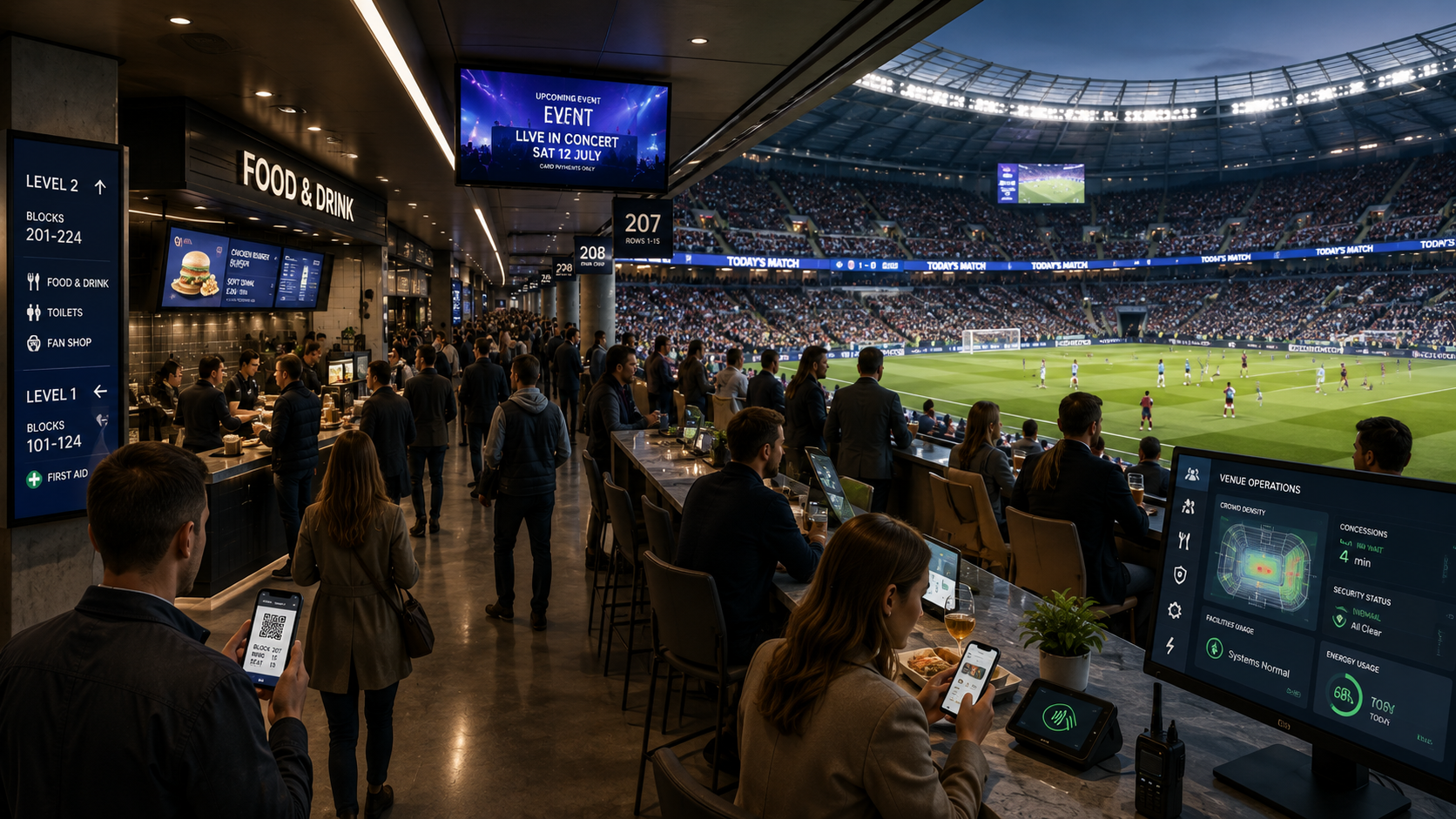
Connecting them changes what a venue can do. Crowd movement can inform staffing decisions. Digital signage can respond to changing conditions. Security teams can gain greater situational awareness, while hospitality operations become more responsive to demand. Sponsors can also gain new ways to reach particular audiences at relevant moments.
For visitors, much of this technology should be almost invisible. Better wayfinding, shorter queues, more relevant information and smoother mobile services matter more than the systems delivering them.
Data is becoming a stadium's most valuable asset
Every event generates huge amounts of information, from ticket sales and attendance patterns to retail purchases, parking usage, mobile interactions and building performance.
The opportunity lies in turning that data into action.
Analytics can help operators optimise staffing, understand crowd movement, manage energy consumption and identify commercial opportunities. Predictive maintenance can highlight potential equipment problems before they cause disruption, while building systems can respond dynamically to changing occupancy.
The important shift is from simply collecting information to using it to make better decisions.
Technology is creating new revenue opportunities
Commercial performance is becoming an increasingly important driver of stadium technology investment.
Dynamic digital signage can create more flexible sponsorship inventory. Mobile services can encourage food and beverage purchases while reducing queues. Premium hospitality can become more personalised, while connected platforms can help venues build longer-term relationships with visitors.
Technology can also make the building itself more versatile. Flexible AV infrastructure allows the same venue to accommodate sport, concerts, conferences, exhibitions and other events without extensive technological reconfiguration.
That matters because the economics of a modern stadium increasingly extend far beyond matchday. The more effectively a venue can accommodate different audiences and events, the harder its physical and digital infrastructure can work.
Premium hospitality shows what personalisation can deliver
Premium hospitality provides a particularly clear example of the commercial potential of connected technology.
The traditional proposition – a better seat, an exclusive lounge and premium catering – is increasingly being supplemented by a more connected visitor journey. Digital tickets and mobile services can bring together parking information, access, personalised itineraries, food and beverage ordering, wayfinding and exclusive content before a guest even reaches the venue.
Inside hospitality areas, integrated AV, digital displays and connectivity can create environments that respond to different events and audiences. The objective, however, should not be to surround premium guests with technology. It is to use technology to remove friction and make the experience feel more personal.
That distinction matters. A premium customer should not need to understand the systems connecting ticketing, access, hospitality, content and payments. Ideally, they simply experience a smoother journey.
There is a wider commercial benefit too. Better understanding of premium customers can help venues develop hospitality propositions, strengthen sponsor activation and maintain relationships beyond an individual event. In this sense, the most valuable ticket is not necessarily the one commanding the highest price on a particular night. It can be the one that begins a longer-term relationship with a high-value visitor.
Sustainability is part of the business case
Efficiency is another important part of the smart stadium equation.
Connected building systems can adjust lighting, heating and cooling according to occupancy. More efficient LED technologies can reduce power requirements, while networked monitoring and control can simplify maintenance and help operators understand where resources are being consumed.
With energy costs and sustainability expectations both affecting venue strategy, these benefits increasingly have a financial as well as environmental value. Smart infrastructure can help operators understand their buildings better and make more informed decisions about how they are used.
Case study: Tottenham Hotspur Stadium
Tottenham Hotspur Stadium provides a useful example of the broader business thinking behind the smart venue concept.
Designed as a multi-purpose destination rather than solely a Premier League football ground, the London venue has hosted NFL games, concerts, rugby and boxing alongside Tottenham Hotspur fixtures. Its retractable grass pitch can be moved beneath the South Stand to reveal an artificial surface underneath, allowing the stadium to accommodate other major events while protecting the football playing surface.
Technology was integrated into the venue from the outset. A high-capacity wired and wireless network supports systems including audiovisual technology, digital signage, access control, CCTV and building management. More than 90 LED displays are deployed across the stadium and surrounding campus, while high-density Wi-Fi and beacon technology support connectivity and digital wayfinding.
The visitor journey also makes extensive use of technology. Stadium entry is digital, while cashless payments are used throughout the venue.
Sanjeev Katwa, CTO of Tottenham Hotspur when the stadium opened, commented: “Creating a technology infrastructure to support an enhanced visitor experience requires solutions that can meet the growing demands of visitors that come to our new stadium.”
The significance of the model is not any individual system. It is the relationship between technology, flexibility and the stadium's wider commercial strategy. By creating infrastructure capable of supporting very different events and audiences, Tottenham Hotspur Stadium can operate as a sports and entertainment destination throughout the year rather than simply as a football ground.
For stadium owners and operators, that distinction is important. Smart stadiums are not defined by how much technology they contain. They are defined by how effectively technology contributes to better operations, stronger commercial performance and a better visitor experience.
Frequently Asked Questions
What is a smart stadium?
A smart stadium uses connected technologies and data to improve venue operations, visitor experience, sustainability and commercial performance.
What technologies are used in smart stadiums?
Typical technologies include IP networking, LED displays, digital signage, building management systems, security technology, ticketing platforms, Wi-Fi, professional audio and operational analytics.
Why are stadiums becoming smarter?
Venues are investing in connected technology to improve operational efficiency, generate new revenue, enhance visitor experiences and make facilities more flexible for year-round use.
Can smart stadium technology improve sustainability?
Yes. Energy monitoring, intelligent building controls, efficient lighting and predictive maintenance can help venues reduce resource consumption as well as operating costs.
 Stay ahead – Stay informed.
As an AV specialist or industry leader, you recognise how crucial it is to keep up with evolving trends, new technologies, and notable happenings within the audiovisual world. That's why we're delighted to invite you to receive exclusive email updates about ISE – the world-renowned annual tech show for the systems integration and audiovisual industry.
When you subscribe, you'll be kept up to speed with insightful commentary on the freshest developments in AV, get early looks at what's planned for the ISE content schedule – including headline speakers – and benefit from in-depth reporting on the show's standout attractions.
Sign up now to stay at the forefront of audiovisual innovation and expertise.
Further reading
Find out more about live events, audio, lighting and staging at ISE
Find out more about digital signage at ISE
Related articles
- Venues are becoming live media factories – Discover why venues are increasingly creating content for audiences far beyond the people inside the building.
- Ticketing is no longer about tickets – Explore how ticketing data is helping venues understand audiences, personalise experiences and create new commercial opportunities.
- Why do so many venues fall behind before they're even finished? – Find out why technology planning needs to begin much earlier in the design of modern connected venues
Related Content
-
) How do venues improve the fan experience? By removing friction at every stage.
How do venues improve the fan experience? By removing friction at every stage. -
) Calling a new venue "future-proof" has always been risky. Today, it is becoming harder still.
Calling a new venue "future-proof" has always been risky. Today, it is becoming harder still. -
) Why the biggest live productions now resemble infrastructure projects rather than concert tours.
Why the biggest live productions now resemble infrastructure projects rather than concert tours. -
) For years, 5G was set to revolutionise live events: faster downloads, lower latency, better connectivity, smarter venues. The reality has been more complicated.
For years, 5G was set to revolutionise live events: faster downloads, lower latency, better connectivity, smarter venues. The reality has been more complicated. -
) Ticketing is becoming one of the most valuable data assets in the live events industry.
Ticketing is becoming one of the most valuable data assets in the live events industry.
Featured Articles
-
) Spanning all eight halls at Fira de Barcelona Gran Via, ISE 2026 delivered four days of record-breaking energy, creativity, and innovation.
Spanning all eight halls at Fira de Barcelona Gran Via, ISE 2026 delivered four days of record-breaking energy, creativity, and innovation. -
) The initiative will create new opportunities for talent development, innovation and community projects across the sector
The initiative will create new opportunities for talent development, innovation and community projects across the sector -
) The Facts & Figures report for ISE 2026 is available to download.
The Facts & Figures report for ISE 2026 is available to download. -
) Bringing together startups, investors and industry leaders, the expanded show feature offers a strong platform for visibility, networking, and commercial opportunity.
Bringing together startups, investors and industry leaders, the expanded show feature offers a strong platform for visibility, networking, and commercial opportunity. -
) This new type of event brings together end users, creators and production specialists from broadcast, live events, advertising and gaming, combining creative showcases, editorial programming and netwo ...
This new type of event brings together end users, creators and production specialists from broadcast, live events, advertising and gaming, combining creative showcases, editorial programming and netwo ...
)
)

)
)
)
)
)
)
)
![rAVe [PUBS]](https://cdn.asp.events/CLIENT_Integrat_169E7B04_E6F3_39F6_8BE4DB27C54F731E/sites/ise-2027/media/libraries/partners/rAVe-PUBS-Google-Logo.png/fit-in/500x500/filters:no_upscale())
)
)
)
)
)
)
)
)
)
)
)
)
)
)
)
)
)
)
)
)
)
)
)
)
)
)
)
)
)
)
)
.png/fit-in/500x500/filters:no_upscale())
)
)
)
)

)
)
)
)
)
)
)
)
)