

Robotics is taking AV automation into the physical world
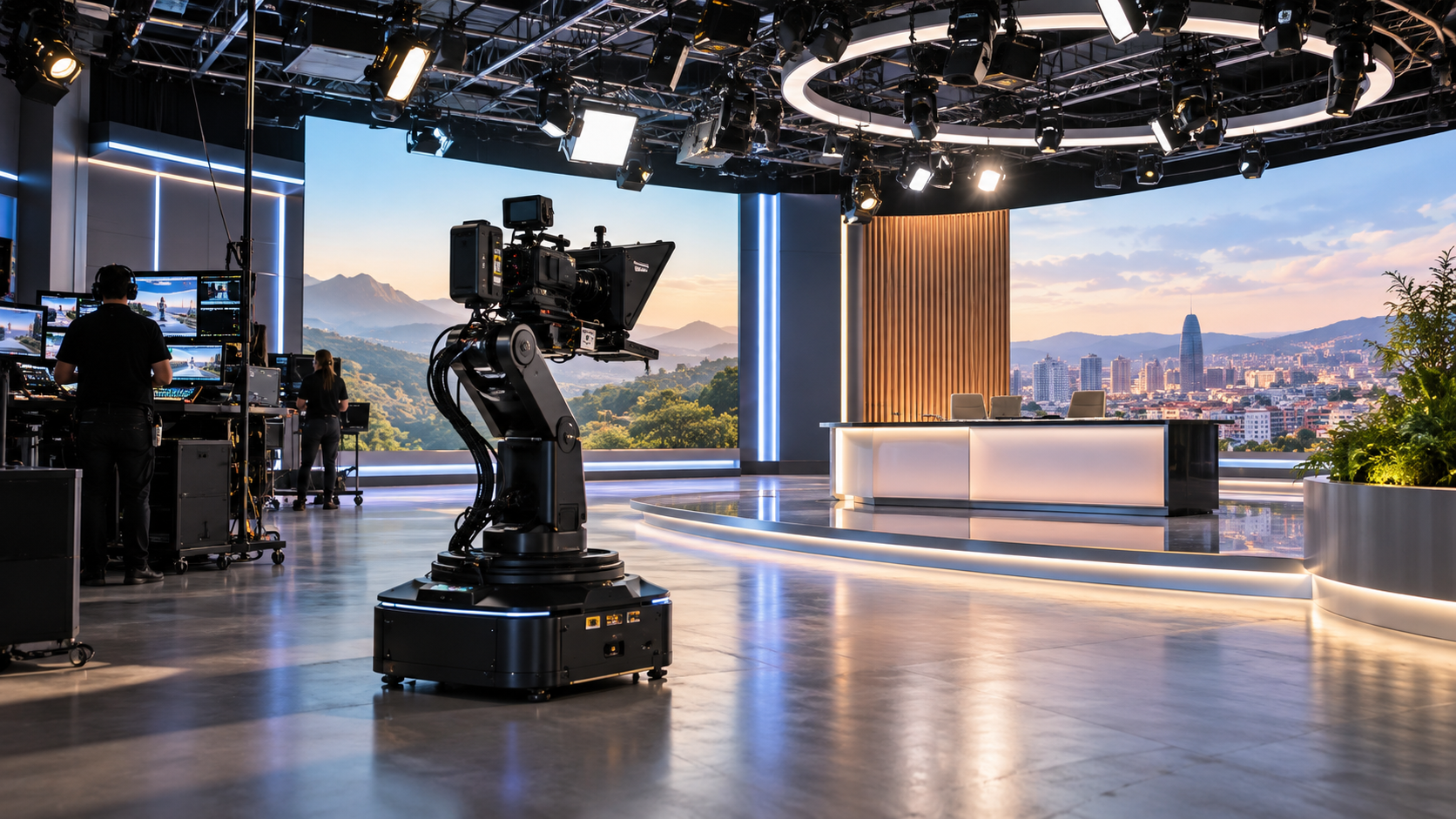
Robotics is extending AV automation beyond software and signal control into the physical world. Cameras can move themselves, lighting and scenery can be synchronised with other systems, while AI-enabled robots are beginning to perceive their surroundings and adapt their behaviour in real time.
That could have significant implications for professional AV.
The Audiovisual Robotics Report, published by the Switch Observatory of the Catalan Audiovisual Cluster, argues that robotics is developing from a production efficiency tool into what Cluster chairman Miquel Rutllant calls a “new creative and industrial lever”. Robots, he writes, are progressing from automated camera systems towards technologies that can expand narrative possibilities as well as simplify production tasks.
The shift matters because it changes what can be automated. AV systems have long been able to route video, recall lighting scenes or configure rooms. Robotics makes physical position and movement programmable too.
Why precision matters as much as automation
Robotic cameras are the most mature example. News production is particularly suited to automation because presenter movements and camera positions tend to be relatively predictable and repetitive.
But reducing the number of routine camera operations is only part of the story.
The report identifies several advantages of robotic cameras: they can repeat complex movements accurately, execute trajectories that would be difficult or impossible for a human operator, move extremely quickly, and coordinate the camera, lens and robotic system with lighting, VFX and other control platforms.
That repeatability becomes especially valuable when the physical and digital worlds have to match.
In virtual production, for example, robotic arms can repeatedly position a camera with millimetre-level precision while synchronising its physical movement with the virtual camera inside a rendering engine. In augmented reality, accurate positional and rotational data helps keep graphics locked convincingly into the physical scene. The same principle applies to VFX, where camera movement, lighting, shadows and perspective have to remain aligned across real and computer-generated elements.
The robot therefore becomes more than a device that moves a camera. Its movement becomes data within a larger AV workflow.
The physical environment is becoming part of the system
That idea extends beyond cameras.
The report documents robotics being used for moving sets and props, controlling lighting, constructing scenery and even retrieving physical media from audiovisual archives. In lighting, for example, robotic systems can synchronise changes with camera movement, performers and moving props, turning physical movement into another element of a programmed sequence.
This has an interesting consequence for AV design. Traditionally, much of an AV system's physical infrastructure has been fixed even when the signals and content flowing through it are dynamic. Robotics introduces the possibility that the physical layer itself can change.
A current example comes from Catalan broadcaster 3Cat (location of an ISE 2026 Tech Tour). Its new news set uses five Ross Video Artimo robots, equipped with geofencing and LiDAR. Rather than following the constraints of a conventional XY pedestal, the cameras can navigate the studio while virtual zones define where they can move, where they must slow down and where they must not enter. LiDAR creates a three-dimensional representation of the environment, allowing the system to recognise the studio, sets, people and other objects around it.
That is a useful glimpse of where robotics and conventional AV integration begin to converge: sensors, spatial data, control, networking and physical movement all become parts of the same system.
AI changes what automation can mean
The bigger transformation may come from artificial intelligence.
Switch Observatory editor Joan Rosés identifies the integration of AI into robot control – particularly the development of “physical AI” capable of understanding environment and context – as one of the most decisive factors shaping robotics.
The report describes the emerging field of cognitive robotics, in which AI gives robots the ability to perceive, learn, reason and adapt in changing physical environments. Instead of acting only as what the report calls “passive executors” of predetermined tasks, robots can increasingly combine vision, audio, touch and other sensor data, interpret a three-dimensional environment and adjust their behaviour.
That is a significant step beyond traditional AV automation.
A conventional automated system might tell a camera to move to position B after a presenter reaches a particular point in a programme. An intelligent robotic system could potentially recognise where the presenter is, understand what else is occupying the space, calculate a safe route and adapt the shot accordingly.
The distinction is between following a sequence and responding to a situation.
Robotics creates a networking challenge too
As robots become more intelligent, familiar IT and AV infrastructure questions follow them into the physical world.
The report distinguishes between robots whose processing happens centrally – potentially giving them access to greater computing power and shared information – and those with more intelligence at the edge. Cloud-dependent robots can be vulnerable to network availability, latency and security problems, whereas local processing offers faster responses and greater resilience at the cost of more limited compute capacity.
For that reason, the report identifies 5G, future 6G networks and edge computing as important robotics technologies. Processing sensor information close to the robot can reduce latency and allow quicker responses to changes in its surroundings.
For AV professionals already dealing with AV over IP, cloud platforms and edge processing, much of this architecture will look familiar. What changes is the consequence of latency or failure: the endpoint may now be physically moving through a room rather than simply displaying an image.
Safety, cybersecurity and system resilience therefore become inseparable from the experience.
Automation does not automatically mean replacement
That also makes the impact on skills more nuanced than a simple “robots replace people” narrative.
The report argues that the value of professional robotics depends on productivity, but defines that in several ways. Automation can replace repetitive, dangerous or low-value tasks, but it can also free skilled professionals for decision-making and creative work, undertake jobs requiring extreme precision or inaccessible locations, and address shortages where suitable people cannot be found.
There are still barriers. The report highlights the cost of adoption, limited autonomy, the difficulty of translating simulations into unpredictable real environments, shortages of physical-world training data and the need for human supervision. It also points to emerging Robots-as-a-Service models as one possible route to making robotics accessible beyond major studios and large organisations.
Those limitations are important because they suggest robotics will arrive unevenly. The immediate opportunity is unlikely to be humanoid robots suddenly taking over AV operations. It is more likely to be specific processes becoming robotic where precision, repeatability, safety or responsiveness produces a clear benefit.
The next AV endpoint might move
Perhaps the most useful way for AV professionals to think about robotics is therefore not as a completely new industry sitting alongside AV.
It is another stage in the evolution of automation.
Cameras already combine optics, processing, networking and AI. Lighting systems are already programmable. Virtual production already connects physical position with digital environments. Robotics adds controlled physical movement to that technology stack.
The Catalan Audiovisual Cluster describes intelligent robotics alongside AI, automation and virtualisation as one of the factors transforming audiovisual production. For integrators and technology buyers, that raises a new question.
The AV system of the future may not only have to decide what to show, capture or communicate. Increasingly, it may also need to understand where it is, what is happening around it and how it should move.
Frequently asked questions
What is audiovisual robotics?
Audiovisual robotics is the use of robotic systems to perform physical tasks within AV environments. Applications include moving and positioning cameras, controlling lighting and scenery, supporting virtual production and automating repetitive production processes.
How are robots used in professional AV?
Robots are already used for camera movement, studio automation, virtual production, lighting, sets and props, and audiovisual archive operations. Robotic systems can provide precise, repeatable movement while integrating with tracking, graphics, sensors and other AV technologies.
How is AI changing audiovisual robotics?
AI is helping robots move beyond executing predetermined instructions towards perceiving and responding to their surroundings. The report highlights cognitive robotics and physical AI as important developments that could enable robots to learn, reason and adapt within changing physical environments.
Will robots replace AV professionals?
Robotics can automate repetitive, dangerous or highly precise tasks, but the report also identifies opportunities to free skilled professionals for creative work and decision-making. Human expertise remains important for designing, programming, supervising and integrating robotic AV systems.
Further reading
Discover emerging technologies at ISE
Related articles
- Robotics is quietly becoming the next AV platform – Discover how robotics is converging with AI, sensors and AV technology to create systems that can move, adapt and interact with the physical world.
- What is edge computing? – Find out why processing data closer to where it is generated can make connected AV systems faster, more responsive and more resilient.
- The network is becoming the most important AV device – Explore why connectivity is becoming fundamental to the performance of everything from cameras and displays to increasingly intelligent AV endpoints.
Related Content
-
) Robotics is steadily becoming another layer of the audiovisual ecosystem.
Robotics is steadily becoming another layer of the audiovisual ecosystem. -
) Physical automation is rapidly shifting from a supporting layer to a defining force in modern integrated system delivery.
Physical automation is rapidly shifting from a supporting layer to a defining force in modern integrated system delivery. -
) A new frontier is emerging where AV infrastructure intersects with autonomous service robotics.
A new frontier is emerging where AV infrastructure intersects with autonomous service robotics. -
) With humanoid robots entering the consumer market at prices from $6,000, and the cost of advanced home robotics dropping, these technologies are becoming accessible to an expanding audience.
With humanoid robots entering the consumer market at prices from $6,000, and the cost of advanced home robotics dropping, these technologies are becoming accessible to an expanding audience. -
) In the past year, drone light shows have moved from a novelty to a staple in the live events world, the technology and scale of these performances have grown exponentially, creating ever-more mesmeris ...
In the past year, drone light shows have moved from a novelty to a staple in the live events world, the technology and scale of these performances have grown exponentially, creating ever-more mesmeris ...
Featured Articles
-
) Spanning all eight halls at Fira de Barcelona Gran Via, ISE 2026 delivered four days of record-breaking energy, creativity, and innovation.
Spanning all eight halls at Fira de Barcelona Gran Via, ISE 2026 delivered four days of record-breaking energy, creativity, and innovation. -
) The initiative will create new opportunities for talent development, innovation and community projects across the sector
The initiative will create new opportunities for talent development, innovation and community projects across the sector -
) The Facts & Figures report for ISE 2026 is available to download.
The Facts & Figures report for ISE 2026 is available to download. -
) Bringing together startups, investors and industry leaders, the expanded show feature offers a strong platform for visibility, networking, and commercial opportunity.
Bringing together startups, investors and industry leaders, the expanded show feature offers a strong platform for visibility, networking, and commercial opportunity. -
) This new type of event brings together end users, creators and production specialists from broadcast, live events, advertising and gaming, combining creative showcases, editorial programming and netwo ...
This new type of event brings together end users, creators and production specialists from broadcast, live events, advertising and gaming, combining creative showcases, editorial programming and netwo ...
)
)

)
)
)
)
)
.png/fit-in/500x500/filters:no_upscale())
)
)
)
)
)
)
)
)
)
)
)
)
)
)
)
)
)
![[inst]ALLICHT](https://cdn.asp.events/CLIENT_Integrat_169E7B04_E6F3_39F6_8BE4DB27C54F731E/sites/ise-2027/media/libraries/partners/Inst_Allicht_Logo.png/fit-in/500x500/filters:no_upscale())
)
)
)
)
)
)
)
.png/fit-in/500x500/filters:no_upscale())
![rAVe [PUBS]](https://cdn.asp.events/CLIENT_Integrat_169E7B04_E6F3_39F6_8BE4DB27C54F731E/sites/ise-2027/media/libraries/partners/rAVe-PUBS-Google-Logo.png/fit-in/500x500/filters:no_upscale())
)
)
)
)
)
)
)
)
)
)
)
)
)

)
)
)
.png/fit-in/500x500/filters:no_upscale())
)
)
)
)
)