

What is edge computing?
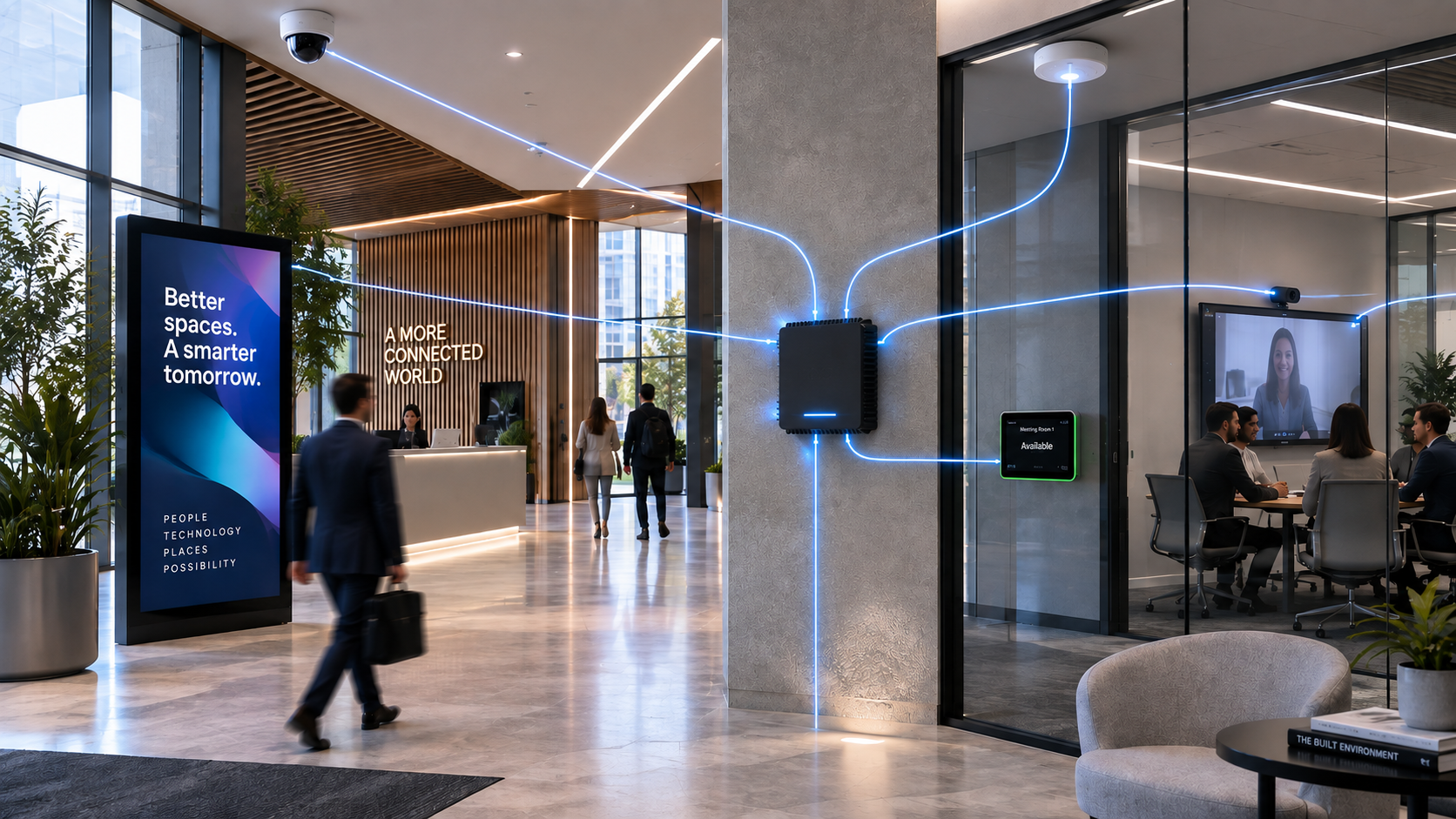
For professional AV, that is becoming increasingly important. An interactive display may need to react instantly to a customer, a smart building may be processing information from thousands of sensors, while a control room could be analysing multiple video feeds in real time.
Sending every piece of data to the cloud and waiting for a response is not always the best approach. Sometimes the processing needs to happen much closer to the experience itself.
That is the role of the edge.
How does edge computing work?
The "edge" could be a processor inside a device, a computer elsewhere in the building or a local server supporting multiple systems. What matters is its proximity to the application and the data it needs to process.
This does not mean replacing the cloud. In many installations, the two work together. The edge handles tasks where speed, resilience or local processing matter, while the cloud provides functions such as central management, storage and large-scale analytics.
This combination is particularly well suited to the demands of professional AV. AVIXA identifies edge computing as one of the technologies shaping AV over IP, with encoding, decoding and content processing moving closer to endpoints to reduce latency and bandwidth requirements.
Why does edge computing matter for AV?
Modern AV environments are generating and consuming enormous quantities of data. Think about high-resolution video, cameras, microphones, occupancy sensors, digital signage, room systems and other connected devices operating simultaneously across a building.
Sending all of that information somewhere else for processing is not always efficient.
An edge device can analyse data locally and decide what actually needs to travel across the network. It can also respond without waiting for a round trip to the cloud.
That matters when milliseconds affect the experience. An interactive installation needs to react when somebody moves. A videoconferencing system needs to process audio and video without distracting delays. A control room may need to analyse multiple video feeds in real time.
Edge computing moves the intelligence closer to the experience itself.
What is edge AI?
Artificial intelligence is making this particularly significant.
Many AI applications depend on analysing information gathered from the physical world. Cameras might identify objects or patterns, for example, while sensors provide information about how a space is being used.
With edge AI, some of that AI processing takes place locally.
Consider a digital signage installation in a retail environment. A camera could analyse what is happening nearby and allow the signage system to respond immediately, without transmitting the entire video stream to the cloud. Intel, for example, has highlighted the combination of AI, IoT and edge computing as a way of enabling more intelligent and immersive digital signage experiences.
Local processing can have privacy advantages too. Rather than transmitting raw data elsewhere, a system may be able to process it locally and send only the information that is required. That does not remove the need for appropriate privacy and security safeguards, but it can change the amount and type of data travelling across networks.
Does edge computing work if the internet goes down?
Another advantage is resilience.
Imagine a network of digital displays across hundreds of stores. If every display depends continuously on a cloud connection, a connectivity problem can become a customer-facing problem.
With appropriate local processing and storage, essential functions can continue at the edge even if the connection to central systems is temporarily interrupted. Cached signage content, for example, can continue playing during an outage.
That makes edge computing particularly interesting wherever AV has become business-critical. A screen that goes blank, a room that stops working or an interactive experience that stops responding is no longer simply an IT inconvenience. Users see the failure.
Is edge computing replacing the cloud?
Probably the most important thing to understand about edge computing is that this is not an edge-versus-cloud contest.
Cloud computing remains extremely powerful. It allows organisations to manage applications across locations, aggregate data, scale resources and update systems centrally.
The question is increasingly what should happen where?
A smart building might process sensor information locally so that rooms respond immediately to occupants, while sending aggregated information to a cloud platform for longer-term analysis. A digital signage network could play and adapt content at the edge while its CMS remains cloud-based. Sony's collaboration with NoviSign provides one current example, combining intelligent edge computing with cloud-based signage software. (Sony and NoviSign are both ISE 2027 exhibitors.) Thorsten Prsybyl, European Retail Sales Manager, Sony Professional Displays & Solutions Europe, said at launch: “By combining the processing power and energy efficiency of Sony's BRAVIA platform with NoviSign's robust CMS and Zero Touch Provisioning, we're offering a truly streamlined approach to digital signage – one that saves time, resources, and energy across the lifecycle of each deployment.”
This hybrid model allows organisations to put computing resources where they make most sense.
Why will edge computing become more important?
The amount of intelligence moving into physical spaces is increasing rapidly.
AV systems are becoming connected to sensors, AI platforms, building systems, corporate networks and cloud services. Displays are becoming interactive. Cameras are becoming data sources. Buildings are becoming responsive. Experiences are expected to adapt in real time.
All of that creates a simple challenge: where should the processing happen?
Increasingly, the answer will not be one central location. Computing will be distributed between devices, local edge infrastructure and the cloud according to the requirements of each application.
That makes edge computing more than an IT infrastructure trend. It is becoming part of the architecture behind the next generation of audiovisual experiences.
At ISE 2027, visitors will be able to explore the technologies that make those experiences possible, from AV-over-IP and network infrastructure to AI, digital signage, smart buildings and cloud-connected platforms. As AV, IT and intelligent systems continue to converge, understanding what happens at the edge will become increasingly important.
Frequently Asked Questions
What is edge computing, in simple terms?
Edge computing means processing data close to where it is created or used, rather than sending everything to a remote cloud or data centre. This can make systems faster and reduce the amount of data travelling across networks.
What is the difference between edge computing and cloud computing?
Edge computing processes data locally or close to connected devices, while cloud computing typically processes it in remote data centres. Many modern AV systems use both, with time-sensitive tasks handled at the edge and central management, storage and analytics handled in the cloud.
Why is edge computing important for AV?
Edge computing can reduce latency, save bandwidth and improve resilience. This is valuable for applications such as interactive displays, AV-over-IP, smart buildings, digital signage and AI-enabled cameras, where systems may need to process information and respond in real time.
Stay ahead – Stay informed.
As an AV specialist or industry leader, you recognise how crucial it is to keep up with evolving trends, new technologies, and notable happenings within the audiovisual world. That's why we're delighted to invite you to receive exclusive email updates about ISE – the world-renowned annual tech show for the systems integration and audiovisual industry.
When you subscribe, you'll be kept up to speed with insightful commentary on the freshest developments in AV, get early looks at what's planned for the ISE content schedule – including headline speakers – and benefit from in-depth reporting on the show's standout attractions.
Sign up now?to stay at the forefront of audiovisual innovation and expertise.
Further reading
Discover Emerging Technologies at ISE 2027
Related articles
- The network is becoming the most important AV device – Discover why network infrastructure is increasingly determining the performance, flexibility and intelligence of modern AV systems.
- Why AV and IT are finally becoming one conversation – Explore how connected technologies are breaking down the traditional boundaries between AV and IT teams.
- The future workplace will be designed by data – See how data from connected spaces is helping organisations understand how workplaces are used and make them more responsive.
Related Content
-
) Rather than simply protecting infrastructure or data, organisations are facing a new priority: protecting the integrity of decisions.
Rather than simply protecting infrastructure or data, organisations are facing a new priority: protecting the integrity of decisions. -
) Uptime, interoperability and cost still matter. But they no longer define whether a collaboration strategy succeeds.
Uptime, interoperability and cost still matter. But they no longer define whether a collaboration strategy succeeds. -
) These days, the value of office space is determined less by how much of it you have, and more by how effectively people use it.
These days, the value of office space is determined less by how much of it you have, and more by how effectively people use it. -
) The organisations creating the best employee experiences are not overwhelming people with technology. They are removing friction.
The organisations creating the best employee experiences are not overwhelming people with technology. They are removing friction. -
) The companies making the strongest case for returning to the office are not simply telling people to come back. They are giving them a reason to want to be there.
The companies making the strongest case for returning to the office are not simply telling people to come back. They are giving them a reason to want to be there.
Featured Articles
-
) Spanning all eight halls at Fira de Barcelona Gran Via, ISE 2026 delivered four days of record-breaking energy, creativity, and innovation.
Spanning all eight halls at Fira de Barcelona Gran Via, ISE 2026 delivered four days of record-breaking energy, creativity, and innovation. -
) The initiative will create new opportunities for talent development, innovation and community projects across the sector
The initiative will create new opportunities for talent development, innovation and community projects across the sector -
) The Facts & Figures report for ISE 2026 is available to download.
The Facts & Figures report for ISE 2026 is available to download. -
) Bringing together startups, investors and industry leaders, the expanded show feature offers a strong platform for visibility, networking, and commercial opportunity.
Bringing together startups, investors and industry leaders, the expanded show feature offers a strong platform for visibility, networking, and commercial opportunity. -
) This new type of event brings together end users, creators and production specialists from broadcast, live events, advertising and gaming, combining creative showcases, editorial programming and netwo ...
This new type of event brings together end users, creators and production specialists from broadcast, live events, advertising and gaming, combining creative showcases, editorial programming and netwo ...
)
)

)
)
)
)
)
)
)
)
)
)
)
)
)
)
)
![rAVe [PUBS]](https://cdn.asp.events/CLIENT_Integrat_169E7B04_E6F3_39F6_8BE4DB27C54F731E/sites/ise-2027/media/libraries/partners/rAVe-PUBS-Google-Logo.png/fit-in/500x500/filters:no_upscale())
)

)
)
)
)
)
)
)
)
)
)
)
)
)
)
)
)
)
)
)
)
)
)
)
)
)
)
.png/fit-in/500x500/filters:no_upscale())
)
)
)
)
)
)
)
)
)