

What is a digital twin?
By Adrian Pennington
Understanding the digital twin
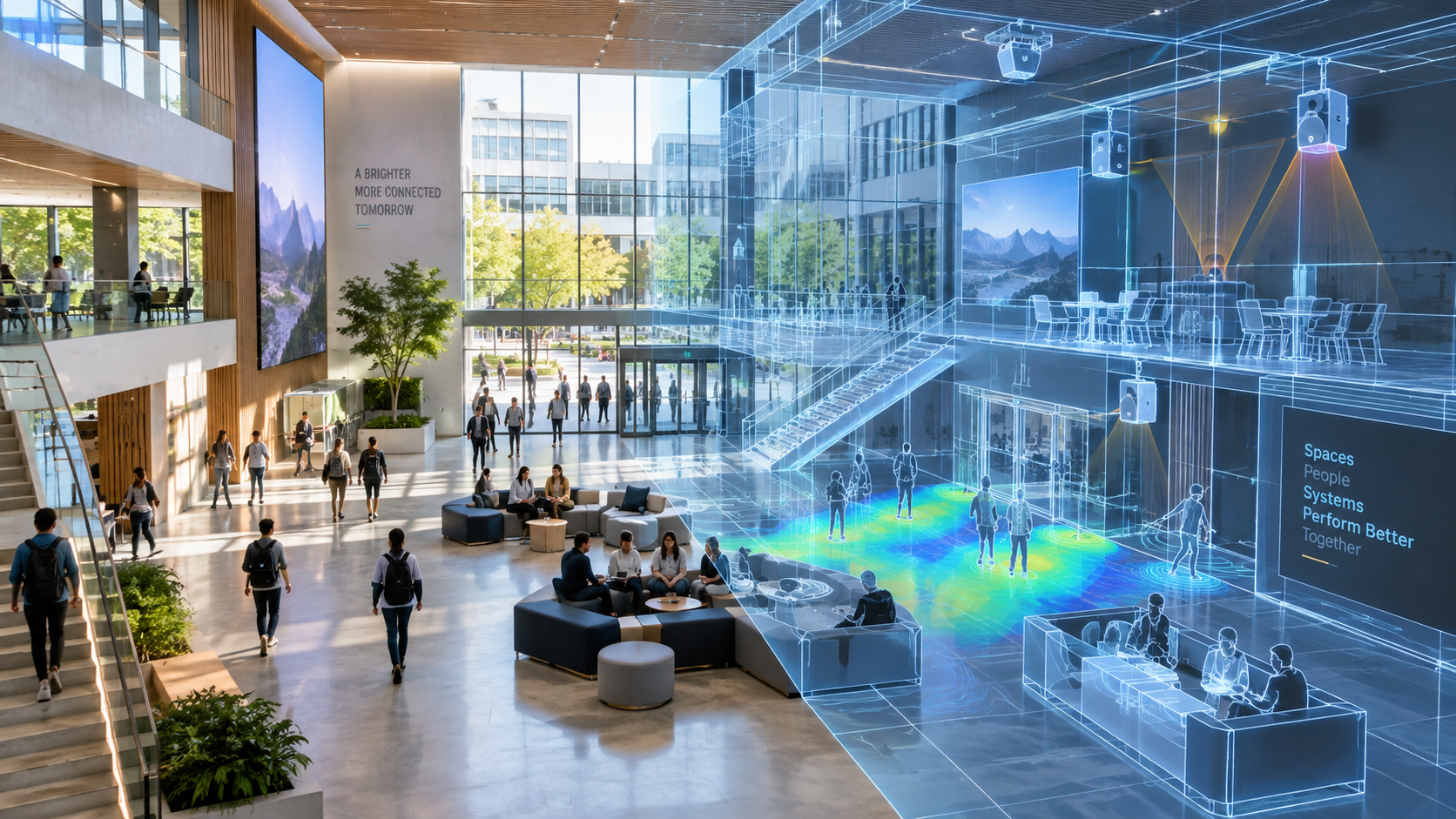
A digital twin blends spatial information, sensor inputs, control data and operational behaviour into one coherent model. A digital twin gives users the power to run simulated experiments repeatedly under real-world conditions, while testing subtle refinements to each and every test parameter. As the physical environment changes (such as lighting levels, occupancy, acoustics, device status) the twin updates in real time, allowing users to observe, test and optimise without interrupting live operations.
Digital twins are used across sectors such as corporate estates, education, industrial parks, smart cities, themed entertainment, and product design. They help organisations understand how spaces evolve, how people use them, and how systems behave under different conditions.
“Extended reality (XR), volumetric media, and digital twin visualisation are converging with AV systems to create shared spaces that span physical and virtual worlds,” states Craig Park, Director of Digital Experience Design at engineering and architecture firm Clark & Enersen, in an AVIXA Xchange post. “In these environments, audiovisual infrastructure does not simply support experience – it becomes the medium of experience itself.”
Key AV uses of digital twins
Digital twins support a wide range of AV workflows:
- R&D and prototyping – Engineers can trial new concepts, test environmental responses and refine designs before any physical build.
- Modelling and simulation – Sightlines, acoustics, lighting, projection, content playback and spatial media can all be tested virtually.
- Workflow testing – Teams can rehearse show sequences, control logic, sensor interactions and user journeys inside the twin.
- Monitoring and diagnostics – Device health, environmental conditions and system performance can be tracked continuously.
- Optimisation – Spaces can be tuned for energy efficiency, crowd flow, media behaviour and operational resilience.
- Design and planning – Integrators can validate layouts, test equipment positions and demonstrate concepts to stakeholders.
These capabilities make digital twins a powerful tool for reducing risk, improving accuracy and shortening project timelines.
Applications across AV environments
Education campuses
Universities and colleges use digital twins to model room utilisation, test AV upgrades, plan hybrid?learning environments and optimise energy use. A campus?wide twin becomes a shared reference point for AV, IT and facilities teams.
Corporate and industrial spaces
Digital twins help organisations understand how meeting rooms, collaboration zones and control rooms are actually used. They support predictive maintenance, workflow optimisation and long?term lifecycle planning.
Smart cities
City?scale twins integrate transport, public screens, wayfinding, civic communication and environmental data. AV systems become part of a wider digital ecosystem that adapts to crowd movement, events and changing conditions.
Urban design
On one of ISE 2026's Tech Tours, architectural consultant Nate Robert-Eze explained how a digital twin of luxury residential Antares Barcelona was created using VR and AI to help customers explore the facility, from anywhere in the world.
Product development
Manufacturers and designers use digital twins to model material choices, energy consumption, thermal behaviour and lifecycle impact. This supports more sustainable product development and helps organisations meet environmental targets.
Immersive and themed environments
Digital twins allow teams to choreograph show sequences, test interactive elements, model audio behaviour and preview media changes long before installation.
Automotive design
Digital twins are being widely adopted throughout the automated vehicle industry. Digital twins allow complex systems to be modelled, tested and refined in secure, interactive and immersive environments.
Why digital twins matter
AV systems are now deeply interconnected with networked media, sensors, building systems and user behaviour which require deeper planning and continuous optimisation. Digital twins give end?users a clearer, more predictable way to manage this complexity.
Growing system complexity is one factor accelerating adoption. Another factor is sustainability and lifecycle expectations. Twins help organisations reduce waste, energy use and travel while supporting long?term asset planning.
As a result, the digital twin market is expanding rapidly. A Fortune Business Insights report expects global value to reach to reach US$384.79bn by 2034, with smart cities, aerospace, healthcare and manufacturing driving growth.
AVIXA also forecasts adoption to grow steadily over the next decade with control systems leading the way in early digital twin integration, followed by visual and audio systems as hardware becomes more networked and cloud-friendly. By the early 2030s, AVIXA predicts that most Tier 1 immersive installations will maintain some form of operational digital twin.
For AV end?users, digital twins offer clarity, confidence and control. They make it possible to preview experiences, optimise performance, and ensure systems behave exactly as intended - regardless of scale, dynamism and complexity.
About the author
Adrian Pennington is a journalist, editor and copywriter with over two decades' experience specialising in the production, the technology, the business and the craft of the moving image. Connect with him on LinkedIn.
 Stay ahead – Stay informed.
As an AV specialist or industry leader, you recognise how crucial it is to keep up with evolving trends, new technologies, and notable happenings within the audiovisual world. That's why we're delighted to invite you to receive exclusive email updates about ISE – the world-renowned annual tech show for the systems integration and audiovisual industry.
When you subscribe, you'll be kept up to speed with insightful commentary on the freshest developments in AV, get early looks at what's planned for the ISE content schedule – including headline speakers – and benefit from in-depth reporting on the show's standout attractions.
Sign up now to stay at the forefront of audiovisual innovation and expertise.
Further reading
Discover emerging technologies at ISE
Related articles
- What is edge computing? – Discover how processing data closer to devices and users is enabling faster, more responsive and increasingly intelligent AV environments.
- Smart building trends: the new rules for working in the built environment – Explore how connected systems, occupancy data and intelligent automation are changing the way buildings are designed, operated and optimised.
Related Content
-
) An immersive experience makes you feel part of the story rather than simply observing it.
An immersive experience makes you feel part of the story rather than simply observing it. -
) How do venues improve the fan experience? By removing friction at every stage.
How do venues improve the fan experience? By removing friction at every stage. -
) Edge computing is the processing of data close to where it is created and used, rather than sending it to a distant data centre or cloud platform.
Edge computing is the processing of data close to where it is created and used, rather than sending it to a distant data centre or cloud platform. -
) Smart stores are using data from sensors, cameras, point-of-sale systems, digital signage and other technologies to make physical shopping more responsive to customer behaviour.
Smart stores are using data from sensors, cameras, point-of-sale systems, digital signage and other technologies to make physical shopping more responsive to customer behaviour. -
) For decades, broadcasters' concerns around operational risk focused primarily on reliability. Today, a different threat is demanding attention: cybersecurity.
For decades, broadcasters' concerns around operational risk focused primarily on reliability. Today, a different threat is demanding attention: cybersecurity.
Featured Articles
-
) Spanning all eight halls at Fira de Barcelona Gran Via, ISE 2026 delivered four days of record-breaking energy, creativity, and innovation.
Spanning all eight halls at Fira de Barcelona Gran Via, ISE 2026 delivered four days of record-breaking energy, creativity, and innovation. -
) The initiative will create new opportunities for talent development, innovation and community projects across the sector
The initiative will create new opportunities for talent development, innovation and community projects across the sector -
) The Facts & Figures report for ISE 2026 is available to download.
The Facts & Figures report for ISE 2026 is available to download. -
) Bringing together startups, investors and industry leaders, the expanded show feature offers a strong platform for visibility, networking, and commercial opportunity.
Bringing together startups, investors and industry leaders, the expanded show feature offers a strong platform for visibility, networking, and commercial opportunity. -
) This new type of event brings together end users, creators and production specialists from broadcast, live events, advertising and gaming, combining creative showcases, editorial programming and netwo ...
This new type of event brings together end users, creators and production specialists from broadcast, live events, advertising and gaming, combining creative showcases, editorial programming and netwo ...
)
)

)
)
)
)
)
)
)
)
)
)
)
)
)
)
)
)
)
)
)
)
)
)
)
)
)
)
)
)
)
)
)
)
)
)

)
)
)
)
)
)
)
)
)
)
.png/fit-in/500x500/filters:no_upscale())
)
)
)
)
)
)
)
)
)